Can an Air Source Heat Pump Be Installed on Wall Brackets?
Can an Air Source Heat Pump Be Installed on Wall Brackets?
Can an Air Source Heat Pump Be Installed on Wall Brackets?
Can an Air Source Heat Pump Be Installed on Wall Brackets?
Can an Air Source Heat Pump Be Installed on Wall Brackets?

UK Heat pump Help Technical Team
Independent Heat Pump Engineer
Can an air source heat pump be installed on wall brackets?
Yes, some air source heat pumps can be fitted to wall brackets instead of a concrete base. Not every model allows it, though, and it isn’t always the better choice. We usually prefer a ground-mounted base, and use wall brackets when both the property and the heat pump suit it.
A quick note on terms. If you’ve searched for a “wall mounted heat pump” and found units that look like air conditioners, that’s a different product. This article is about the outdoor unit of an air-to-water heat pump, the type that heats your radiators, underfloor heating and hot water.
Ground base or wall bracket at a glance
Ground-mounted base | Wall brackets | |
|---|---|---|
Vibration | Kept away from the building | Can travel through the wall |
Drainage | Defrost water drains into the ground | Needs a planned route so it doesn’t freeze on a path |
Fixing | Concrete footings | Needs a wall that can carry the weight |
Manufacturer approval | Standard | Only for approved models and brackets |
Maintenance access | Usually easier | Depends on height and position |
Why would anyone put a heat pump on wall brackets?
Brackets can make sense where ground space is tight, there’s no suitable spot at ground level, or the unit needs to sit higher off the ground. That can help with clearance, as long as the manufacturer approves the mounting arrangement.
That’s about as far as the case for them goes. Wall mounting isn’t automatically better, and it brings problems that a ground base avoids.
Not every heat pump can be wall mounted
Each manufacturer sets its own mounting rules. Vaillant, for example, makes wall brackets for the aroTHERM plus, with separate versions for insulated and non-insulated walls. They only cover the 3.5kW, 5kW and 7kW models, so the larger 10kW and 12kW units can’t use them. Other manufacturers have their own limits, and models and accessories change, so always check the current installation manual.
Before anyone settles on wall mounting, the installer should check the unit’s weight, the bracket specification and the manufacturer’s instructions. Fitting a unit in a way the manufacturer doesn’t approve can also put the warranty at risk.
Vibration and noise
Even a quiet heat pump has a compressor and a fan, and both vibrate while the unit runs. When the unit is bolted to brackets on the house, that vibration can pass into the building structure. You can end up with a low hum inside, even when the unit sounds quiet from the garden.
Anti-vibration mounts help, but the wall construction and the way the unit is fixed matter just as much. If you already hear a hum or rattle from an existing installation, our Fix My Heat Pump service can look into it.
Is the wall strong enough?
A heat pump is heavy. Even the smaller units commonly weigh around 100kg or more, and the fixing also has to cope with vibration and other loads.
The wall matters. A bracket that suits solid masonry may not suit a lightweight wall, or a house with external wall insulation, unless the fixing has been specifically designed for it. This needs to be checked before installation, not worked out on the day.
What happens to the defrost water?
In cold weather an air source heat pump regularly defrosts its outdoor coil, and the melted water has to go somewhere. On brackets, it still needs a route.
If it drips onto a patio or path, it can freeze and create an ice hazard. Whatever drainage is used should suit the location and be designed to keep the risk of freezing low.
How we usually do it
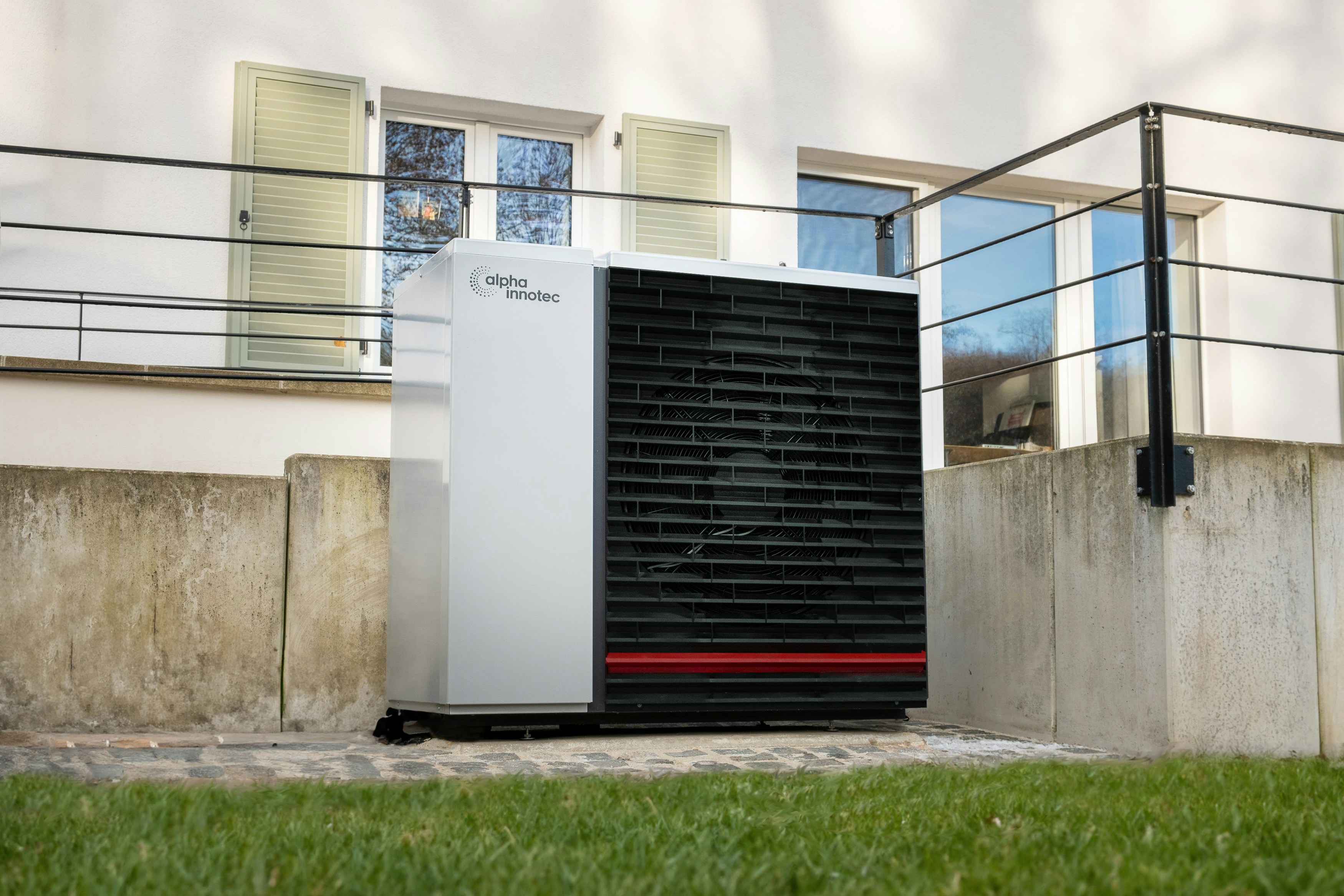
Our usual choice is a ground-mounted installation on two separate concrete footings under the unit’s supports. The footings are typically around 300mm deep, depending on ground conditions. We normally finish them level with the surrounding ground or slightly below, with a light covering of shingle. The shingle gives defrost water somewhere to drain and keeps the concrete out of sight, subject to the ground conditions and the manufacturer’s requirements.
This gives us more control over vibration, support and drainage, and we don’t have to fix a large unit to the building.
When wall brackets are the right call
Sometimes they are. If the manufacturer allows wall mounting, the wall is suitable, and the vibration and drainage have been properly thought through, brackets can be a practical alternative. A tight terraced house with no usable ground space is a common example.
What matters is picking the mounting that suits the actual property and the actual heat pump.
Questions to ask your installer
Does the manufacturer approve wall mounting for this exact model and bracket?
What is the wall made of, and how will the unit be fixed to it?
How will vibration be kept out of the building structure?
Where will the defrost water go, and could it freeze on a path or step?
How close will the unit be to bedroom windows and your neighbours’ windows?
If you’ve been quoted wall brackets and want a second opinion, our Pre-Installation Design Review checks the design behind a quote for £295 including VAT. Our heat loss and plumbing survey also covers heat pump positioning and practical pipe routes.
Frequently asked questions
Can all air source heat pumps be wall mounted?
No. It depends on the manufacturer, the model, the weight and the brackets approved for it. Check the installation manual before deciding.
Do wall brackets make a heat pump noisier?
They can. Vibration can travel through the wall into the house, which can cause low-frequency noise indoors. Good anti-vibration mounts and a suitable wall construction reduce the risk.
How deep should heat pump footings be?
Ours are typically around 300mm deep, depending on ground conditions. Your installer should confirm this once they’ve seen the site.
Do I need shingle under a heat pump?
We normally put shingle under the unit so defrost water has somewhere to drain, subject to the ground conditions and the manufacturer’s requirements.
Can I fit wall brackets myself?
We wouldn’t recommend it. The weight, the structural fixing and the manufacturer’s rules all matter, and a grant-funded installation must be carried out by an MCS-certified installer.
Planning a heat pump installation?
We arrange air source heat pump installations across Essex, Suffolk and parts of Norfolk through our MCS-accredited partner arrangement. Outdoor unit position, foundations, noise, drainage and the rest of the heating system are all planned as part of the design, before any work starts.


Nov 13, 2026
5 min read
Can You Cool Your Home Through Underfloor Heating? And Does It Actually Work?
Read More
Nov 13, 2026
5 min read
Can You Cool Your Home Through Underfloor Heating? And Does It Actually Work?
Read More
Nov 13, 2026
5 min read
Can You Cool Your Home Through Underfloor Heating? And Does It Actually Work?
Read More

Nov 12, 2026
5 min read
Heat Pump Compressor Failure: Signs, Causes and What to Do (UK Guide)
Read More
Nov 12, 2026
5 min read
Heat Pump Compressor Failure: Signs, Causes and What to Do (UK Guide)
Read More
Nov 12, 2026
5 min read
Heat Pump Compressor Failure: Signs, Causes and What to Do (UK Guide)
Read More



Contact Us
Still having heat pump problems? Talk to an engineer today.
Still having heat pump problems? Talk to an engineer today.
Still having heat pump problems? Talk to an engineer today.
Still having heat pump problems? Talk to an engineer today.
Still having heat pump problems? Talk to an engineer today.
Whether you're planning an installation, need a repair or service, or want independent advice, tell us what's happening and we'll point you in the right direction.
Whether you're planning an installation, need a repair or service, or want independent advice, tell us what's happening and we'll point you in the right direction.
Whether you're planning an installation, need a repair or service, or want independent advice, tell us what's happening and we'll point you in the right direction.

