What Is Delta T on a Heat Pump System and Why Does It Actually Matter?
What Is Delta T on a Heat Pump System and Why Does It Actually Matter?
What Is Delta T on a Heat Pump System and Why Does It Actually Matter?
What Is Delta T on a Heat Pump System and Why Does It Actually Matter?
What Is Delta T on a Heat Pump System and Why Does It Actually Matter?

UK Heat pump Help Technical Team
Independent Heat Pump Engineer
I reviewed a system in Berkshire last winter where the homeowner was convinced their heat pump was faulty. The unit was running almost constantly, the radiators were barely warm to the touch, and the electricity bills had doubled compared to their old gas boiler. The heat pump itself was perfectly fine. The problem was Delta T and specifically, the fact that nobody had explained to the installer what Delta T means in the context of a heat pump. Once we identified the issue, a radiator upgrade in three rooms solved the problem completely.
Most people who’ve had a heat pump installed have never heard of Delta T. And most people who have heard of it have been told the wrong definition.
This matters because getting Delta T wrong is one of the most common reasons heat pump systems underperform, and one of the most common reasons homeowners end up with lukewarm radiators and a system that never quite reaches temperature.
This guide explains what Delta T actually means in the context of a heat pump, why it’s different from what most installers describe, and what it means for how your system performs day to day.
There Are Two Versions of Delta T and Only One Really Matters
When an installer or engineer talks about Delta T, they usually mean the difference between the flow temperature and the return temperature. So if water leaves the heat pump at 45°C and comes back at 39°C, they’ll say your Delta T is 6°C.
That number is useful for checking circulation and flow rates. But it tells you almost nothing about how much heat is actually getting into your rooms.
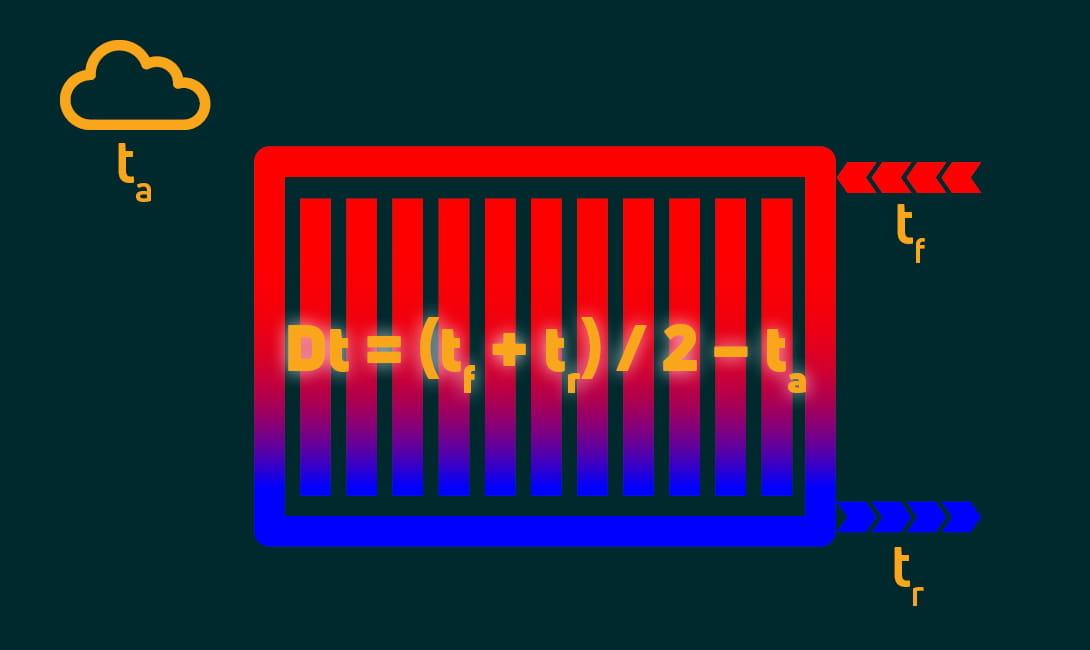
The Delta T that matters for heating performance is different. It’s the difference between:
The mean water temperature in the radiator (the average of flow and return), and
The room temperature
Using the same example:
Flow: 45°C
Return: 39°C
Mean water temperature: 42°C
Room temperature: 20°C
Delta T = 22°C
That 22°C gap is what determines how much heat your radiators can actually emit. And this is where most heat pump systems run into trouble.
Why Radiators Are Rated for a Much Higher Delta T
Every radiator sold in the UK has a heat output rating. But that rating is measured at Delta T 50 meaning the mean water temperature is 50°C above room temperature.
In a traditional gas boiler system, that’s perfectly normal. Water circulates at around 70–80°C, the room sits at 20°C, and you get a mean water temperature roughly 50°C above the room. Radiators give off their rated heat output. Everyone’s happy.
Heat pumps work completely differently.
A well-designed heat pump system typically runs flow temperatures between 35°C and 50°C. That means your mean water temperature might be 40–45°C giving you a Delta T to room of around 20–25°C, not 50°C.
At Delta T 20, a radiator gives off roughly 40–45% of its rated output. Not half. Not close to its label. Less than half.
This is why so many heat pump systems feel like they’re always nearly there — running constantly, never quite getting the house up to temperature, leaving radiators feeling lukewarm even when the system is working hard.
What Happens When Radiators Are Too Small for a Heat Pump
If a system was designed with standard radiator sizes sized for a boiler at Delta T 50 and then a heat pump is installed without upgrading them, the numbers simply don’t add up.
The heat pump can produce water at a reasonable temperature. The pipework can circulate it efficiently. But the radiators can’t emit enough heat into the rooms because the temperature difference between the water and the air is too small.
The system responds by running longer and longer, trying to compensate. Electricity usage goes up. The house stays cooler than it should. And the heat pump gets blamed for being inefficient when the real problem is a design decision made before a single pipe was laid.
Common signs this is happening in your home:
Your heat pump runs almost continuously but the house never quite gets warm
Radiators feel warm to touch but not hot nothing like a boiler
The system performs better in mild weather than in cold spells
The Practical Fix and Why It’s Not Always Simple
The straightforward solution is to upsize the radiators. If you double the radiator surface area, you roughly double the heat output at the same Delta T. Many homes that have switched from a boiler to a heat pump need larger radiators in at least some rooms — particularly north-facing rooms, rooms with high ceilings, or older properties with solid walls.
In some cases, the flow temperature can be raised slightly to close the Delta T gap. But this comes at a cost every degree you raise the flow temperature reduces the heat pump’s efficiency (COP). Running a heat pump at 55°C flow rather than 45°C can increase your electricity use noticeably over a heating season.
The better long-term answer is always a properly sized emitter system whether that’s larger radiators, additional panel radiators, or underfloor heating combined with the lowest possible flow temperature the system can run at while still keeping the house comfortable.
What This Means If You’re Planning an Installation
If you’re still at the planning stage, this is the most important thing to take away from this article: ask your installer how they’ve calculated radiator sizing, and at what Delta T.
If they’ve sized radiators at Delta T 50, those radiators are designed for a boiler — not a heat pump. A proper heat pump system design should size radiators at Delta T 25 or lower, depending on what flow temperature the system will run at.
If you’ve already received a quote and you’re unsure whether the design is correct, an independent review of the heat loss calculations and radiator sizing can confirm whether the numbers stack up before any work begins.
Already Installed and Experiencing These Problems?
If your system is already in and you recognise any of the symptoms described above constant running, lukewarm radiators, higher-than-expected bills the issue is almost certainly related to the effective Delta T your radiators are working at.
A Full Performance Review covers your system’s actual flow and return temperatures, radiator sizes relative to room heat loss, and the overall design approach and gives you a clear picture of what’s limiting performance and what the practical options are to improve it. Pricing and how to book is on our services page. Most reviews are completed within 5 working days of receiving your system details.
You can find full details, including pricing, on the services page.
If you are in that situation and want a broader diagnostic framework beyond Delta T alone, our guide on why your house is still cold with a heat pump covers the full range of causes — from radiator sizing through to circulation and commissioning — in a single reference.
Related reading: What Is the Ideal Delta T for a Heat Pump System?
I reviewed a system in Berkshire last winter where the homeowner was convinced their heat pump was faulty. The unit was running almost constantly, the radiators were barely warm to the touch, and the electricity bills had doubled compared to their old gas boiler. The heat pump itself was perfectly fine. The problem was Delta T and specifically, the fact that nobody had explained to the installer what Delta T means in the context of a heat pump. Once we identified the issue, a radiator upgrade in three rooms solved the problem completely.
Most people who’ve had a heat pump installed have never heard of Delta T. And most people who have heard of it have been told the wrong definition.
This matters because getting Delta T wrong is one of the most common reasons heat pump systems underperform, and one of the most common reasons homeowners end up with lukewarm radiators and a system that never quite reaches temperature.
This guide explains what Delta T actually means in the context of a heat pump, why it’s different from what most installers describe, and what it means for how your system performs day to day.
There Are Two Versions of Delta T and Only One Really Matters
When an installer or engineer talks about Delta T, they usually mean the difference between the flow temperature and the return temperature. So if water leaves the heat pump at 45°C and comes back at 39°C, they’ll say your Delta T is 6°C.
That number is useful for checking circulation and flow rates. But it tells you almost nothing about how much heat is actually getting into your rooms.
The Delta T that matters for heating performance is different. It’s the difference between:
The mean water temperature in the radiator (the average of flow and return), and
The room temperature
Using the same example:
Flow: 45°C
Return: 39°C
Mean water temperature: 42°C
Room temperature: 20°C
Delta T = 22°C
That 22°C gap is what determines how much heat your radiators can actually emit. And this is where most heat pump systems run into trouble.
Why Radiators Are Rated for a Much Higher Delta T
Every radiator sold in the UK has a heat output rating. But that rating is measured at Delta T 50 meaning the mean water temperature is 50°C above room temperature.
In a traditional gas boiler system, that’s perfectly normal. Water circulates at around 70–80°C, the room sits at 20°C, and you get a mean water temperature roughly 50°C above the room. Radiators give off their rated heat output. Everyone’s happy.
Heat pumps work completely differently.
A well-designed heat pump system typically runs flow temperatures between 35°C and 50°C. That means your mean water temperature might be 40–45°C giving you a Delta T to room of around 20–25°C, not 50°C.
At Delta T 20, a radiator gives off roughly 40–45% of its rated output. Not half. Not close to its label. Less than half.
This is why so many heat pump systems feel like they’re always nearly there — running constantly, never quite getting the house up to temperature, leaving radiators feeling lukewarm even when the system is working hard.
What Happens When Radiators Are Too Small for a Heat Pump
If a system was designed with standard radiator sizes sized for a boiler at Delta T 50 and then a heat pump is installed without upgrading them, the numbers simply don’t add up.
The heat pump can produce water at a reasonable temperature. The pipework can circulate it efficiently. But the radiators can’t emit enough heat into the rooms because the temperature difference between the water and the air is too small.
The system responds by running longer and longer, trying to compensate. Electricity usage goes up. The house stays cooler than it should. And the heat pump gets blamed for being inefficient when the real problem is a design decision made before a single pipe was laid.
Common signs this is happening in your home:
Your heat pump runs almost continuously but the house never quite gets warm
Radiators feel warm to touch but not hot nothing like a boiler
The system performs better in mild weather than in cold spells
The Practical Fix and Why It’s Not Always Simple
The straightforward solution is to upsize the radiators. If you double the radiator surface area, you roughly double the heat output at the same Delta T. Many homes that have switched from a boiler to a heat pump need larger radiators in at least some rooms — particularly north-facing rooms, rooms with high ceilings, or older properties with solid walls.
In some cases, the flow temperature can be raised slightly to close the Delta T gap. But this comes at a cost every degree you raise the flow temperature reduces the heat pump’s efficiency (COP). Running a heat pump at 55°C flow rather than 45°C can increase your electricity use noticeably over a heating season.
The better long-term answer is always a properly sized emitter system whether that’s larger radiators, additional panel radiators, or underfloor heating combined with the lowest possible flow temperature the system can run at while still keeping the house comfortable.
What This Means If You’re Planning an Installation
If you’re still at the planning stage, this is the most important thing to take away from this article: ask your installer how they’ve calculated radiator sizing, and at what Delta T.
If they’ve sized radiators at Delta T 50, those radiators are designed for a boiler — not a heat pump. A proper heat pump system design should size radiators at Delta T 25 or lower, depending on what flow temperature the system will run at.
If you’ve already received a quote and you’re unsure whether the design is correct, an independent review of the heat loss calculations and radiator sizing can confirm whether the numbers stack up before any work begins.
Already Installed and Experiencing These Problems?
If your system is already in and you recognise any of the symptoms described above constant running, lukewarm radiators, higher-than-expected bills the issue is almost certainly related to the effective Delta T your radiators are working at.
A Full Performance Review covers your system’s actual flow and return temperatures, radiator sizes relative to room heat loss, and the overall design approach and gives you a clear picture of what’s limiting performance and what the practical options are to improve it. Pricing and how to book is on our services page. Most reviews are completed within 5 working days of receiving your system details.
You can find full details, including pricing, on the services page.
If you are in that situation and want a broader diagnostic framework beyond Delta T alone, our guide on why your house is still cold with a heat pump covers the full range of causes — from radiator sizing through to circulation and commissioning — in a single reference.
Related reading: What Is the Ideal Delta T for a Heat Pump System?
Oct 17, 2026
5 min read
Replacing a Gas Boiler With a Heat Pump: What to Check First
Read More
Oct 17, 2026
5 min read
Replacing a Gas Boiler With a Heat Pump: What to Check First
Read More

Oct 16, 2026
5 min read
Heat Pump Legionella Cycle: Why It Heats to 60°C (UK Guide)
Read More
Oct 16, 2026
5 min read
Heat Pump Legionella Cycle: Why It Heats to 60°C (UK Guide)
Read More

Contact Us
Not Sure Which Service You Need?
Not Sure Which Service You Need?
Not Sure Which Service You Need?
Not Sure Which Service You Need?
Not Sure Which Service You Need?
Whether you need help with an existing heat pump, a pre-installation review, cooling advice, servicing or a room-by-room heat loss survey, send us a few details and we'll point you in the right direction.
Whether you need help with an existing heat pump, a pre-installation review, cooling advice, servicing or a room-by-room heat loss survey, send us a few details and we'll point you in the right direction.
Whether you need help with an existing heat pump, a pre-installation review, cooling advice, servicing or a room-by-room heat loss survey, send us a few details and we'll point you in the right direction.

