LG CH14 Error Code Explained: What to Check and How to Fix It
LG CH14 Error Code Explained: What to Check and How to Fix It
LG CH14 Error Code Explained: What to Check and How to Fix It
LG CH14 Error Code Explained: What to Check and How to Fix It
LG CH14 Error Code Explained: What to Check and How to Fix It

UK Heat pump Help Technical Team
Independent Heat Pump Engineer
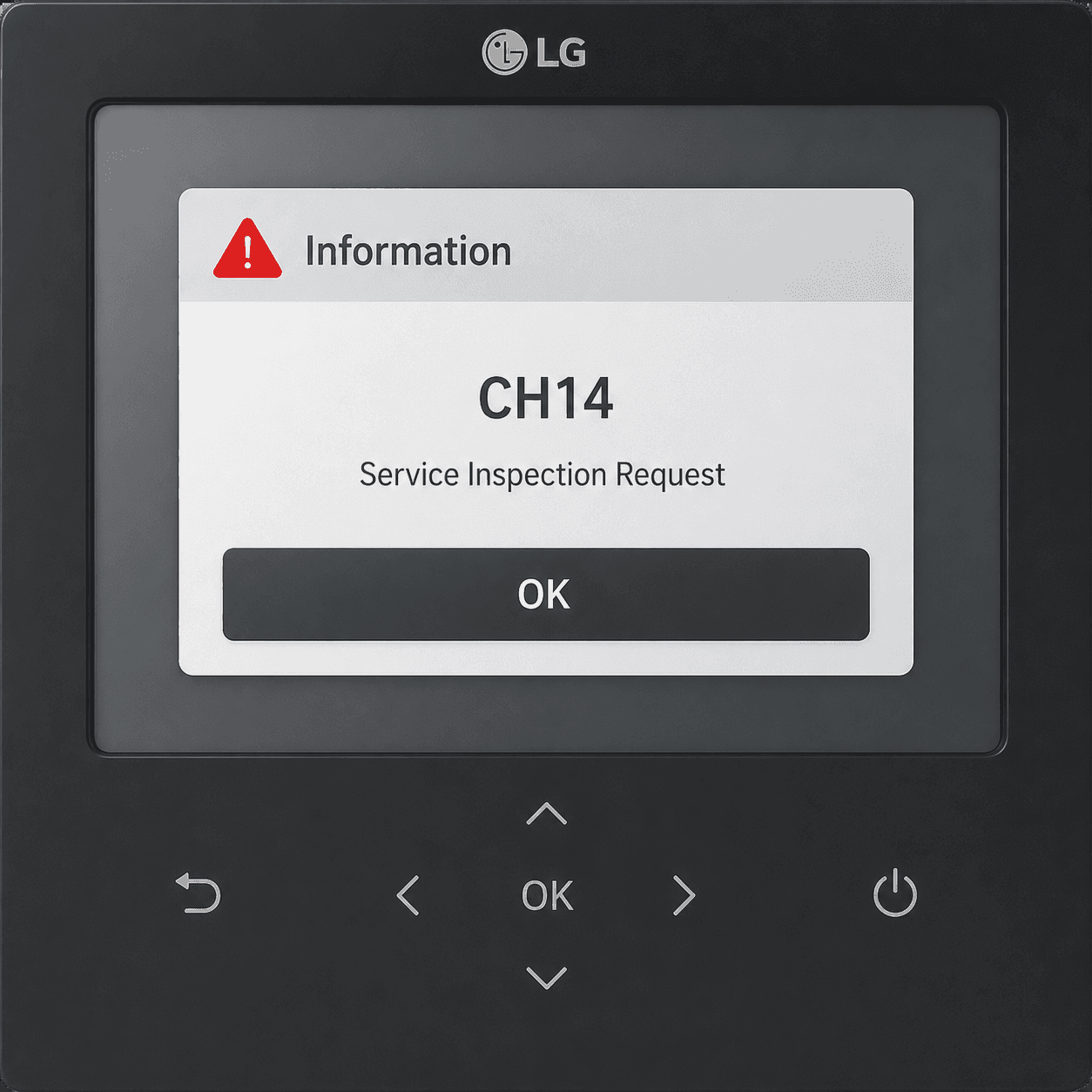
If your LG heat pump is showing a CH14 fault code, don't immediately assume the heat pump itself has failed. CH14 is one of the most common fault codes we see on LG heat pump systems, and in the majority of cases, the issue lies elsewhere in the heating system, not with the unit itself.
CH14 is a water flow fault. Your LG heat pump isn't detecting enough water circulating through the heating system, so it shuts itself down to protect the unit. The important question isn't really "what does CH14 mean?" It's "why haven't I got enough flow?" That's where this guide comes in.
What Does CH14 Actually Mean?
CH14 is a flow protection fault. It means the heat pump can't detect sufficient water circulation through the heating circuit to operate safely. Heat pumps depend on a constant, adequate flow of water to move heat around the property, and when the flow rate drops below the threshold the system needs, it protects itself by shutting down rather than continuing to run. The code tells you there's a circulation problem. It doesn't tell you what's causing it, and that distinction matters enormously before any parts get ordered or replaced. Our guide on why your heat pump shows a flow error explains the broader mechanics of flow faults and is worth reading alongside this one.
What Causes an LG CH14 Fault?
We've seen CH14 triggered by several different things, and it's rarely just one:
Blocked or dirty magnetic filters
Blocked strainers
Air trapped in the heating system
Low system pressure
Closed or partially closed valves
Too many closed TRVs
Circulation pump problems or incorrect settings
Poor zoning arrangements
Commissioning or installation issues
A blocked or dirty magnetic filter is one of the most frequent culprits, debris and magnetite build up gradually over time, and once the filter is sufficiently blocked, it restricts flow enough to trigger the fault. Our guide on how dirty filters can cause heat pump problems explains exactly how this happens and what to check. Blocked inline strainers cause the same effect and are often overlooked during routine maintenance. Air trapped in the system after a drain-down or top-up is another common cause, it disrupts circulation in ways that can be intermittent and confusing to diagnose.
Closed or partially closed valves are a surprisingly common cause that's easy to miss. Valves are frequently left partially closed after maintenance work, sometimes by the homeowner, sometimes by a tradesperson who visited for something else entirely, and the effect on circulation can be significant. Similarly, TRVs that have been turned down or closed on too many radiators can reduce the flow the heat pump sees to the point where CH14 triggers. Our articles on what happens if too many TRVs are turned off and should you use TRVs with a heat pump go into this in more depth. For systems with lots of separate zones, the zoning design itself can be the underlying cause, a pattern we've seen cause persistent flow faults and short cycling together, as shown in our zoning design case study.
Commissioning errors are worth mentioning separately, because they're a common root cause of flow problems that only show up months after installation. The system works fine in milder conditions but can't maintain flow once demand increases in cold weather. Our guide on common commissioning mistakes with air source heat pumps covers the setup errors we see most often.
A Few Things You Can Check Yourself
Before calling an engineer, there are some basic checks worth making:
Check your system pressure. If it's unusually low, that could be contributing to the problem.
Check obvious valves are open. CH14 can appear after maintenance when a valve has accidentally been left closed or partially closed.
Check your radiator TRVs. If you've recently turned lots of radiators off, try opening them again. Your heat pump needs somewhere to circulate water.
Think about when the problem started. Has anyone recently serviced, drained or altered the heating system? That timing detail is genuinely useful for diagnosis.
If you're not confident checking something yourself, don't start taking the system apart.
Why Does CH14 Suddenly Appear After Months of Working Fine?
Because most flow problems develop gradually. Filters get dirtier. Strainers collect debris. Air slowly enters the system. TRVs get turned down room by room over a winter. Settings drift. A system that had adequate flow six months ago can gradually reach the point where it no longer does, and then one cold morning, when the heating system is working hardest, CH14 appears. It can look like a sudden failure even though the underlying problem has often been building for weeks or months.
Don't Replace the Circulation Pump Just Because You've Got CH14
This is important. CH14 tells you there's a flow problem. It doesn't automatically tell you what caused it. We've seen cases where the underlying issue was considerably simpler than expected, a restriction, a valve position, a zoning issue, or a commissioning error, and replacing components without diagnosing the actual cause first can get expensive very quickly. Diagnose first. Replace second.
Still Showing CH14? We Can Help You Diagnose It Remotely
You don't necessarily need to start ringing around trying to find an LG specialist to visit immediately. Our Fix My Heat Pump service lets us work through the system with you remotely, using a video call, photographs and information from your controller, we can look at system pressure, filters and strainers, valve positions, pump settings, flow rates, zoning and anything recently changed on the system. The aim is simple: work out why you're getting CH14 before you start spending money replacing things.
Already have a plumber? Even better. They don't need to be an LG heat pump specialist. If you've got someone local you're comfortable using, we're happy to work alongside them, helping establish what needs checking and providing technical guidance while they're on site. Your plumber can be our hands on the ground, while we handle the heat pump side.
For anyone planning a new installation who wants to avoid these issues from the outset, our Pre-Installation Design & Heat Loss Review covers system design, including pipework, zoning, pump sizing and filter placement, before any work begins.
LG heat pump showing CH14? Don't guess. Diagnose it.
If your LG heat pump is showing a CH14 fault code, don't immediately assume the heat pump itself has failed. CH14 is one of the most common fault codes we see on LG heat pump systems, and in the majority of cases, the issue lies elsewhere in the heating system, not with the unit itself.
CH14 is a water flow fault. Your LG heat pump isn't detecting enough water circulating through the heating system, so it shuts itself down to protect the unit. The important question isn't really "what does CH14 mean?" It's "why haven't I got enough flow?" That's where this guide comes in.
What Does CH14 Actually Mean?
CH14 is a flow protection fault. It means the heat pump can't detect sufficient water circulation through the heating circuit to operate safely. Heat pumps depend on a constant, adequate flow of water to move heat around the property, and when the flow rate drops below the threshold the system needs, it protects itself by shutting down rather than continuing to run. The code tells you there's a circulation problem. It doesn't tell you what's causing it, and that distinction matters enormously before any parts get ordered or replaced. Our guide on why your heat pump shows a flow error explains the broader mechanics of flow faults and is worth reading alongside this one.
What Causes an LG CH14 Fault?
We've seen CH14 triggered by several different things, and it's rarely just one:
Blocked or dirty magnetic filters
Blocked strainers
Air trapped in the heating system
Low system pressure
Closed or partially closed valves
Too many closed TRVs
Circulation pump problems or incorrect settings
Poor zoning arrangements
Commissioning or installation issues
A blocked or dirty magnetic filter is one of the most frequent culprits, debris and magnetite build up gradually over time, and once the filter is sufficiently blocked, it restricts flow enough to trigger the fault. Our guide on how dirty filters can cause heat pump problems explains exactly how this happens and what to check. Blocked inline strainers cause the same effect and are often overlooked during routine maintenance. Air trapped in the system after a drain-down or top-up is another common cause, it disrupts circulation in ways that can be intermittent and confusing to diagnose.
Closed or partially closed valves are a surprisingly common cause that's easy to miss. Valves are frequently left partially closed after maintenance work, sometimes by the homeowner, sometimes by a tradesperson who visited for something else entirely, and the effect on circulation can be significant. Similarly, TRVs that have been turned down or closed on too many radiators can reduce the flow the heat pump sees to the point where CH14 triggers. Our articles on what happens if too many TRVs are turned off and should you use TRVs with a heat pump go into this in more depth. For systems with lots of separate zones, the zoning design itself can be the underlying cause, a pattern we've seen cause persistent flow faults and short cycling together, as shown in our zoning design case study.
Commissioning errors are worth mentioning separately, because they're a common root cause of flow problems that only show up months after installation. The system works fine in milder conditions but can't maintain flow once demand increases in cold weather. Our guide on common commissioning mistakes with air source heat pumps covers the setup errors we see most often.
A Few Things You Can Check Yourself
Before calling an engineer, there are some basic checks worth making:
Check your system pressure. If it's unusually low, that could be contributing to the problem.
Check obvious valves are open. CH14 can appear after maintenance when a valve has accidentally been left closed or partially closed.
Check your radiator TRVs. If you've recently turned lots of radiators off, try opening them again. Your heat pump needs somewhere to circulate water.
Think about when the problem started. Has anyone recently serviced, drained or altered the heating system? That timing detail is genuinely useful for diagnosis.
If you're not confident checking something yourself, don't start taking the system apart.
Why Does CH14 Suddenly Appear After Months of Working Fine?
Because most flow problems develop gradually. Filters get dirtier. Strainers collect debris. Air slowly enters the system. TRVs get turned down room by room over a winter. Settings drift. A system that had adequate flow six months ago can gradually reach the point where it no longer does, and then one cold morning, when the heating system is working hardest, CH14 appears. It can look like a sudden failure even though the underlying problem has often been building for weeks or months.
Don't Replace the Circulation Pump Just Because You've Got CH14
This is important. CH14 tells you there's a flow problem. It doesn't automatically tell you what caused it. We've seen cases where the underlying issue was considerably simpler than expected, a restriction, a valve position, a zoning issue, or a commissioning error, and replacing components without diagnosing the actual cause first can get expensive very quickly. Diagnose first. Replace second.
Still Showing CH14? We Can Help You Diagnose It Remotely
You don't necessarily need to start ringing around trying to find an LG specialist to visit immediately. Our Fix My Heat Pump service lets us work through the system with you remotely, using a video call, photographs and information from your controller, we can look at system pressure, filters and strainers, valve positions, pump settings, flow rates, zoning and anything recently changed on the system. The aim is simple: work out why you're getting CH14 before you start spending money replacing things.
Already have a plumber? Even better. They don't need to be an LG heat pump specialist. If you've got someone local you're comfortable using, we're happy to work alongside them, helping establish what needs checking and providing technical guidance while they're on site. Your plumber can be our hands on the ground, while we handle the heat pump side.
For anyone planning a new installation who wants to avoid these issues from the outset, our Pre-Installation Design & Heat Loss Review covers system design, including pipework, zoning, pump sizing and filter placement, before any work begins.
LG heat pump showing CH14? Don't guess. Diagnose it.
Oct 12, 2026
5 min read
Heat Pump Holiday Settings: What to Do When You Go Away in Winter
Read More
Oct 12, 2026
5 min read
Heat Pump Holiday Settings: What to Do When You Go Away in Winter
Read More

Oct 12, 2026
5 min read
Heat Pump Pipe Insulation: What You Need, How Thick, and Where It Goes Wrong
Read More
Oct 12, 2026
5 min read
Heat Pump Pipe Insulation: What You Need, How Thick, and Where It Goes Wrong
Read More

Contact Us
Not Sure Which Service You Need?
Not Sure Which Service You Need?
Not Sure Which Service You Need?
Not Sure Which Service You Need?
Not Sure Which Service You Need?
Whether you need help with an existing heat pump, a pre-installation review, cooling advice, servicing or a room-by-room heat loss survey, send us a few details and we'll point you in the right direction.
Whether you need help with an existing heat pump, a pre-installation review, cooling advice, servicing or a room-by-room heat loss survey, send us a few details and we'll point you in the right direction.
Whether you need help with an existing heat pump, a pre-installation review, cooling advice, servicing or a room-by-room heat loss survey, send us a few details and we'll point you in the right direction.

