Why Is My Vaillant aroTHERM Showing 'Domestic Hot Water Compressor Blocked'?
Why Is My Vaillant aroTHERM Showing 'Domestic Hot Water Compressor Blocked'?
Why Is My Vaillant aroTHERM Showing 'Domestic Hot Water Compressor Blocked'?
Why Is My Vaillant aroTHERM Showing 'Domestic Hot Water Compressor Blocked'?
Why Is My Vaillant aroTHERM Showing 'Domestic Hot Water Compressor Blocked'?

UK Heat pump Help Technical Team
Independent Heat Pump Engineer
Why Is My Vaillant aroTHERM Showing “Domestic Hot Water Compressor Blocked”?
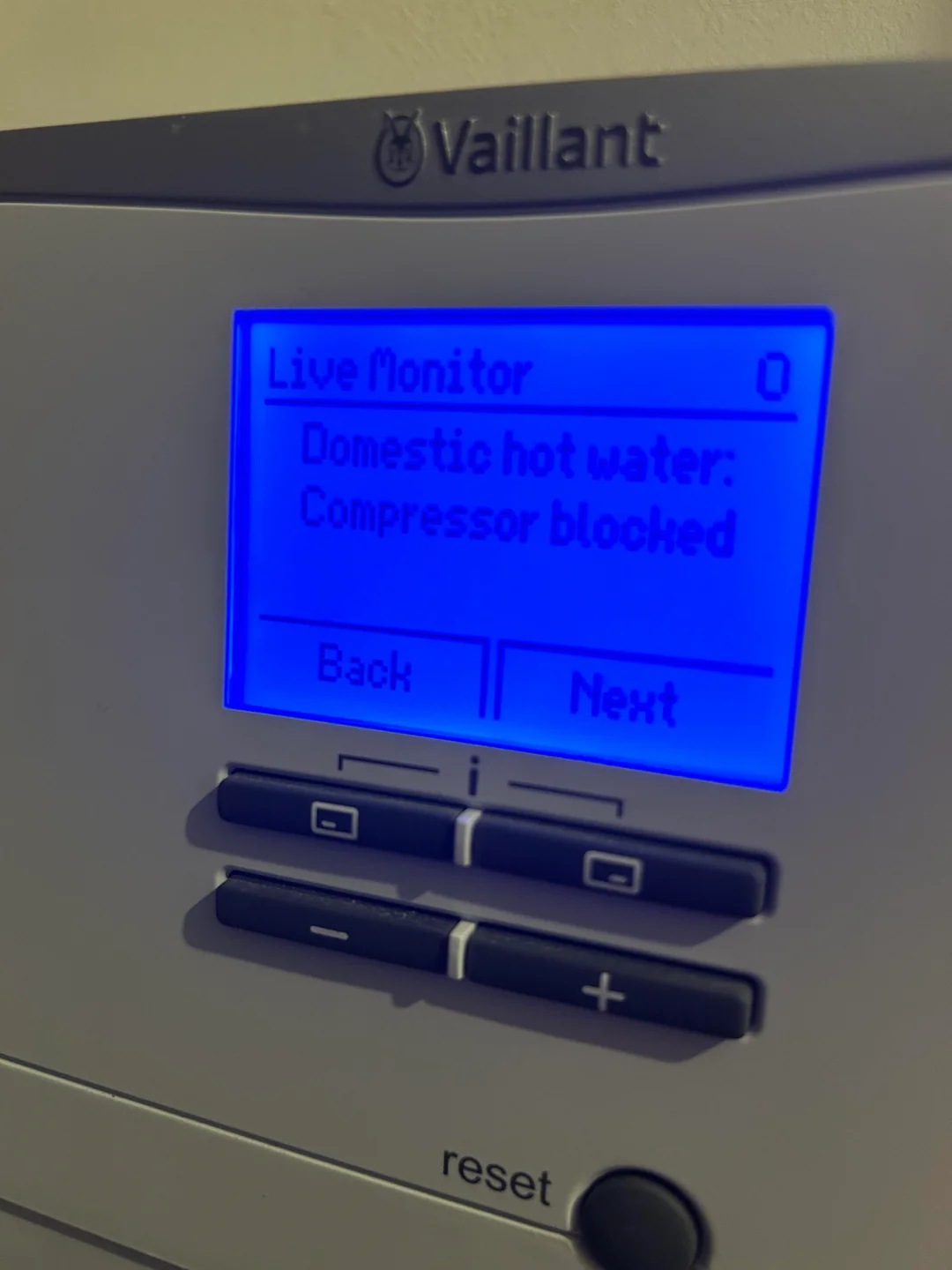
If your Vaillant aroTHERM has just thrown up “Domestic Hot Water Compressor Blocked” on the display, take a breath before assuming the worst. It reads like a compressor failure, and that’s the first thought that crosses almost everyone’s mind, but in the majority of cases the actual fault has nothing to do with the compressor itself. Nine times out of ten it comes down to something far more ordinary: air trapped somewhere in the heating circuit, low system pressure, a magnetic filter or strainer that’s clogged, or poor circulation through the hot water side of the system. When water can’t move through the heat pump properly, the controller steps in and stops the compressor as a protective measure, and that’s exactly what this fault code is telling you, not that a component has broken.
To understand why this happens, it helps to know what the compressor actually needs to run safely. A heat pump compressor relies on a steady, predictable flow of water moving through the hot water circuit to carry heat away efficiently. If that flow drops below what the system expects, whether because of an airlock, a partially blocked filter, or pressure that’s fallen too low, the unit has no way of knowing whether that’s a temporary blip or a real problem. So it plays it safe and locks the compressor out rather than risk damaging it by running under poor flow conditions. That’s a sensible design choice from Vaillant’s side, but it does mean the fault code you’re staring at is really a symptom, not a diagnosis.
The first time this fault showed up on one of our jobs, honestly, the same thought crossed our minds too. “Compressor blocked” sounds expensive. But a few basic checks later, it turned out there was simply a large volume of air sitting in the system. Once that air was bled out and proper circulation was restored, the fault cleared on its own and never came back. Since then, we’ve seen the same message triggered by low pressure and by blocked filters just as often as by anything more serious, which is really the pattern worth understanding before anyone starts talking about replacement parts.
Before assuming you’re looking at a major repair, there are a few things genuinely worth checking first. Start with your system pressure and confirm it’s sitting where it should be, because a heat pump running on low pressure will struggle to circulate water properly and the compressor will protect itself accordingly. Think about whether the system has recently been filled, drained, or worked on in any way, since that’s often when air gets introduced in the first place. Consider whether air could still be trapped somewhere in the heating circuit even if it’s already been bled once, because it can take more than one pass to fully clear a system, especially after any pipework has been disturbed. And check when the magnetic filter was last cleaned, since a filter that’s been quietly collecting debris for months will restrict flow long before anyone notices anything else wrong. If this is sounding familiar, our guide on what happens if a heat pump has air in the system goes into more depth on exactly this, since air ingress is one of the most common root causes behind this specific fault.
So does this mean the compressor has actually failed? Not necessarily, and it’s important not to jump to that conclusion. This fault code isn’t a diagnosis in itself, it’s the heat pump reporting that it has detected a condition it isn’t willing to continue producing domestic hot water under, and stopping the compressor to protect it. What’s actually causing that condition, whether it’s airlock, pressure, flow restriction, or something else entirely, still needs to be properly identified before anyone starts reaching for parts or booking an engineer. We’ve seen this exact pattern before, where a fault that looked serious on the surface turned out to be something else hiding in the system entirely, similar to what came up in this case study where a “no heating or hot water” complaint had nothing to do with the heat pump itself.
This is exactly the kind of fault we help homeowners work through every week. If you’re seeing “Domestic Hot Water Compressor Blocked” on your aroTHERM, we can talk you through the checks over a video call and in a lot of cases identify and resolve the cause with you there and then, without anyone needing to set foot on site. If it does turn out that specialist work is genuinely needed, you won’t be left guessing, we’ll tell you exactly what’s wrong and give you clear written instructions to hand to your engineer, so you’re not paying for parts that were never the problem in the first place. You can see how that process works in detail on our Fix My Heat Pump page, and if the issue turns out to be more about how the controller itself has been set up rather than a mechanical fault, our Controller Configuration Review can help clear that up too.
Don’t guess, and don’t start replacing expensive components on the strength of a fault code alone. Get on a call with us, we’ll diagnose it properly, and wherever possible walk you through fixing it yourself. You can browse more real examples of faults we’ve diagnosed for UK homeowners on our case studies page, or if you’d rather get straight to sorting your own aroTHERM out, book a technical review with us here.
Related reading: Why Is My Heat Pump Not Producing Hot Water? · What Should I Do If I Have A Vaillant F.788 Fault?
You may also find What Should I Do If I Have A Vaillant F.788 Fault? useful.
Why Is My Vaillant aroTHERM Showing “Domestic Hot Water Compressor Blocked”?
If your Vaillant aroTHERM has just thrown up “Domestic Hot Water Compressor Blocked” on the display, take a breath before assuming the worst. It reads like a compressor failure, and that’s the first thought that crosses almost everyone’s mind, but in the majority of cases the actual fault has nothing to do with the compressor itself. Nine times out of ten it comes down to something far more ordinary: air trapped somewhere in the heating circuit, low system pressure, a magnetic filter or strainer that’s clogged, or poor circulation through the hot water side of the system. When water can’t move through the heat pump properly, the controller steps in and stops the compressor as a protective measure, and that’s exactly what this fault code is telling you, not that a component has broken.
To understand why this happens, it helps to know what the compressor actually needs to run safely. A heat pump compressor relies on a steady, predictable flow of water moving through the hot water circuit to carry heat away efficiently. If that flow drops below what the system expects, whether because of an airlock, a partially blocked filter, or pressure that’s fallen too low, the unit has no way of knowing whether that’s a temporary blip or a real problem. So it plays it safe and locks the compressor out rather than risk damaging it by running under poor flow conditions. That’s a sensible design choice from Vaillant’s side, but it does mean the fault code you’re staring at is really a symptom, not a diagnosis.
The first time this fault showed up on one of our jobs, honestly, the same thought crossed our minds too. “Compressor blocked” sounds expensive. But a few basic checks later, it turned out there was simply a large volume of air sitting in the system. Once that air was bled out and proper circulation was restored, the fault cleared on its own and never came back. Since then, we’ve seen the same message triggered by low pressure and by blocked filters just as often as by anything more serious, which is really the pattern worth understanding before anyone starts talking about replacement parts.
Before assuming you’re looking at a major repair, there are a few things genuinely worth checking first. Start with your system pressure and confirm it’s sitting where it should be, because a heat pump running on low pressure will struggle to circulate water properly and the compressor will protect itself accordingly. Think about whether the system has recently been filled, drained, or worked on in any way, since that’s often when air gets introduced in the first place. Consider whether air could still be trapped somewhere in the heating circuit even if it’s already been bled once, because it can take more than one pass to fully clear a system, especially after any pipework has been disturbed. And check when the magnetic filter was last cleaned, since a filter that’s been quietly collecting debris for months will restrict flow long before anyone notices anything else wrong. If this is sounding familiar, our guide on what happens if a heat pump has air in the system goes into more depth on exactly this, since air ingress is one of the most common root causes behind this specific fault.
So does this mean the compressor has actually failed? Not necessarily, and it’s important not to jump to that conclusion. This fault code isn’t a diagnosis in itself, it’s the heat pump reporting that it has detected a condition it isn’t willing to continue producing domestic hot water under, and stopping the compressor to protect it. What’s actually causing that condition, whether it’s airlock, pressure, flow restriction, or something else entirely, still needs to be properly identified before anyone starts reaching for parts or booking an engineer. We’ve seen this exact pattern before, where a fault that looked serious on the surface turned out to be something else hiding in the system entirely, similar to what came up in this case study where a “no heating or hot water” complaint had nothing to do with the heat pump itself.
This is exactly the kind of fault we help homeowners work through every week. If you’re seeing “Domestic Hot Water Compressor Blocked” on your aroTHERM, we can talk you through the checks over a video call and in a lot of cases identify and resolve the cause with you there and then, without anyone needing to set foot on site. If it does turn out that specialist work is genuinely needed, you won’t be left guessing, we’ll tell you exactly what’s wrong and give you clear written instructions to hand to your engineer, so you’re not paying for parts that were never the problem in the first place. You can see how that process works in detail on our Fix My Heat Pump page, and if the issue turns out to be more about how the controller itself has been set up rather than a mechanical fault, our Controller Configuration Review can help clear that up too.
Don’t guess, and don’t start replacing expensive components on the strength of a fault code alone. Get on a call with us, we’ll diagnose it properly, and wherever possible walk you through fixing it yourself. You can browse more real examples of faults we’ve diagnosed for UK homeowners on our case studies page, or if you’d rather get straight to sorting your own aroTHERM out, book a technical review with us here.
Related reading: Why Is My Heat Pump Not Producing Hot Water? · What Should I Do If I Have A Vaillant F.788 Fault?
You may also find What Should I Do If I Have A Vaillant F.788 Fault? useful.
Oct 19, 2026
5 min read
Air-to-Air Heat Pump UK: Grant Status, Cost and Limits
Read More
Oct 19, 2026
5 min read
Air-to-Air Heat Pump UK: Grant Status, Cost and Limits
Read More
Oct 17, 2026
5 min read
Replacing a Gas Boiler With a Heat Pump: What to Check First
Read More
Oct 17, 2026
5 min read
Replacing a Gas Boiler With a Heat Pump: What to Check First
Read More


Contact Us
Not Sure Which Service You Need?
Not Sure Which Service You Need?
Not Sure Which Service You Need?
Not Sure Which Service You Need?
Not Sure Which Service You Need?
Whether you need help with an existing heat pump, a pre-installation review, cooling advice, servicing or a room-by-room heat loss survey, send us a few details and we'll point you in the right direction.
Whether you need help with an existing heat pump, a pre-installation review, cooling advice, servicing or a room-by-room heat loss survey, send us a few details and we'll point you in the right direction.
Whether you need help with an existing heat pump, a pre-installation review, cooling advice, servicing or a room-by-room heat loss survey, send us a few details and we'll point you in the right direction.

