What Should I Do If I Have A Vaillant F.788 Fault?
What Should I Do If I Have A Vaillant F.788 Fault?
What Should I Do If I Have A Vaillant F.788 Fault?
What Should I Do If I Have A Vaillant F.788 Fault?
What Should I Do If I Have A Vaillant F.788 Fault?

UK Heat pump Help Technical Team
Independent Heat Pump Engineer
What Should I Do If I Have A Vaillant F.788 Fault?
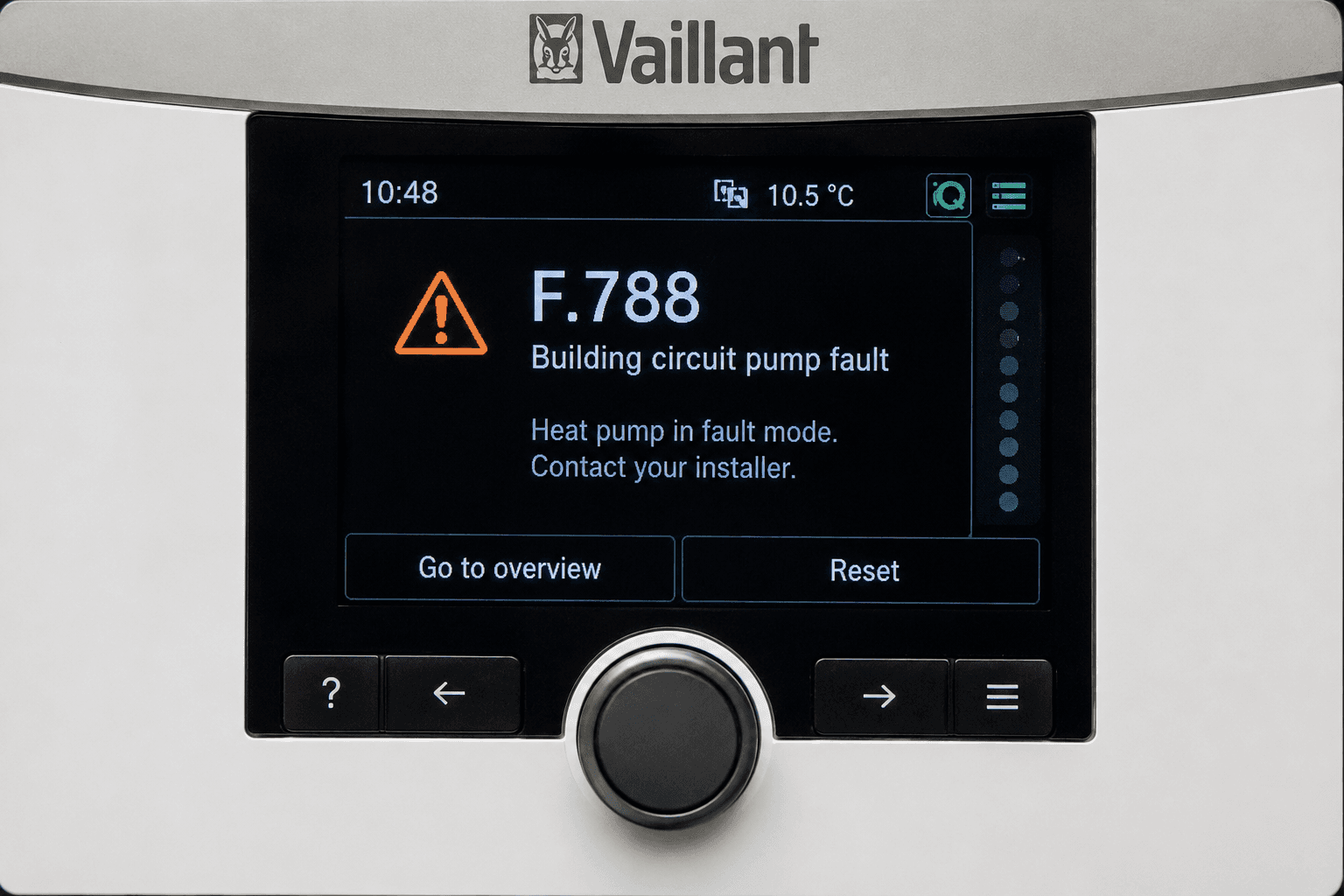
If your Vaillant heat pump is displaying an F.788 fault code, the first thing worth knowing is that this does not automatically mean you need a new circulation pump. In our experience, a significant number of F.788 faults are caused by flow restrictions elsewhere in the heating system rather than a failed pump, and replacing the pump without first investigating the underlying cause often results in the same fault returning.
Understanding what this fault code actually means, what the common causes are, and what can be checked before any parts are replaced is the most useful starting point.
What Does the Vaillant F.788 Fault Code Mean?
The F.788 fault indicates that the Vaillant heat pump has detected a problem with the building circuit pump. In practical terms, the unit has registered that circulation through the primary heating circuit is not functioning as expected, and has shut itself down as a protective measure.
However, the fault code points to a symptom rather than a guaranteed diagnosis. The heat pump is telling you that it cannot detect adequate circulation it is not necessarily telling you that the pump itself is the cause. The pump may be functioning correctly while something else in the system is preventing water from moving through the circuit at the level the heat pump requires.
What Commonly Causes an F.788 Fault?
Blocked Y-strainers and dirty magnetic filters are among the most frequent causes of F.788 faults that we come across. A Y-strainer is a mesh filter fitted in the pipework specifically to catch debris before it reaches sensitive components. Over time, magnetite particles, scale, and other material accumulate inside the strainer and reduce the flow of water through the circuit. The pump may be running perfectly, but if the strainer is partially blocked, it cannot push enough water through the restricted circuit to satisfy the heat pump’s minimum flow requirements. Our article on how dirty filters can cause heat pump problems covers this in detail and explains what the signs of filter-related flow problems typically look like and how frequently these components need attention on different types of system.
Air trapped within the heating circuit is another common cause. Air locks reduce the effective volume of water available for circulation and can interfere with flow in ways that closely mimic a pump fault. This is particularly common following any recent maintenance work, after a system has been drained and refilled, or where a slow pressure leak has allowed air to enter the circuit over time. Our article on why your heat pump shows a flow error explains the relationship between air, flow, and fault codes in more depth and is worth reading alongside this one.
Low system pressure can also trigger an F.788 in some cases, because insufficient pressure affects how well the pump can circulate water through the circuit. If the pressure gauge is reading below the normal operating range for the installation, this is worth addressing before drawing any conclusions about the pump. The broader causes of recurring pressure loss on Vaillant heat pump systems, and why topping up alone is not enough, are covered in our article on why does the Vaillant F.22 keep coming back.
A valve that has been accidentally left partially closed is something we see regularly, particularly where maintenance work has been carried out on the system in the recent past. A single isolation valve left in the wrong position can restrict flow significantly enough to trigger an F.788 without there being any fault with the pump or any other component.
If too many thermostatic radiator valves have been closed across the property, this can also restrict the total flow path available to the heating circuit and contribute to flow-related faults. Our article on what happens if too many TRVs are turned off explains why heat pumps respond to TRV closures very differently from gas boilers and what the practical consequences can be for system behaviour and fault codes.
Is the Circulation Pump Actually at Fault?
Sometimes, yes. But in many cases the answer is no. The pump can appear to have failed because the fault code references it directly, when in reality the pump has locked out as a result of being unable to circulate water against a restriction in the system. In some instances, a pump that has been locked out due to air entrainment or a temporary blockage will recover once the underlying issue is cleared, without any component needing to be replaced.
This is why proper investigation before replacing parts matters. Fitting a new pump into a system that still has a blocked strainer, trapped air, or a partially closed valve will simply result in the same fault code appearing again once the new pump encounters the same conditions.
What Can I Check Before Calling an Engineer?
Start with the system pressure. Confirm it is within the normal operating range and top up if necessary. Then check all isolation valves and system valves to make sure they are fully open, particularly if any work has been carried out on the system recently. Inspect the magnetic filter and Y-strainer if accessible, and check whether the system needs bleeding to remove trapped air.
If you can hear the pump running but the fault persists, the issue is more likely to be a restriction in the circuit than a failed pump. If you cannot hear the pump running at all during a call for heat, that narrows things down, though it is still worth ruling out the other causes before assuming the pump has failed.
How We Can Help
Many homeowners arrange a video call and walk us through the system using a smartphone or tablet. During the call we can review the fault code, system pressures, pipework arrangements, filters and strainers, pump settings, and any recent changes to the system. Depending on the issue and your level of confidence, we may be able to guide you through some basic checks while on the call and resolve the fault together.
We are also happy to work directly with your plumber, heating engineer, or electrician if someone is already attending the property. Many excellent heating engineers only occasionally work on heat pumps, and a second opinion from a specialist can often identify the cause of an F.788 more quickly than working through it alone. You can find out more about how that process works at ukheatpumphelp.co.uk/full-performance-review.
Related reading: Why Does Vaillant F.22 Keep Coming Back?
You may also find Why Does Vaillant F.22 Keep Coming Back? useful.
What Should I Do If I Have A Vaillant F.788 Fault?
If your Vaillant heat pump is displaying an F.788 fault code, the first thing worth knowing is that this does not automatically mean you need a new circulation pump. In our experience, a significant number of F.788 faults are caused by flow restrictions elsewhere in the heating system rather than a failed pump, and replacing the pump without first investigating the underlying cause often results in the same fault returning.
Understanding what this fault code actually means, what the common causes are, and what can be checked before any parts are replaced is the most useful starting point.
What Does the Vaillant F.788 Fault Code Mean?
The F.788 fault indicates that the Vaillant heat pump has detected a problem with the building circuit pump. In practical terms, the unit has registered that circulation through the primary heating circuit is not functioning as expected, and has shut itself down as a protective measure.
However, the fault code points to a symptom rather than a guaranteed diagnosis. The heat pump is telling you that it cannot detect adequate circulation it is not necessarily telling you that the pump itself is the cause. The pump may be functioning correctly while something else in the system is preventing water from moving through the circuit at the level the heat pump requires.
What Commonly Causes an F.788 Fault?
Blocked Y-strainers and dirty magnetic filters are among the most frequent causes of F.788 faults that we come across. A Y-strainer is a mesh filter fitted in the pipework specifically to catch debris before it reaches sensitive components. Over time, magnetite particles, scale, and other material accumulate inside the strainer and reduce the flow of water through the circuit. The pump may be running perfectly, but if the strainer is partially blocked, it cannot push enough water through the restricted circuit to satisfy the heat pump’s minimum flow requirements. Our article on how dirty filters can cause heat pump problems covers this in detail and explains what the signs of filter-related flow problems typically look like and how frequently these components need attention on different types of system.
Air trapped within the heating circuit is another common cause. Air locks reduce the effective volume of water available for circulation and can interfere with flow in ways that closely mimic a pump fault. This is particularly common following any recent maintenance work, after a system has been drained and refilled, or where a slow pressure leak has allowed air to enter the circuit over time. Our article on why your heat pump shows a flow error explains the relationship between air, flow, and fault codes in more depth and is worth reading alongside this one.
Low system pressure can also trigger an F.788 in some cases, because insufficient pressure affects how well the pump can circulate water through the circuit. If the pressure gauge is reading below the normal operating range for the installation, this is worth addressing before drawing any conclusions about the pump. The broader causes of recurring pressure loss on Vaillant heat pump systems, and why topping up alone is not enough, are covered in our article on why does the Vaillant F.22 keep coming back.
A valve that has been accidentally left partially closed is something we see regularly, particularly where maintenance work has been carried out on the system in the recent past. A single isolation valve left in the wrong position can restrict flow significantly enough to trigger an F.788 without there being any fault with the pump or any other component.
If too many thermostatic radiator valves have been closed across the property, this can also restrict the total flow path available to the heating circuit and contribute to flow-related faults. Our article on what happens if too many TRVs are turned off explains why heat pumps respond to TRV closures very differently from gas boilers and what the practical consequences can be for system behaviour and fault codes.
Is the Circulation Pump Actually at Fault?
Sometimes, yes. But in many cases the answer is no. The pump can appear to have failed because the fault code references it directly, when in reality the pump has locked out as a result of being unable to circulate water against a restriction in the system. In some instances, a pump that has been locked out due to air entrainment or a temporary blockage will recover once the underlying issue is cleared, without any component needing to be replaced.
This is why proper investigation before replacing parts matters. Fitting a new pump into a system that still has a blocked strainer, trapped air, or a partially closed valve will simply result in the same fault code appearing again once the new pump encounters the same conditions.
What Can I Check Before Calling an Engineer?
Start with the system pressure. Confirm it is within the normal operating range and top up if necessary. Then check all isolation valves and system valves to make sure they are fully open, particularly if any work has been carried out on the system recently. Inspect the magnetic filter and Y-strainer if accessible, and check whether the system needs bleeding to remove trapped air.
If you can hear the pump running but the fault persists, the issue is more likely to be a restriction in the circuit than a failed pump. If you cannot hear the pump running at all during a call for heat, that narrows things down, though it is still worth ruling out the other causes before assuming the pump has failed.
How We Can Help
Many homeowners arrange a video call and walk us through the system using a smartphone or tablet. During the call we can review the fault code, system pressures, pipework arrangements, filters and strainers, pump settings, and any recent changes to the system. Depending on the issue and your level of confidence, we may be able to guide you through some basic checks while on the call and resolve the fault together.
We are also happy to work directly with your plumber, heating engineer, or electrician if someone is already attending the property. Many excellent heating engineers only occasionally work on heat pumps, and a second opinion from a specialist can often identify the cause of an F.788 more quickly than working through it alone. You can find out more about how that process works at ukheatpumphelp.co.uk/full-performance-review.
Related reading: Why Does Vaillant F.22 Keep Coming Back?
You may also find Why Does Vaillant F.22 Keep Coming Back? useful.

Sep 22, 2026
5 min read
On-Site Heat Pump Maintenance: Which Service Do You Need?
Read More
Sep 22, 2026
5 min read
On-Site Heat Pump Maintenance: Which Service Do You Need?
Read More
Sep 20, 2026
5 min read
How Often Should You Service a Heat Pump?
Read More
Sep 20, 2026
5 min read
How Often Should You Service a Heat Pump?
Read More


Contact Us
Not Sure Which Service You Need?
Not Sure Which Service You Need?
Not Sure Which Service You Need?
Not Sure Which Service You Need?
Not Sure Which Service You Need?
Whether you need help with an existing heat pump, a pre-installation review, cooling advice, servicing or a room-by-room heat loss survey, send us a few details and we'll point you in the right direction.
Whether you need help with an existing heat pump, a pre-installation review, cooling advice, servicing or a room-by-room heat loss survey, send us a few details and we'll point you in the right direction.
Whether you need help with an existing heat pump, a pre-installation review, cooling advice, servicing or a room-by-room heat loss survey, send us a few details and we'll point you in the right direction.

