Why Turning Up the Flow Temperature Doesn't Always Heat Your House Faster
Why Turning Up the Flow Temperature Doesn't Always Heat Your House Faster
Why Turning Up the Flow Temperature Doesn't Always Heat Your House Faster
Why Turning Up the Flow Temperature Doesn't Always Heat Your House Faster
Why Turning Up the Flow Temperature Doesn't Always Heat Your House Faster

UK Heat pump Help Technical Team
Independent Heat Pump Engineer
Why Turning Up the Flow Temperature Doesn’t Always Heat Your House Faster
It’s one of the most common instincts when a home feels cold: turn the heating up. With a gas boiler, that instinct is usually rewarded — a hotter flow temperature means hotter radiators, which means a warmer room, fairly quickly. So it’s understandable that many homeowners assume the same logic applies to a heat pump. If the house isn’t warming up fast enough, just push the flow temperature higher.
With a heat pump, that assumption often works against you. Heat pumps are not simply “electric boilers,” and the way they’re designed to heat a home is fundamentally different from the on/off, blast-of-heat approach that boilers use. Understanding that difference explains why increasing the flow temperature can leave a home less comfortable, not more, and why it usually costs more to run as well.
Heat Pumps Are Built to Run Differently
A gas boiler heats water to a high temperature very quickly, then relies on the room thermostat to switch the whole system on and off as needed. It’s a start-stop way of working, and it’s effective with a boiler because boilers are efficient regardless of how hot the water gets.
A heat pump doesn’t work that way, and running it as if it does removes most of the efficiency advantage it’s supposed to offer. Heat pumps are designed to produce a steady, continuous supply of heat over long periods, ideally completing very few full heating cycles each hour rather than repeatedly firing up and shutting down. This is usually managed through weather compensation, a control strategy that automatically raises or lowers the flow temperature based on the outdoor temperature, so the system is always supplying roughly the amount of heat the house is losing at that moment no more, no less.
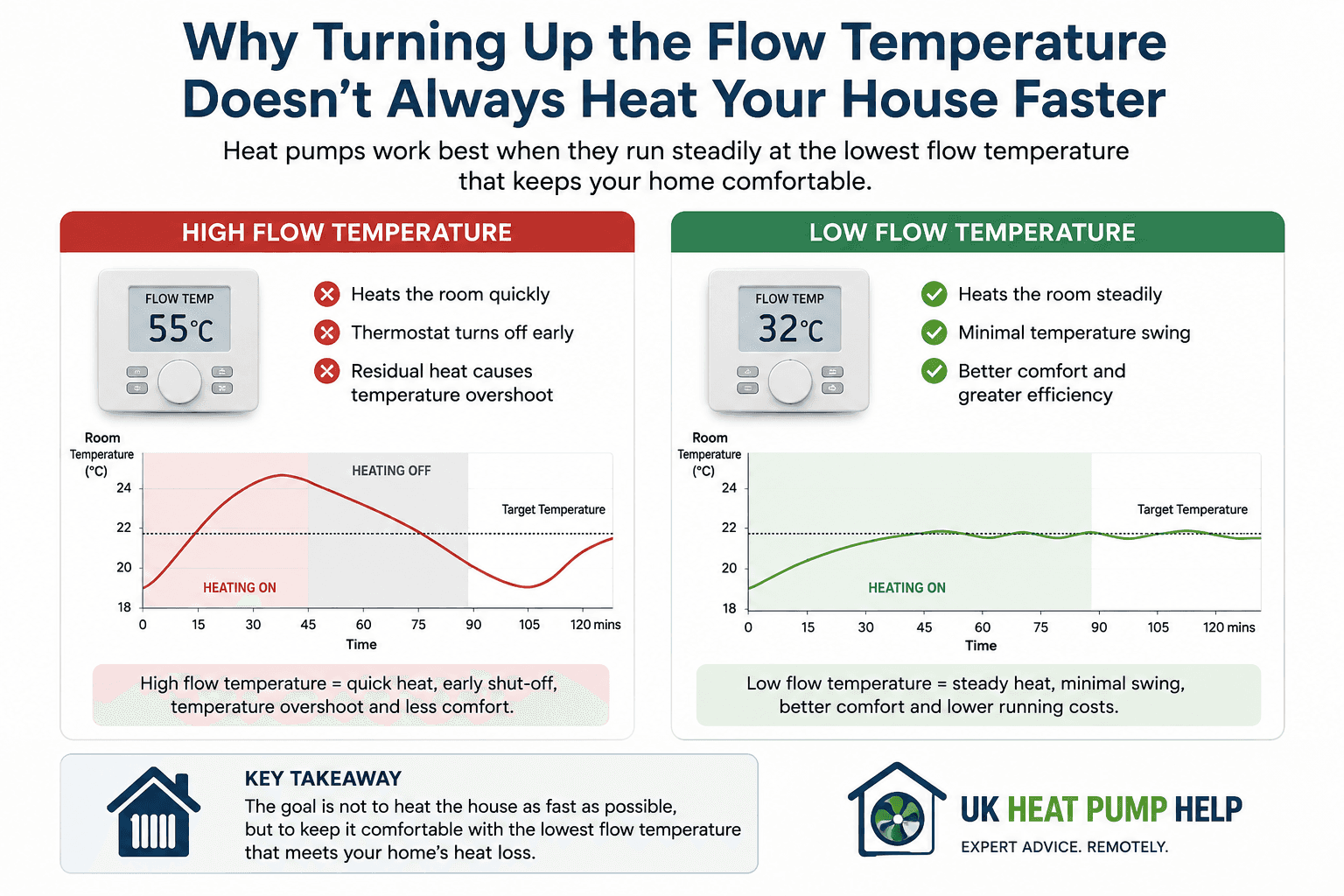
The target isn’t to blast the radiators with very hot water and then coast. It’s to find the lowest flow temperature that still keeps the home at a comfortable, stable temperature, and hold that steady state for as long as possible.
Why Pushing the Flow Temperature Higher Backfires
If a room feels cold and you increase the flow temperature significantly, the radiators will get hotter and the room will warm up faster. On the surface, that looks like a win. In practice, it tends to create a different problem.
As the room temperature climbs quickly, the thermostat reaches its target sooner and switches the heat pump off. But the radiators don’t cool down the moment the heat pump stops they’re still holding a large amount of stored heat, and they keep releasing it into the room for some time afterwards. With a normal, moderate flow temperature this stored heat is small and barely noticeable. With a much higher flow temperature, there’s considerably more heat stored in the radiators, and releasing it after the system has already switched off causes the room to overshoot the target temperature. The room ends up hotter than you actually wanted, then gradually cools again until the heat pump kicks back in — a cycle of overshoot and drift rather than a steady, comfortable temperature.
This is the opposite of what a heat pump is supposed to deliver. Instead of smooth, continuous heating, high flow temperatures push the system back toward the on/off cycling behaviour of a boiler, just with a less efficient appliance doing the cycling.
Your Thermostat Isn’t Meant to Do the Heavy Lifting
In a properly designed and commissioned heat pump system, the room thermostat isn’t there to constantly switch the system on and off the way it would with a boiler. Its role is closer to a high-limit control something that only intervenes if the room becomes warmer than needed, as a safeguard rather than the main control mechanism.
The actual regulation of comfort is handled by the heat pump’s own controls and its weather compensation curve, which continuously adjust the flow temperature as outdoor conditions change. The objective is to hold the house at the desired temperature using the lowest flow temperature that will do the job, rather than repeatedly heating the house up past the target and letting it fall back down again.
If your thermostat is switching the system on and off frequently throughout the day, that’s often a sign the flow temperature or weather compensation curve isn’t set correctly for the property, not a sign that the flow temperature needs to go up.
Lower Flow Temperatures Are More Efficient, Not Less
Running at a lower flow temperature isn’t a compromise — it’s usually what makes a heat pump efficient in the first place. The lower the flow temperature, the less work the compressor has to do to lift the water to that temperature, and the less electricity is used to produce the same amount of heat. This is why a correctly commissioned heat pump system tends to run for long, steady stretches at relatively modest flow temperatures, rather than cycling on and off with very hot water the way a boiler-style setup would.
Pushing the flow temperature up to “catch up” on heat may solve the immediate discomfort of a cold room, but it does so at the cost of efficiency, and often at the cost of comfort stability as well, once the overshoot-and-drift cycle sets in.
If Your Home Isn’t Warming Up, the Flow Temperature Usually Isn’t the Real Problem
When a heat pump home genuinely isn’t reaching a comfortable temperature, the underlying cause is rarely “the flow temperature just needs to be higher.” More often it points to something in the design or commissioning of the system: radiators that are undersized for the property’s heat loss, a weather compensation curve that was never properly balanced to the building, poor system balancing between circuits, or trapped air or low flow restricting circulation. Simply turning the flow temperature up treats the symptom rather than the cause, and can mask a problem that would be cheaper and more effective to fix properly.
Getting the flow temperature right in the first place is closely tied to how the weather compensation curve is set the two work together to determine how the system responds to outdoor conditions throughout the year. If you want to understand what a sensible flow temperature actually looks like for your system, our article on What Flow Temperature Should My Heat Pump Run At? goes through the typical ranges and what affects them. And if you’re not sure whether your weather compensation is doing its job correctly, What Does Weather Compensation Actually Do? breaks down how the curve is meant to behave and the signs that it’s been set up incorrectly.
The Bottom Line
If your home isn’t warming up as quickly as you’d like, reaching for the flow temperature dial isn’t automatically the right move. A heat pump that’s correctly designed, balanced, and commissioned should be able to maintain your desired room temperature efficiently, using the lowest flow temperature the property needs not the highest one it can tolerate.
Need Help Getting More From Your Heat Pump?
If your heat pump isn’t heating your home the way you’d expect, don’t assume the fix is simply turning the flow temperature up. During a one-to-one video consultation, we’ll assess how your system is actually operating, identify what’s limiting its performance, and, where it’s safe and appropriate, help you optimise the settings yourself. If further work is needed, you’ll get clear written instructions for exactly what your engineer should check or adjust.
Whether your system is running unnecessarily high flow temperatures, struggling to hold a comfortable temperature, or simply costing more than it should to run, we’ll help you understand why — and what to do about it.
Learn more about our Fix My Heat Pump service.
Planning a New Heat Pump?
Getting the design right from the outset is the best way to avoid high running costs and poor performance later. Our Pre-Installation Review checks your heat loss calculations, radiator sizing, and design flow temperatures, helping make sure your new heat pump is set up to run efficiently from day one.
Learn more about our Pre-Installation Review.
Related reading: What Flow Temperature Should My Heat Pump Run At? · Why Is My Flow Temperature Higher Than My Neighbour’s? · Why Your Heat Pump Isn’t Reaching Target Temperature
You may also find Why Is My Flow Temperature Higher Than My Neighbour’s? useful.
Why Turning Up the Flow Temperature Doesn’t Always Heat Your House Faster
It’s one of the most common instincts when a home feels cold: turn the heating up. With a gas boiler, that instinct is usually rewarded — a hotter flow temperature means hotter radiators, which means a warmer room, fairly quickly. So it’s understandable that many homeowners assume the same logic applies to a heat pump. If the house isn’t warming up fast enough, just push the flow temperature higher.
With a heat pump, that assumption often works against you. Heat pumps are not simply “electric boilers,” and the way they’re designed to heat a home is fundamentally different from the on/off, blast-of-heat approach that boilers use. Understanding that difference explains why increasing the flow temperature can leave a home less comfortable, not more, and why it usually costs more to run as well.
Heat Pumps Are Built to Run Differently
A gas boiler heats water to a high temperature very quickly, then relies on the room thermostat to switch the whole system on and off as needed. It’s a start-stop way of working, and it’s effective with a boiler because boilers are efficient regardless of how hot the water gets.
A heat pump doesn’t work that way, and running it as if it does removes most of the efficiency advantage it’s supposed to offer. Heat pumps are designed to produce a steady, continuous supply of heat over long periods, ideally completing very few full heating cycles each hour rather than repeatedly firing up and shutting down. This is usually managed through weather compensation, a control strategy that automatically raises or lowers the flow temperature based on the outdoor temperature, so the system is always supplying roughly the amount of heat the house is losing at that moment no more, no less.
The target isn’t to blast the radiators with very hot water and then coast. It’s to find the lowest flow temperature that still keeps the home at a comfortable, stable temperature, and hold that steady state for as long as possible.
Why Pushing the Flow Temperature Higher Backfires
If a room feels cold and you increase the flow temperature significantly, the radiators will get hotter and the room will warm up faster. On the surface, that looks like a win. In practice, it tends to create a different problem.
As the room temperature climbs quickly, the thermostat reaches its target sooner and switches the heat pump off. But the radiators don’t cool down the moment the heat pump stops they’re still holding a large amount of stored heat, and they keep releasing it into the room for some time afterwards. With a normal, moderate flow temperature this stored heat is small and barely noticeable. With a much higher flow temperature, there’s considerably more heat stored in the radiators, and releasing it after the system has already switched off causes the room to overshoot the target temperature. The room ends up hotter than you actually wanted, then gradually cools again until the heat pump kicks back in — a cycle of overshoot and drift rather than a steady, comfortable temperature.
This is the opposite of what a heat pump is supposed to deliver. Instead of smooth, continuous heating, high flow temperatures push the system back toward the on/off cycling behaviour of a boiler, just with a less efficient appliance doing the cycling.
Your Thermostat Isn’t Meant to Do the Heavy Lifting
In a properly designed and commissioned heat pump system, the room thermostat isn’t there to constantly switch the system on and off the way it would with a boiler. Its role is closer to a high-limit control something that only intervenes if the room becomes warmer than needed, as a safeguard rather than the main control mechanism.
The actual regulation of comfort is handled by the heat pump’s own controls and its weather compensation curve, which continuously adjust the flow temperature as outdoor conditions change. The objective is to hold the house at the desired temperature using the lowest flow temperature that will do the job, rather than repeatedly heating the house up past the target and letting it fall back down again.
If your thermostat is switching the system on and off frequently throughout the day, that’s often a sign the flow temperature or weather compensation curve isn’t set correctly for the property, not a sign that the flow temperature needs to go up.
Lower Flow Temperatures Are More Efficient, Not Less
Running at a lower flow temperature isn’t a compromise — it’s usually what makes a heat pump efficient in the first place. The lower the flow temperature, the less work the compressor has to do to lift the water to that temperature, and the less electricity is used to produce the same amount of heat. This is why a correctly commissioned heat pump system tends to run for long, steady stretches at relatively modest flow temperatures, rather than cycling on and off with very hot water the way a boiler-style setup would.
Pushing the flow temperature up to “catch up” on heat may solve the immediate discomfort of a cold room, but it does so at the cost of efficiency, and often at the cost of comfort stability as well, once the overshoot-and-drift cycle sets in.
If Your Home Isn’t Warming Up, the Flow Temperature Usually Isn’t the Real Problem
When a heat pump home genuinely isn’t reaching a comfortable temperature, the underlying cause is rarely “the flow temperature just needs to be higher.” More often it points to something in the design or commissioning of the system: radiators that are undersized for the property’s heat loss, a weather compensation curve that was never properly balanced to the building, poor system balancing between circuits, or trapped air or low flow restricting circulation. Simply turning the flow temperature up treats the symptom rather than the cause, and can mask a problem that would be cheaper and more effective to fix properly.
Getting the flow temperature right in the first place is closely tied to how the weather compensation curve is set the two work together to determine how the system responds to outdoor conditions throughout the year. If you want to understand what a sensible flow temperature actually looks like for your system, our article on What Flow Temperature Should My Heat Pump Run At? goes through the typical ranges and what affects them. And if you’re not sure whether your weather compensation is doing its job correctly, What Does Weather Compensation Actually Do? breaks down how the curve is meant to behave and the signs that it’s been set up incorrectly.
The Bottom Line
If your home isn’t warming up as quickly as you’d like, reaching for the flow temperature dial isn’t automatically the right move. A heat pump that’s correctly designed, balanced, and commissioned should be able to maintain your desired room temperature efficiently, using the lowest flow temperature the property needs not the highest one it can tolerate.
Need Help Getting More From Your Heat Pump?
If your heat pump isn’t heating your home the way you’d expect, don’t assume the fix is simply turning the flow temperature up. During a one-to-one video consultation, we’ll assess how your system is actually operating, identify what’s limiting its performance, and, where it’s safe and appropriate, help you optimise the settings yourself. If further work is needed, you’ll get clear written instructions for exactly what your engineer should check or adjust.
Whether your system is running unnecessarily high flow temperatures, struggling to hold a comfortable temperature, or simply costing more than it should to run, we’ll help you understand why — and what to do about it.
Learn more about our Fix My Heat Pump service.
Planning a New Heat Pump?
Getting the design right from the outset is the best way to avoid high running costs and poor performance later. Our Pre-Installation Review checks your heat loss calculations, radiator sizing, and design flow temperatures, helping make sure your new heat pump is set up to run efficiently from day one.
Learn more about our Pre-Installation Review.
Related reading: What Flow Temperature Should My Heat Pump Run At? · Why Is My Flow Temperature Higher Than My Neighbour’s? · Why Your Heat Pump Isn’t Reaching Target Temperature
You may also find Why Is My Flow Temperature Higher Than My Neighbour’s? useful.
Oct 21, 2026
5 min read
Air to Water Heat Pump: How It Works and What It Needs
Read More
Oct 21, 2026
5 min read
Air to Water Heat Pump: How It Works and What It Needs
Read More
Oct 19, 2026
5 min read
Heat Pump System Water Treatment: Inhibitor, Filters and Annual Water Tests
Read More
Oct 19, 2026
5 min read
Heat Pump System Water Treatment: Inhibitor, Filters and Annual Water Tests
Read More

Contact Us
Not Sure Which Service You Need?
Not Sure Which Service You Need?
Not Sure Which Service You Need?
Not Sure Which Service You Need?
Not Sure Which Service You Need?
Whether you need help with an existing heat pump, a pre-installation review, cooling advice, servicing or a room-by-room heat loss survey, send us a few details and we'll point you in the right direction.
Whether you need help with an existing heat pump, a pre-installation review, cooling advice, servicing or a room-by-room heat loss survey, send us a few details and we'll point you in the right direction.
Whether you need help with an existing heat pump, a pre-installation review, cooling advice, servicing or a room-by-room heat loss survey, send us a few details and we'll point you in the right direction.

