Why Is My Flow Temperature Higher Than My Neighbour's?
Why Is My Flow Temperature Higher Than My Neighbour's?
Why Is My Flow Temperature Higher Than My Neighbour's?
Why Is My Flow Temperature Higher Than My Neighbour's?
Why Is My Flow Temperature Higher Than My Neighbour's?

UK Heat pump Help Technical Team
Independent Heat Pump Engineer
What Is Flow Temperature, and Why Does It Matter?
Flow temperature is the temperature of the water leaving your heat pump and travelling into your radiators or underfloor heating circuits.
It’s one of the most closely watched figures in any heat pump system — and with good reason. Lower flow temperatures generally mean better efficiency, because heat pumps work harder as the gap between the water temperature and the outside air grows.
But here’s the part that often gets missed: the temperature your system actually needs is determined entirely by your home. Not by a figure you’ve seen quoted online, and not by what your neighbour happens to be running.
For a full breakdown of how flow temperature is set — and what it should be for your property — see: What Flow Temperature Should My Heat Pump Run At?
Why Your Flow Temperature Probably Isn’t the Same as Your Neighbour’s
Say your neighbour mentions their heat pump runs at 35°C. Yours is sitting at 50°C. That gap can feel alarming — but in the vast majority of cases, it simply means your homes have different heating requirements.
The flow temperature your heat pump sets is a direct response to what it needs to deliver to keep your home comfortable. If your property demands more heat — because of smaller radiators, older windows, poor insulation, or more rooms to warm — it will naturally run at a higher flow temperature to do that job.
Two houses on the same street can have very different heating demands, even when they were built at the same time from similar plans. Among the factors that directly influence your flow temperature:
The level of loft, wall, and floor insulation
The size and output rating of your radiators
Whether you have underfloor heating across all zones, or only some
The room temperatures you prefer to keep the house at
How airtight or draughty the property is
The number of external walls and how they’re constructed
The total glazed area and quality of your windows
Each of these factors changes how much heat your system needs to produce — and that directly shapes the flow temperature it settles at.
Radiator Size Has a Bigger Effect Than Most Homeowners Realise
Radiators give off less heat as water temperature falls. That’s simply how they work.
A standard radiator sized for a gas boiler running at 70°C will produce a fraction of that heat output at 45°C. To get the same warmth into a room at lower temperatures, you need significantly more radiator surface area — which is why well-designed heat pump installations typically use larger or double-panel radiators.
If your neighbour’s installation included larger radiators and yours did not, their system will naturally be able to operate at a lower flow temperature. It doesn’t mean everything about their setup is superior they simply have more radiator surface area doing the work.
If you’re consistently running at higher flow temperatures than you’d expect, it’s worth understanding whether your radiators were properly sized for your system. We’ve covered this in detail: Do Heat Pumps Need Bigger Radiators?
The Difference Weather Compensation Makes
One of the most overlooked reasons for different flow temperatures between homes is weather compensation specifically, whether it’s switched on and set correctly.
When weather compensation is working properly, the heat pump constantly adjusts its flow temperature based on how cold it is outside. On a mild autumn morning, the system might run at 32°C. On a cold January night, it could climb to 52°C or more.
This means that if you and your neighbour compare readings at different times of day or even on the same day in slightly different conditions you’ll naturally see different numbers. That’s the system responding correctly. It’s not a fault.
It’s also worth knowing that some installers disable weather compensation at handover, leaving the heat pump running at a fixed high flow temperature regardless of outdoor conditions. This is more common than it should be, and it needlessly increases running costs.
For a plain-English explanation of how weather compensation works: What Does Weather Compensation Actually Do?
If you want to check or adjust your own settings: How to Set Weather Compensation on a Heat Pump.
Your Home’s Heat Loss Is Unique to Your Property
Heat loss is the rate at which warmth escapes from your home. Before any heat pump installation, a proper heat loss calculation should be carried out to understand exactly how much heat the system needs to produce and at what flow temperature.
Every property has its own heat loss figure. It’s shaped by the building fabric, insulation levels, window area, room volumes, and orientation. You cannot assume it from the property type or postcode and you certainly cannot borrow it from a similar-looking house nearby.
To understand what this means in practice: Heat Loss in a House: What It Means and Why It Matters for Heat Pumps.
When the heat loss calculation is done incorrectly — or skipped entirely — radiators often end up sized to the wrong figure. The system then compensates by running at higher flow temperatures than it should need to, just to keep the house warm.
A Higher Flow Temperature Doesn’t Automatically Mean High Bills
This is something we explain to homeowners regularly: the goal isn’t the lowest possible flow temperature. The goal is the lowest flow temperature that still heats your home properly.
If your home genuinely needs 55°C to stay comfortable on a cold winter day, running at that temperature is perfectly normal. The problem arises when a system is running at 55°C because of a wrong setting, disabled weather compensation, or radiators that are too small — not because the house actually requires it.
In those situations, the high flow temperature is a symptom of something fixable. The number itself isn’t the problem what’s causing it is.
If running costs are a concern alongside your flow temperature, these are worth reading: Why Is My Heat Pump So Expensive to Run? and How to Reduce Heat Pump Electricity Bills.
Signs Your Flow Temperature May Be Worth Investigating
Context matters a great deal here. A higher flow temperature on a cold day is normal. But there are situations where digging a little deeper is worthwhile:
Electricity bills are noticeably higher than comparable homes or higher than you expected after installation
The system runs at high flow temperatures even during mild autumn or spring weather
Rooms still feel cold or underheated despite the system running hard
The flow temperature doesn’t seem to change as outdoor conditions change — a sign weather compensation may be off or incorrectly configured
No formal heat loss calculation was carried out before installation — meaning the system may have been designed to the wrong figure from the start
If you’re unsure whether your installation was set up correctly, these articles cover the key signs: 7 Signs Your Heat Pump May Not Be Installed Correctly and How Do I Know If My Heat Pump Was Installed Correctly?
Real Cases We’ve Seen
Sometimes the clearest way to understand a problem is to see how it played out in someone else’s home. Here are three cases where high flow temperatures turned out to have identifiable, fixable causes.
Family Home in Birmingham — Heat Pump Running at 55°C All Winter, Bills Higher Than Expected — The weather compensation curve had been set far too aggressively, and two of the main rooms had radiators that were undersized for the space. Once both issues were addressed, the system ran noticeably cooler and bills came down.
House Not Reaching Temperature — Incorrect Heat Loss and Undersized Radiators — The original heat loss calculation was incorrect. The system had been designed for a lower heat loss than the house actually had, so the radiators were too small from day one. Higher flow temperatures were simply the heat pump’s way of compensating for a design fault that was there from the start.
Detached in Berkshire — Weather Compensation Disabled by Installer at Handover — The installer had turned off weather compensation during commissioning and never re-enabled it. The homeowner had no idea. The system had been locked at a fixed high flow temperature for months. The fix itself took minutes, but the unnecessary running costs over that period were very real.
Not Sure What’s Causing Your High Flow Temperature?
If your system is running at a higher flow temperature than expected — or your bills feel disproportionate to what your home actually needs our Fix My Heat Pump service can review your settings, system design, and real-world performance. You’ll get a clear, independent picture of what’s happening and what, if anything, needs to change.
If you’re still in the planning stage and want reassurance that the proposed radiator sizes and design temperatures are right for your property, our Pre-Installation Review service provides an independent assessment before any work begins so you can go into your installation with confidence.
What Is Flow Temperature, and Why Does It Matter?
Flow temperature is the temperature of the water leaving your heat pump and travelling into your radiators or underfloor heating circuits.
It’s one of the most closely watched figures in any heat pump system — and with good reason. Lower flow temperatures generally mean better efficiency, because heat pumps work harder as the gap between the water temperature and the outside air grows.
But here’s the part that often gets missed: the temperature your system actually needs is determined entirely by your home. Not by a figure you’ve seen quoted online, and not by what your neighbour happens to be running.
For a full breakdown of how flow temperature is set — and what it should be for your property — see: What Flow Temperature Should My Heat Pump Run At?
Why Your Flow Temperature Probably Isn’t the Same as Your Neighbour’s
Say your neighbour mentions their heat pump runs at 35°C. Yours is sitting at 50°C. That gap can feel alarming — but in the vast majority of cases, it simply means your homes have different heating requirements.
The flow temperature your heat pump sets is a direct response to what it needs to deliver to keep your home comfortable. If your property demands more heat — because of smaller radiators, older windows, poor insulation, or more rooms to warm — it will naturally run at a higher flow temperature to do that job.
Two houses on the same street can have very different heating demands, even when they were built at the same time from similar plans. Among the factors that directly influence your flow temperature:
The level of loft, wall, and floor insulation
The size and output rating of your radiators
Whether you have underfloor heating across all zones, or only some
The room temperatures you prefer to keep the house at
How airtight or draughty the property is
The number of external walls and how they’re constructed
The total glazed area and quality of your windows
Each of these factors changes how much heat your system needs to produce — and that directly shapes the flow temperature it settles at.
Radiator Size Has a Bigger Effect Than Most Homeowners Realise
Radiators give off less heat as water temperature falls. That’s simply how they work.
A standard radiator sized for a gas boiler running at 70°C will produce a fraction of that heat output at 45°C. To get the same warmth into a room at lower temperatures, you need significantly more radiator surface area — which is why well-designed heat pump installations typically use larger or double-panel radiators.
If your neighbour’s installation included larger radiators and yours did not, their system will naturally be able to operate at a lower flow temperature. It doesn’t mean everything about their setup is superior they simply have more radiator surface area doing the work.
If you’re consistently running at higher flow temperatures than you’d expect, it’s worth understanding whether your radiators were properly sized for your system. We’ve covered this in detail: Do Heat Pumps Need Bigger Radiators?
The Difference Weather Compensation Makes
One of the most overlooked reasons for different flow temperatures between homes is weather compensation specifically, whether it’s switched on and set correctly.
When weather compensation is working properly, the heat pump constantly adjusts its flow temperature based on how cold it is outside. On a mild autumn morning, the system might run at 32°C. On a cold January night, it could climb to 52°C or more.
This means that if you and your neighbour compare readings at different times of day or even on the same day in slightly different conditions you’ll naturally see different numbers. That’s the system responding correctly. It’s not a fault.
It’s also worth knowing that some installers disable weather compensation at handover, leaving the heat pump running at a fixed high flow temperature regardless of outdoor conditions. This is more common than it should be, and it needlessly increases running costs.
For a plain-English explanation of how weather compensation works: What Does Weather Compensation Actually Do?
If you want to check or adjust your own settings: How to Set Weather Compensation on a Heat Pump.
Your Home’s Heat Loss Is Unique to Your Property
Heat loss is the rate at which warmth escapes from your home. Before any heat pump installation, a proper heat loss calculation should be carried out to understand exactly how much heat the system needs to produce and at what flow temperature.
Every property has its own heat loss figure. It’s shaped by the building fabric, insulation levels, window area, room volumes, and orientation. You cannot assume it from the property type or postcode and you certainly cannot borrow it from a similar-looking house nearby.
To understand what this means in practice: Heat Loss in a House: What It Means and Why It Matters for Heat Pumps.
When the heat loss calculation is done incorrectly — or skipped entirely — radiators often end up sized to the wrong figure. The system then compensates by running at higher flow temperatures than it should need to, just to keep the house warm.
A Higher Flow Temperature Doesn’t Automatically Mean High Bills
This is something we explain to homeowners regularly: the goal isn’t the lowest possible flow temperature. The goal is the lowest flow temperature that still heats your home properly.
If your home genuinely needs 55°C to stay comfortable on a cold winter day, running at that temperature is perfectly normal. The problem arises when a system is running at 55°C because of a wrong setting, disabled weather compensation, or radiators that are too small — not because the house actually requires it.
In those situations, the high flow temperature is a symptom of something fixable. The number itself isn’t the problem what’s causing it is.
If running costs are a concern alongside your flow temperature, these are worth reading: Why Is My Heat Pump So Expensive to Run? and How to Reduce Heat Pump Electricity Bills.
Signs Your Flow Temperature May Be Worth Investigating
Context matters a great deal here. A higher flow temperature on a cold day is normal. But there are situations where digging a little deeper is worthwhile:
Electricity bills are noticeably higher than comparable homes or higher than you expected after installation
The system runs at high flow temperatures even during mild autumn or spring weather
Rooms still feel cold or underheated despite the system running hard
The flow temperature doesn’t seem to change as outdoor conditions change — a sign weather compensation may be off or incorrectly configured
No formal heat loss calculation was carried out before installation — meaning the system may have been designed to the wrong figure from the start
If you’re unsure whether your installation was set up correctly, these articles cover the key signs: 7 Signs Your Heat Pump May Not Be Installed Correctly and How Do I Know If My Heat Pump Was Installed Correctly?
Real Cases We’ve Seen
Sometimes the clearest way to understand a problem is to see how it played out in someone else’s home. Here are three cases where high flow temperatures turned out to have identifiable, fixable causes.
Family Home in Birmingham — Heat Pump Running at 55°C All Winter, Bills Higher Than Expected — The weather compensation curve had been set far too aggressively, and two of the main rooms had radiators that were undersized for the space. Once both issues were addressed, the system ran noticeably cooler and bills came down.
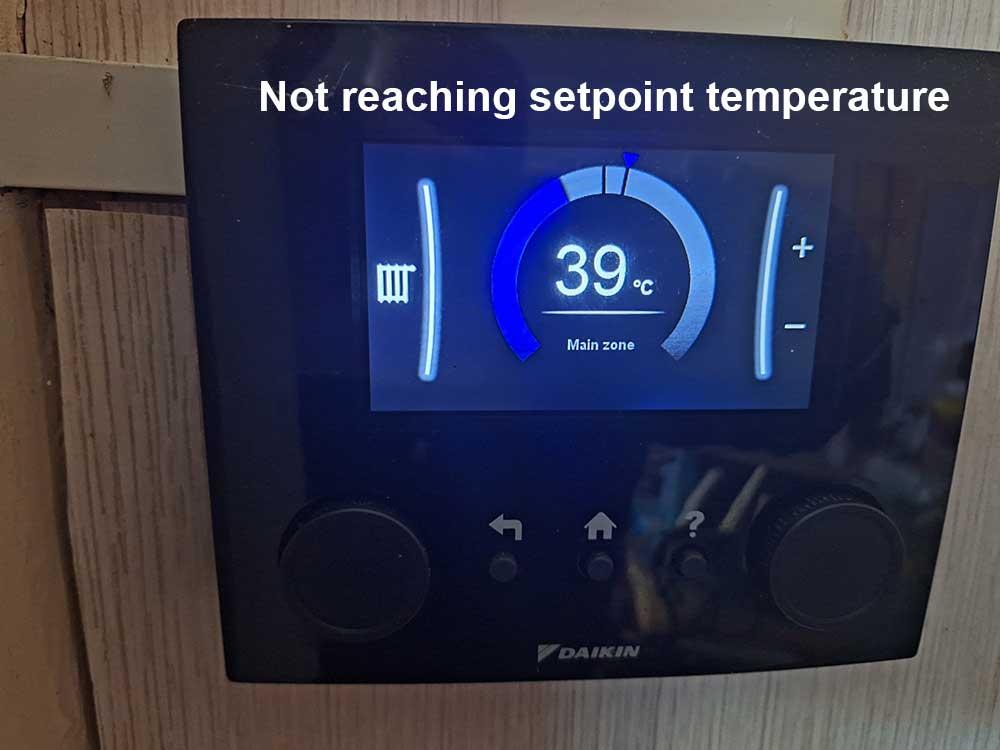
House Not Reaching Temperature — Incorrect Heat Loss and Undersized Radiators — The original heat loss calculation was incorrect. The system had been designed for a lower heat loss than the house actually had, so the radiators were too small from day one. Higher flow temperatures were simply the heat pump’s way of compensating for a design fault that was there from the start.
Detached in Berkshire — Weather Compensation Disabled by Installer at Handover — The installer had turned off weather compensation during commissioning and never re-enabled it. The homeowner had no idea. The system had been locked at a fixed high flow temperature for months. The fix itself took minutes, but the unnecessary running costs over that period were very real.
Not Sure What’s Causing Your High Flow Temperature?
If your system is running at a higher flow temperature than expected — or your bills feel disproportionate to what your home actually needs our Fix My Heat Pump service can review your settings, system design, and real-world performance. You’ll get a clear, independent picture of what’s happening and what, if anything, needs to change.
If you’re still in the planning stage and want reassurance that the proposed radiator sizes and design temperatures are right for your property, our Pre-Installation Review service provides an independent assessment before any work begins so you can go into your installation with confidence.
Sep 20, 2026
5 min read
How Often Should You Service a Heat Pump?
Read More
Sep 20, 2026
5 min read
How Often Should You Service a Heat Pump?
Read More

Sep 18, 2026
5 min read
Why Is My Heat Pump Not Reaching Temperature? (UK Guide)
Read More
Sep 18, 2026
5 min read
Why Is My Heat Pump Not Reaching Temperature? (UK Guide)
Read More


Contact Us
Not Sure Which Service You Need?
Not Sure Which Service You Need?
Not Sure Which Service You Need?
Not Sure Which Service You Need?
Not Sure Which Service You Need?
Whether you need help with an existing heat pump, a pre-installation review, cooling advice, servicing or a room-by-room heat loss survey, send us a few details and we'll point you in the right direction.
Whether you need help with an existing heat pump, a pre-installation review, cooling advice, servicing or a room-by-room heat loss survey, send us a few details and we'll point you in the right direction.
Whether you need help with an existing heat pump, a pre-installation review, cooling advice, servicing or a room-by-room heat loss survey, send us a few details and we'll point you in the right direction.

