Best Heat Pump Thermostat Settings (UK Guide)
Best Heat Pump Thermostat Settings (UK Guide)
Best Heat Pump Thermostat Settings (UK Guide)
Best Heat Pump Thermostat Settings (UK Guide)
Best Heat Pump Thermostat Settings (UK Guide)

UK Heat pump Help Technical Team
Independent Heat Pump Engineer
Heat Pump Thermostat Settings — What You Actually Need to Know
One of the most confusing aspects of heat pump ownership is that there are actually three different ‘temperature settings’ on most systems, and they do very different things. Getting them wrong or understanding only one of them is why so many homeowners end up with systems that are uncomfortable, expensive, or both.
The three settings are: your room thermostat temperature (what most people think of as ‘the thermostat’), your flow temperature (the temperature of the water in the heating system), and your weather compensation curve (how the flow temperature changes with outdoor conditions). Let me explain each one.
Room Thermostat: The Setting Everyone Knows
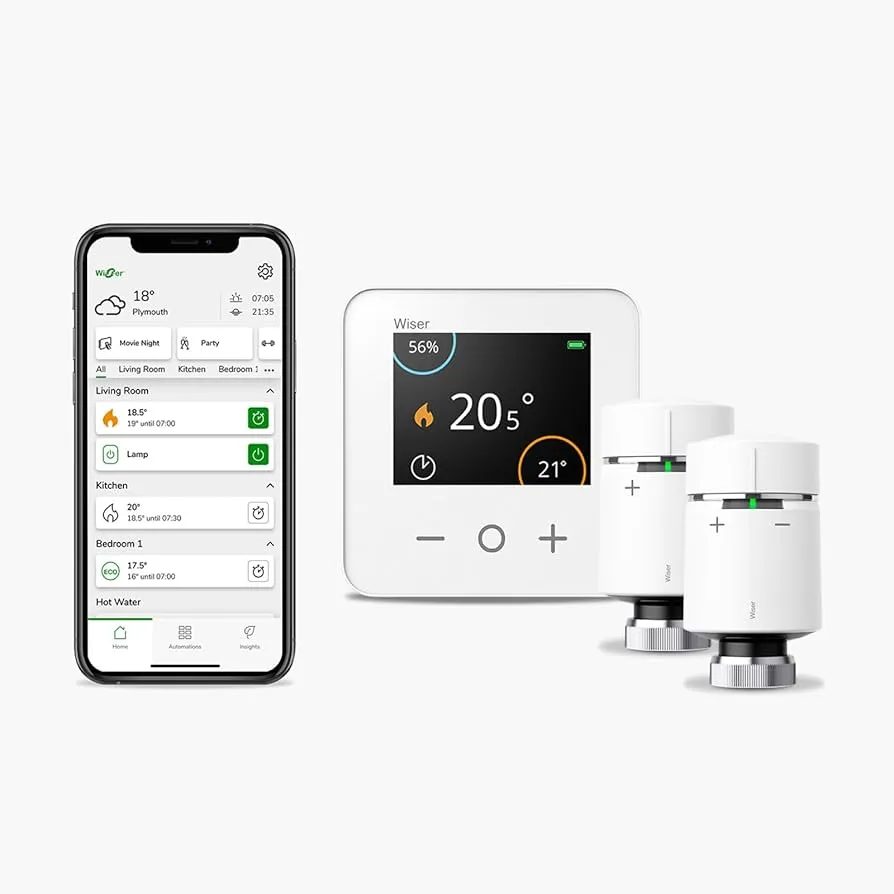
Your room thermostat (or smart thermostat, or the temperature dial on your heat pump controller) sets the target air temperature you want in your home. For most households, this is somewhere between 19°C and 21°C during the day.
The key difference from a boiler is this: with a heat pump, you should set this temperature and leave it. The instinct with a gas boiler is to turn it up when you’re cold and down when you’re warm, or to let the house cool overnight and blast it in the morning. This approach actively damages heat pump efficiency.
Heat pumps work best maintaining a steady temperature. The system is designed to trickle heat in continuously rather than heat-and-stop. If you let the house drop to 15°C overnight and then demand 21°C by morning, the heat pump has to work much harder possibly activating the backup electric heater and uses more electricity than if you’d simply kept the house at 18°C overnight.
One of the most common mistakes we come across is homeowners trying to save money by restricting their heat pump to cheap tariff hours only — our running heat pump on cheap tariffs poor comfort case study shows exactly why this strategy tends to backfire.
This is covered in more depth in our dedicated guide on whether you should turn your heat pump off at night, which explains the efficiency case for maintaining a steady temperature and what a sensible overnight setback actually looks like.
Recommended starting point: 20–21°C during the day, no lower than 17–18°C overnight. The difference in running costs between 17°C and 15°C overnight is smaller than most people expect, and the cost of the recovery from 15°C can easily cancel out the overnight saving.
Flow Temperature: The Setting That Matters Most for Efficiency
Flow temperature is the temperature of the water leaving the heat pump and circulating through your radiators. This is the setting that has the biggest impact on your running costs and most homeowners have never looked at it.
Every degree of flow temperature costs efficiency. Running at 45°C instead of 55°C can improve your COP by 25–30%. A system running at 35°C in mild weather might achieve COP 4 or even 5. A system running at 55°C year-round might achieve COP 2 or less.
The ‘best’ flow temperature for your system depends on your radiator sizes. If your radiators are correctly sized for heat pump temperatures, you should be able to run at 40–45°C in cold weather and lower in mild weather. If radiators are undersized, you may need a higher flow temperature to compensate but that’s a design problem, not a settings solution.
If you can access your heat pump settings, look for the maximum flow temperature. If it’s fixed at 55°C or above, this is worth investigating.
Weather Compensation: The Setting That Ties It All Together
Weather compensation is a feature that automatically adjusts your flow temperature based on the outdoor air temperature. When it’s mild outside (say 12°C), the system lowers the flow temperature to perhaps 35°C. When it’s cold (say -2°C), it raises it to 48°C. This means the system is always running at the minimum necessary temperature which maximises efficiency.
Most modern heat pumps have weather compensation built in. Most are also delivered from installation either with it disabled or with the curve set incorrectly. It’s one of the most impactful settings to get right, and one of the most commonly wrong settings we find in reviews.
Weather compensation explained simply: imagine your heat pump is a runner. Weather compensation tells the runner to walk on flat ground and sprint only when there’s a hill. Without it, the runner is sprinting all the time. Same destination, far more energy spent.
If you are not confident navigating your controller’s menus or want someone to review the full configuration rather than adjust individual settings yourself, our System Controller Configuration Review covers this as a standalone service.
What to Do If the House Still Feels Cold
If you’ve set the thermostat to 21°C and the house doesn’t reach it, the problem is almost certainly not the thermostat. The most common causes are: flow temperature too low for the radiator sizes (radiators that feel warm but not hot are the giveaway), weather compensation curve set incorrectly, radiators that are too small and need upgrading, or a heat pump that is undersized for the property.
Adjusting the room thermostat upward won’t fix any of these — it will just make the heat pump run more and use more electricity. The fix has to address the underlying design or configuration issue.
It is also worth reading our explanation of why a heat pump feels less powerful than a gas boiler — not because it is underperforming, but because the two systems deliver heat in fundamentally different ways, and understanding that distinction changes how you interpret what you are experiencing.
Summary: The Ideal Setup
For a typical UK home with a properly designed heat pump system: room thermostat set to 20–21°C with a night setback of no lower than 17–18°C, flow temperature modulating between 35°C (mild weather) and 48°C (cold weather) via weather compensation, and the backup electric element only activating during a true cold snap below -3°C or so.
If your system doesn’t match this picture, or if you’re not sure what your flow temperature is set to, a system review can assess the configuration and give you specific settings guidance.
Related reading: Heat Pump Condensate Drainage: Best Practice Explained
Heat Pump Thermostat Settings — What You Actually Need to Know
One of the most confusing aspects of heat pump ownership is that there are actually three different ‘temperature settings’ on most systems, and they do very different things. Getting them wrong or understanding only one of them is why so many homeowners end up with systems that are uncomfortable, expensive, or both.
The three settings are: your room thermostat temperature (what most people think of as ‘the thermostat’), your flow temperature (the temperature of the water in the heating system), and your weather compensation curve (how the flow temperature changes with outdoor conditions). Let me explain each one.
Room Thermostat: The Setting Everyone Knows
Your room thermostat (or smart thermostat, or the temperature dial on your heat pump controller) sets the target air temperature you want in your home. For most households, this is somewhere between 19°C and 21°C during the day.
The key difference from a boiler is this: with a heat pump, you should set this temperature and leave it. The instinct with a gas boiler is to turn it up when you’re cold and down when you’re warm, or to let the house cool overnight and blast it in the morning. This approach actively damages heat pump efficiency.
Heat pumps work best maintaining a steady temperature. The system is designed to trickle heat in continuously rather than heat-and-stop. If you let the house drop to 15°C overnight and then demand 21°C by morning, the heat pump has to work much harder possibly activating the backup electric heater and uses more electricity than if you’d simply kept the house at 18°C overnight.
One of the most common mistakes we come across is homeowners trying to save money by restricting their heat pump to cheap tariff hours only — our running heat pump on cheap tariffs poor comfort case study shows exactly why this strategy tends to backfire.
This is covered in more depth in our dedicated guide on whether you should turn your heat pump off at night, which explains the efficiency case for maintaining a steady temperature and what a sensible overnight setback actually looks like.
Recommended starting point: 20–21°C during the day, no lower than 17–18°C overnight. The difference in running costs between 17°C and 15°C overnight is smaller than most people expect, and the cost of the recovery from 15°C can easily cancel out the overnight saving.
Flow Temperature: The Setting That Matters Most for Efficiency
Flow temperature is the temperature of the water leaving the heat pump and circulating through your radiators. This is the setting that has the biggest impact on your running costs and most homeowners have never looked at it.
Every degree of flow temperature costs efficiency. Running at 45°C instead of 55°C can improve your COP by 25–30%. A system running at 35°C in mild weather might achieve COP 4 or even 5. A system running at 55°C year-round might achieve COP 2 or less.
The ‘best’ flow temperature for your system depends on your radiator sizes. If your radiators are correctly sized for heat pump temperatures, you should be able to run at 40–45°C in cold weather and lower in mild weather. If radiators are undersized, you may need a higher flow temperature to compensate but that’s a design problem, not a settings solution.
If you can access your heat pump settings, look for the maximum flow temperature. If it’s fixed at 55°C or above, this is worth investigating.
Weather Compensation: The Setting That Ties It All Together
Weather compensation is a feature that automatically adjusts your flow temperature based on the outdoor air temperature. When it’s mild outside (say 12°C), the system lowers the flow temperature to perhaps 35°C. When it’s cold (say -2°C), it raises it to 48°C. This means the system is always running at the minimum necessary temperature which maximises efficiency.
Most modern heat pumps have weather compensation built in. Most are also delivered from installation either with it disabled or with the curve set incorrectly. It’s one of the most impactful settings to get right, and one of the most commonly wrong settings we find in reviews.
Weather compensation explained simply: imagine your heat pump is a runner. Weather compensation tells the runner to walk on flat ground and sprint only when there’s a hill. Without it, the runner is sprinting all the time. Same destination, far more energy spent.
If you are not confident navigating your controller’s menus or want someone to review the full configuration rather than adjust individual settings yourself, our System Controller Configuration Review covers this as a standalone service.
What to Do If the House Still Feels Cold
If you’ve set the thermostat to 21°C and the house doesn’t reach it, the problem is almost certainly not the thermostat. The most common causes are: flow temperature too low for the radiator sizes (radiators that feel warm but not hot are the giveaway), weather compensation curve set incorrectly, radiators that are too small and need upgrading, or a heat pump that is undersized for the property.
Adjusting the room thermostat upward won’t fix any of these — it will just make the heat pump run more and use more electricity. The fix has to address the underlying design or configuration issue.
It is also worth reading our explanation of why a heat pump feels less powerful than a gas boiler — not because it is underperforming, but because the two systems deliver heat in fundamentally different ways, and understanding that distinction changes how you interpret what you are experiencing.
Summary: The Ideal Setup
For a typical UK home with a properly designed heat pump system: room thermostat set to 20–21°C with a night setback of no lower than 17–18°C, flow temperature modulating between 35°C (mild weather) and 48°C (cold weather) via weather compensation, and the backup electric element only activating during a true cold snap below -3°C or so.
If your system doesn’t match this picture, or if you’re not sure what your flow temperature is set to, a system review can assess the configuration and give you specific settings guidance.
Related reading: Heat Pump Condensate Drainage: Best Practice Explained
Oct 12, 2026
5 min read
Heat Pump Holiday Settings: What to Do When You Go Away in Winter
Read More
Oct 12, 2026
5 min read
Heat Pump Holiday Settings: What to Do When You Go Away in Winter
Read More

Oct 12, 2026
5 min read
Heat Pump Pipe Insulation: What You Need, How Thick, and Where It Goes Wrong
Read More
Oct 12, 2026
5 min read
Heat Pump Pipe Insulation: What You Need, How Thick, and Where It Goes Wrong
Read More

Contact Us
Not Sure Which Service You Need?
Not Sure Which Service You Need?
Not Sure Which Service You Need?
Not Sure Which Service You Need?
Not Sure Which Service You Need?
Whether you need help with an existing heat pump, a pre-installation review, cooling advice, servicing or a room-by-room heat loss survey, send us a few details and we'll point you in the right direction.
Whether you need help with an existing heat pump, a pre-installation review, cooling advice, servicing or a room-by-room heat loss survey, send us a few details and we'll point you in the right direction.
Whether you need help with an existing heat pump, a pre-installation review, cooling advice, servicing or a room-by-room heat loss survey, send us a few details and we'll point you in the right direction.

