Why Your Heat Pump Shows a Flow Error (And What It Actually Means)
Why Your Heat Pump Shows a Flow Error (And What It Actually Means)
Why Your Heat Pump Shows a Flow Error (And What It Actually Means)
Why Your Heat Pump Shows a Flow Error (And What It Actually Means)
Why Your Heat Pump Shows a Flow Error (And What It Actually Means)

UK Heat pump Help Technical Team
Independent Heat Pump Engineer
Why Your Heat Pump Shows a Flow Error (And What It Actually Means)
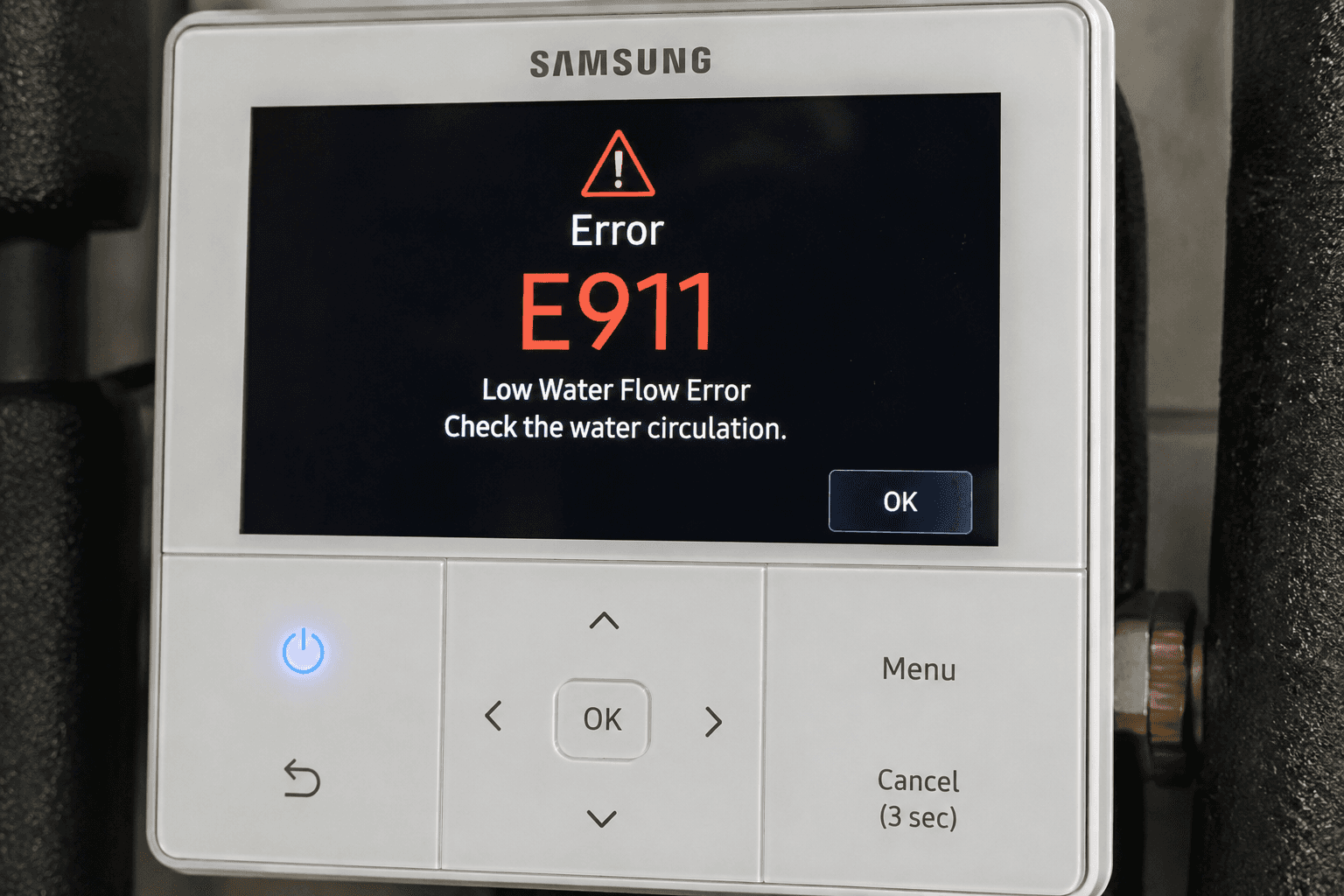
One of the most common faults UK homeowners see on a heat pump is a flow error, and the first reaction is almost always panic. Has the heat pump broken? In the majority of cases, the answer is no. A flow error simply means the heat pump is struggling to move enough water around the heating system. Because the unit is designed to protect itself, when water flow drops too low, it shuts down and displays a fault code. The problem driving that fault, however, can range from something simple to a more serious design issue that needs professional attention.
What Does a Flow Error Actually Mean?
Your heat pump constantly monitors the movement of water through the system. If water slows down too much or loses the ability to circulate properly, temperatures inside the unit can rise too quickly. Rather than allowing internal damage to occur, the heat pump shuts itself down. A useful way to think about it is like driving a car with no coolant circulation the heat source is still running, but heat cannot move away from it efficiently. The result is a fault, not a failure.
Signs That Often Appear Before a Flow Error
Many homeowners notice problems developing before the actual fault code appears on the display. Some rooms may stay cold while others overheat. Radiators may feel only lukewarm rather than properly warm. The heat pump may turn on and off more frequently than usual in a pattern known as short cycling. Gurgling or bubbling sounds may come from the pipework. The house may take longer than normal to reach temperature, or it may never quite get there even when the system appears to be running continuously. If your radiators are only ever lukewarm rather than properly heating your rooms, our guide on why some rooms stay cold with a heat pump explains the most common reasons in detail.
Dirty Filters and Blocked Strainers
This is one of the first things we check when a flow error is reported. Most heat pump systems have inline filters or strainers fitted to protect the pump and heat exchanger from debris that exists within the heating system. Over time, these can become partially blocked with magnetite, flux residues left over from installation, construction debris, or general system dirt that has settled and broken loose. Even a partial blockage is enough to reduce water movement to the point where flow errors begin to occur, because heat pumps depend entirely on unrestricted, steady circulation at lower flow temperatures rather than the high-pressure bursts that a gas boiler can use to push through restrictions. Our detailed guide on how dirty filters cause heat pump problems explains what to look for and what to do.
Too Many Radiators Restricted or Closed
Heat pumps need a sufficient volume of water moving around the system at all times. A situation we encounter regularly is one where multiple thermostatic radiator valves (TRVs) have been turned down, certain rooms have been isolated, or zoning has shut off too large a portion of the circuit. Traditional gas boilers can sometimes tolerate this because their high flow temperatures compensate. Heat pumps often cannot, because their efficiency and protection depend on stable, continuous circulation across the full system. If your system uses zones, it is worth checking whether too much of the circuit is being closed off during normal operation.
Air Trapped Within the System
Airlocks are another common cause of circulation problems and flow errors. Air does not carry heat effectively and creates unpredictable restrictions that move around the system. Signs of trapped air include gurgling or banging noises in the pipework, certain radiators failing to warm up while others work normally, and intermittent faults that seem to clear themselves only to return. Bleeding radiators after maintenance work is one of the most common triggers for a temporary flow error, and in that specific situation a one-off fault may resolve without further intervention. However, if airlocks keep recurring, there is usually an underlying reason worth investigating.
Pipework That Is Too Small or Too Long
Sometimes the cause of a flow error has nothing to do with settings, controls, or maintenance at all. If the pipework supplying the heating circuit is undersized for the volume of water the heat pump needs to move, restrictions will occur naturally particularly during periods of higher heating demand in cold weather. Long external pipe runs between the heat pump unit and the internal system can also create enough resistance to cause problems, especially if they were not accounted for properly at the design stage.
Circulation Pump Faults
The circulation pump is responsible for physically moving water around the heating circuit. If the pump fails, runs at the wrong speed, has been set too low, or has been wired incorrectly, flow problems can develop rapidly. This is less common than filters or control issues, but it does happen and it is something we check when other causes have been ruled out.
Real Examples From UK Systems We Have Reviewed
We have reviewed a heat pump that was freezing repeatedly due to poor pipework design that restricted circulation even in moderate weather. In another case, a homeowner was experiencing high running costs caused by short cycling, where the root issue was not a fault with the heat pump itself but a system design that prevented stable operation. We have also investigated a brand new installation where efficiency was significantly below expectations from the first winter, traced back to decisions made before installation began. These cases are documented in our case studies section and illustrate how often the heat pump is not actually the problem.
When Should You Be Concerned About a Flow Error?
A single flow error following maintenance work, after bleeding radiators, or after a power interruption is not necessarily a reason to worry. Repeated flow errors are a different matter entirely. If the fault keeps returning, simply resetting the heat pump is not a solution it is masking something that will continue to get worse. There is always a reason behind a recurring fault, and in most cases it is identifiable with the right information.
Need Help With Your Heat Pump?
If your heat pump keeps showing flow errors, shutting down, or struggling to heat the house reliably, our Fix My Heat Pump service can help identify what is actually happening. We review controls, system performance, temperatures, flow rates, and possible design issues to give you clear, independent answers not guesswork.
Thinking About Getting a Heat Pump Installed?
Many of the circulation and flow problems we diagnose start before the heat pump is even fitted. Pipe sizing, heat loss calculations, and system design decisions made at the planning stage all play a significant role in whether a system performs reliably from day one. Our Pre-Installation Design and Heat Loss Review helps identify potential issues before installation begins, so problems can be designed out rather than diagnosed later.
Related reading: Why Is My Heat Pump Showing A Low Flow Fault?
Why Your Heat Pump Shows a Flow Error (And What It Actually Means)
One of the most common faults UK homeowners see on a heat pump is a flow error, and the first reaction is almost always panic. Has the heat pump broken? In the majority of cases, the answer is no. A flow error simply means the heat pump is struggling to move enough water around the heating system. Because the unit is designed to protect itself, when water flow drops too low, it shuts down and displays a fault code. The problem driving that fault, however, can range from something simple to a more serious design issue that needs professional attention.
What Does a Flow Error Actually Mean?
Your heat pump constantly monitors the movement of water through the system. If water slows down too much or loses the ability to circulate properly, temperatures inside the unit can rise too quickly. Rather than allowing internal damage to occur, the heat pump shuts itself down. A useful way to think about it is like driving a car with no coolant circulation the heat source is still running, but heat cannot move away from it efficiently. The result is a fault, not a failure.
Signs That Often Appear Before a Flow Error
Many homeowners notice problems developing before the actual fault code appears on the display. Some rooms may stay cold while others overheat. Radiators may feel only lukewarm rather than properly warm. The heat pump may turn on and off more frequently than usual in a pattern known as short cycling. Gurgling or bubbling sounds may come from the pipework. The house may take longer than normal to reach temperature, or it may never quite get there even when the system appears to be running continuously. If your radiators are only ever lukewarm rather than properly heating your rooms, our guide on why some rooms stay cold with a heat pump explains the most common reasons in detail.
Dirty Filters and Blocked Strainers
This is one of the first things we check when a flow error is reported. Most heat pump systems have inline filters or strainers fitted to protect the pump and heat exchanger from debris that exists within the heating system. Over time, these can become partially blocked with magnetite, flux residues left over from installation, construction debris, or general system dirt that has settled and broken loose. Even a partial blockage is enough to reduce water movement to the point where flow errors begin to occur, because heat pumps depend entirely on unrestricted, steady circulation at lower flow temperatures rather than the high-pressure bursts that a gas boiler can use to push through restrictions. Our detailed guide on how dirty filters cause heat pump problems explains what to look for and what to do.
Too Many Radiators Restricted or Closed
Heat pumps need a sufficient volume of water moving around the system at all times. A situation we encounter regularly is one where multiple thermostatic radiator valves (TRVs) have been turned down, certain rooms have been isolated, or zoning has shut off too large a portion of the circuit. Traditional gas boilers can sometimes tolerate this because their high flow temperatures compensate. Heat pumps often cannot, because their efficiency and protection depend on stable, continuous circulation across the full system. If your system uses zones, it is worth checking whether too much of the circuit is being closed off during normal operation.
Air Trapped Within the System
Airlocks are another common cause of circulation problems and flow errors. Air does not carry heat effectively and creates unpredictable restrictions that move around the system. Signs of trapped air include gurgling or banging noises in the pipework, certain radiators failing to warm up while others work normally, and intermittent faults that seem to clear themselves only to return. Bleeding radiators after maintenance work is one of the most common triggers for a temporary flow error, and in that specific situation a one-off fault may resolve without further intervention. However, if airlocks keep recurring, there is usually an underlying reason worth investigating.
Pipework That Is Too Small or Too Long
Sometimes the cause of a flow error has nothing to do with settings, controls, or maintenance at all. If the pipework supplying the heating circuit is undersized for the volume of water the heat pump needs to move, restrictions will occur naturally particularly during periods of higher heating demand in cold weather. Long external pipe runs between the heat pump unit and the internal system can also create enough resistance to cause problems, especially if they were not accounted for properly at the design stage.
Circulation Pump Faults
The circulation pump is responsible for physically moving water around the heating circuit. If the pump fails, runs at the wrong speed, has been set too low, or has been wired incorrectly, flow problems can develop rapidly. This is less common than filters or control issues, but it does happen and it is something we check when other causes have been ruled out.
Real Examples From UK Systems We Have Reviewed
We have reviewed a heat pump that was freezing repeatedly due to poor pipework design that restricted circulation even in moderate weather. In another case, a homeowner was experiencing high running costs caused by short cycling, where the root issue was not a fault with the heat pump itself but a system design that prevented stable operation. We have also investigated a brand new installation where efficiency was significantly below expectations from the first winter, traced back to decisions made before installation began. These cases are documented in our case studies section and illustrate how often the heat pump is not actually the problem.
When Should You Be Concerned About a Flow Error?
A single flow error following maintenance work, after bleeding radiators, or after a power interruption is not necessarily a reason to worry. Repeated flow errors are a different matter entirely. If the fault keeps returning, simply resetting the heat pump is not a solution it is masking something that will continue to get worse. There is always a reason behind a recurring fault, and in most cases it is identifiable with the right information.
Need Help With Your Heat Pump?
If your heat pump keeps showing flow errors, shutting down, or struggling to heat the house reliably, our Fix My Heat Pump service can help identify what is actually happening. We review controls, system performance, temperatures, flow rates, and possible design issues to give you clear, independent answers not guesswork.
Thinking About Getting a Heat Pump Installed?
Many of the circulation and flow problems we diagnose start before the heat pump is even fitted. Pipe sizing, heat loss calculations, and system design decisions made at the planning stage all play a significant role in whether a system performs reliably from day one. Our Pre-Installation Design and Heat Loss Review helps identify potential issues before installation begins, so problems can be designed out rather than diagnosed later.
Related reading: Why Is My Heat Pump Showing A Low Flow Fault?
Oct 21, 2026
5 min read
Air to Water Heat Pump: How It Works and What It Needs
Read More
Oct 21, 2026
5 min read
Air to Water Heat Pump: How It Works and What It Needs
Read More
Oct 19, 2026
5 min read
Heat Pump System Water Treatment: Inhibitor, Filters and Annual Water Tests
Read More
Oct 19, 2026
5 min read
Heat Pump System Water Treatment: Inhibitor, Filters and Annual Water Tests
Read More

Contact Us
Not Sure Which Service You Need?
Not Sure Which Service You Need?
Not Sure Which Service You Need?
Not Sure Which Service You Need?
Not Sure Which Service You Need?
Whether you need help with an existing heat pump, a pre-installation review, cooling advice, servicing or a room-by-room heat loss survey, send us a few details and we'll point you in the right direction.
Whether you need help with an existing heat pump, a pre-installation review, cooling advice, servicing or a room-by-room heat loss survey, send us a few details and we'll point you in the right direction.
Whether you need help with an existing heat pump, a pre-installation review, cooling advice, servicing or a room-by-room heat loss survey, send us a few details and we'll point you in the right direction.

