Do I Need Planning Permission for a Heat Pump?
Do I Need Planning Permission for a Heat Pump?
Do I Need Planning Permission for a Heat Pump?
Do I Need Planning Permission for a Heat Pump?
Do I Need Planning Permission for a Heat Pump?

UK Heat pump Help Technical Team
Independent Heat Pump Engineer
The Short Answer
In most cases, no. Thanks to changes introduced in 2025, the majority of domestic air source heat pump installations in England can now be installed under Permitted Development Rights, meaning you won't need to submit a planning application before work begins. That said, there are still several important conditions that must be met, covering everything from noise output to the size and position of the outdoor unit, so it's worth understanding the rules properly before committing to an installation date rather than assuming every property automatically qualifies.
What Are Permitted Development Rights?
Permitted Development Rights are national planning rules that allow certain categories of building work to go ahead without a formal planning application. The Government introduced and later expanded these rules specifically to make it easier for homeowners to improve the energy efficiency of their properties, reduce reliance on fossil fuel heating, and cut down on unnecessary planning applications clogging up local council planning departments. Heat pumps fall squarely into this category, provided the specific installation meets the conditions set out below.
When You Normally Don't Need Planning Permission
Most homes won't need planning permission provided the installation meets all of the permitted development conditions. This means the outdoor unit complies with the MCS 020a sound assessment requirements, is no larger than 1.5 cubic metres in size for a house, isn't installed on a pitched roof, isn't used solely for cooling rather than heating, and is positioned in a way that minimises its visual impact on the property and surrounding area. If your installer confirms all of these conditions are met, which a competent MCS-certified installer should check as a standard part of the design process, no application needs to be submitted and installation can proceed directly.
When Planning Permission May Be Required
There are several specific situations where planning permission will normally be required rather than assumed. If your property is a listed building, permitted development rights simply do not apply, and you'll need both planning permission and listed building consent before a heat pump can be installed, regardless of how quiet or well-positioned the unit is. If you're installing more units than permitted development allows, this also triggers the need for an application: detached houses can have up to two air source heat pumps under permitted development, while semi-detached houses, terraced houses, and flats are limited to just one, meaning any additional outdoor unit beyond that limit will normally require planning permission in its own right.
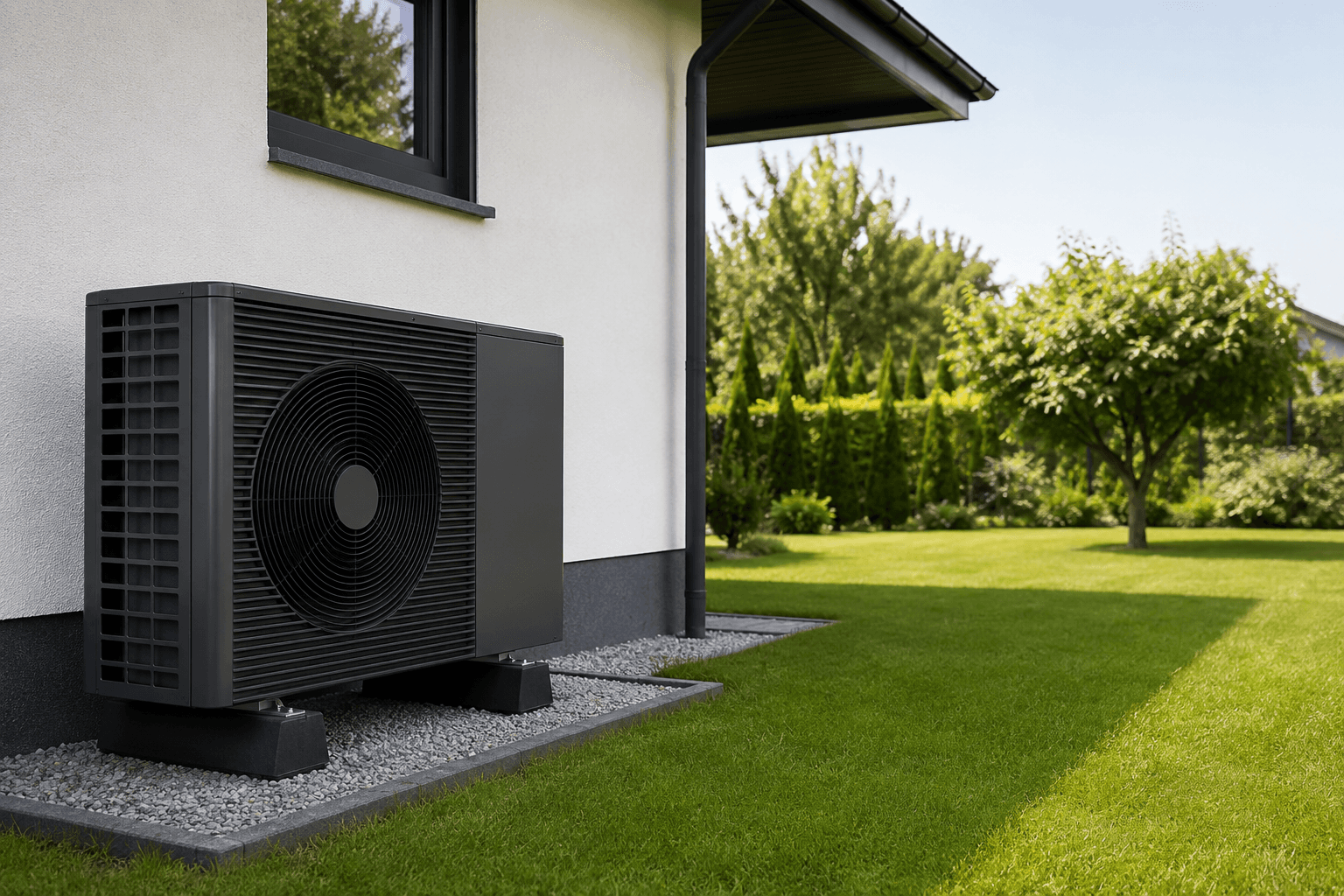
Size is another common trigger. The outdoor unit, including its casing, must not exceed 1.5 cubic metres on a house or 0.6 cubic metres on a block of flats, and larger units will require planning permission regardless of where they're positioned. The installation must also comply with the wider permitted development rules around positioning: the unit cannot be installed on a pitched roof, and if it's installed on a flat roof, it must sit at least 1 metre from the roof edge, alongside meeting the MCS 020a noise assessment. Finally, if your property sits within a Conservation Area, positioning becomes more restrictive again; the outdoor unit cannot be installed on a wall or roof facing a highway, or positioned closer to the highway than the front of the house, and getting this wrong is one of the more common reasons an otherwise straightforward installation ends up needing a retrospective application.
Conservation Areas
Installing a heat pump within a Conservation Area doesn't automatically mean planning permission is required, which is a common misconception among homeowners in these areas. In many cases, permitted development still applies in full, but there are additional restrictions on exactly where the outdoor unit can be positioned. As mentioned above, it must not be installed on a wall or roof fronting a highway, or placed closer to the road than the front of the house, which in practice usually means the unit needs to go around the side or back of the property rather than the most visible or convenient wall.
What About Noise?
Noise is one of the single biggest planning considerations for any heat pump installation, and it's the condition most likely to catch out a poorly planned project. Installers are required to carry out an MCS 020a sound assessment to demonstrate that the specific installation, at that specific distance from neighbouring boundaries, meets the permitted development noise limits. Modern heat pumps are generally very quiet in normal operation, and a correctly designed installation will usually pass this assessment without any issues, but positioning still matters, particularly in Conservation Areas or where the unit will sit close to a neighbour's window or garden. If you've ever wondered whether a specific unit's noise levels are normal or a sign of a problem, it's worth reading our separate piece on why heat pumps can be noisy, since ongoing operational noise and the one-off planning noise assessment are related but distinct questions.
Do I Need to Arrange Planning Permission Myself?
If planning permission does turn out to be required for your specific installation, the application is normally submitted in the homeowner's name, although in practice many installers will complete the application on your behalf, or arrange it through a planning consultant they work with regularly. Your installer should provide all of the technical information needed to support the application, including a site plan showing the proposed heat pump location, the manufacturer's technical specification sheet, the MCS 020a sound assessment, and full details of the proposed installation. Before any work begins, a properly organised installer should explain clearly whether planning permission applies to your specific property and installation, and exactly what information you'll need to provide if it does, rather than leaving this as an afterthought once equipment has already been ordered.
How This Fits Into the Wider Installation Process
Planning permission and permitted development compliance sit alongside a number of other things that should be checked properly before installation, and unfortunately this early planning stage is where we most often see corners cut. We've covered the broader pattern of what tends to go wrong when this stage is rushed in common commissioning mistakes with air source heat pumps and in 7 signs your heat pump may not be installed correctly, both of which are worth a read if you're currently comparing installers or quotes. Correct sizing matters just as much as planning compliance, since an outdoor unit that's the wrong size for your home creates ongoing performance problems long after the planning question has been settled, which we explain in what size heat pump does my house need. If you're in an older property and weighing up whether a heat pump is even the right fit before you get as far as planning considerations, our guide on whether heat pumps work in older houses is a useful starting point, and if you're still deciding whether to go ahead with a heat pump at all, are heat pumps worth it in the UK covers the wider cost and performance picture. It's also worth checking current funding, since eligibility and grant amounts have changed recently, covered in replacing an oil boiler: heat pump grants are increasing to £9,000.
Thinking About Installing a Heat Pump?
If you're considering replacing your existing heating system and want an independent view before committing to a quote, our Pre-Installation Design Review service reviews the proposed design in full, including heat loss calculations, system sizing, flow temperature, and radiator suitability, and discusses any potential planning or technical considerations specific to your property, helping you make an informed decision before any work begins rather than after. You can also see the kind of real, documented design issues this process uncovers in our case studies.
Already Have a Heat Pump?
If your heat pump has already been installed but isn't performing as expected, whether that's rooms not reaching temperature, unexpectedly high running costs, or a system that simply doesn't feel right, our Fix My Heat Pump service provides independent remote technical support. We can often diagnose faults over a video call and help you understand exactly what's happening before an engineer even needs to visit.
Final Thoughts
For most homeowners, installing a heat pump no longer requires a planning application. The changes to permitted development rules introduced in 2025 have made the process considerably simpler, but there are still real conditions covering noise, unit size, position, and protected properties that need to be checked against your specific home rather than assumed. A good installer should walk you through these requirements clearly, confirming your installation complies with both planning legislation and MCS standards before any work begins.
The Short Answer
In most cases, no. Thanks to changes introduced in 2025, the majority of domestic air source heat pump installations in England can now be installed under Permitted Development Rights, meaning you won't need to submit a planning application before work begins. That said, there are still several important conditions that must be met, covering everything from noise output to the size and position of the outdoor unit, so it's worth understanding the rules properly before committing to an installation date rather than assuming every property automatically qualifies.
What Are Permitted Development Rights?
Permitted Development Rights are national planning rules that allow certain categories of building work to go ahead without a formal planning application. The Government introduced and later expanded these rules specifically to make it easier for homeowners to improve the energy efficiency of their properties, reduce reliance on fossil fuel heating, and cut down on unnecessary planning applications clogging up local council planning departments. Heat pumps fall squarely into this category, provided the specific installation meets the conditions set out below.
When You Normally Don't Need Planning Permission
Most homes won't need planning permission provided the installation meets all of the permitted development conditions. This means the outdoor unit complies with the MCS 020a sound assessment requirements, is no larger than 1.5 cubic metres in size for a house, isn't installed on a pitched roof, isn't used solely for cooling rather than heating, and is positioned in a way that minimises its visual impact on the property and surrounding area. If your installer confirms all of these conditions are met, which a competent MCS-certified installer should check as a standard part of the design process, no application needs to be submitted and installation can proceed directly.
When Planning Permission May Be Required
There are several specific situations where planning permission will normally be required rather than assumed. If your property is a listed building, permitted development rights simply do not apply, and you'll need both planning permission and listed building consent before a heat pump can be installed, regardless of how quiet or well-positioned the unit is. If you're installing more units than permitted development allows, this also triggers the need for an application: detached houses can have up to two air source heat pumps under permitted development, while semi-detached houses, terraced houses, and flats are limited to just one, meaning any additional outdoor unit beyond that limit will normally require planning permission in its own right.
Size is another common trigger. The outdoor unit, including its casing, must not exceed 1.5 cubic metres on a house or 0.6 cubic metres on a block of flats, and larger units will require planning permission regardless of where they're positioned. The installation must also comply with the wider permitted development rules around positioning: the unit cannot be installed on a pitched roof, and if it's installed on a flat roof, it must sit at least 1 metre from the roof edge, alongside meeting the MCS 020a noise assessment. Finally, if your property sits within a Conservation Area, positioning becomes more restrictive again; the outdoor unit cannot be installed on a wall or roof facing a highway, or positioned closer to the highway than the front of the house, and getting this wrong is one of the more common reasons an otherwise straightforward installation ends up needing a retrospective application.
Conservation Areas
Installing a heat pump within a Conservation Area doesn't automatically mean planning permission is required, which is a common misconception among homeowners in these areas. In many cases, permitted development still applies in full, but there are additional restrictions on exactly where the outdoor unit can be positioned. As mentioned above, it must not be installed on a wall or roof fronting a highway, or placed closer to the road than the front of the house, which in practice usually means the unit needs to go around the side or back of the property rather than the most visible or convenient wall.
What About Noise?
Noise is one of the single biggest planning considerations for any heat pump installation, and it's the condition most likely to catch out a poorly planned project. Installers are required to carry out an MCS 020a sound assessment to demonstrate that the specific installation, at that specific distance from neighbouring boundaries, meets the permitted development noise limits. Modern heat pumps are generally very quiet in normal operation, and a correctly designed installation will usually pass this assessment without any issues, but positioning still matters, particularly in Conservation Areas or where the unit will sit close to a neighbour's window or garden. If you've ever wondered whether a specific unit's noise levels are normal or a sign of a problem, it's worth reading our separate piece on why heat pumps can be noisy, since ongoing operational noise and the one-off planning noise assessment are related but distinct questions.
Do I Need to Arrange Planning Permission Myself?
If planning permission does turn out to be required for your specific installation, the application is normally submitted in the homeowner's name, although in practice many installers will complete the application on your behalf, or arrange it through a planning consultant they work with regularly. Your installer should provide all of the technical information needed to support the application, including a site plan showing the proposed heat pump location, the manufacturer's technical specification sheet, the MCS 020a sound assessment, and full details of the proposed installation. Before any work begins, a properly organised installer should explain clearly whether planning permission applies to your specific property and installation, and exactly what information you'll need to provide if it does, rather than leaving this as an afterthought once equipment has already been ordered.
How This Fits Into the Wider Installation Process
Planning permission and permitted development compliance sit alongside a number of other things that should be checked properly before installation, and unfortunately this early planning stage is where we most often see corners cut. We've covered the broader pattern of what tends to go wrong when this stage is rushed in common commissioning mistakes with air source heat pumps and in 7 signs your heat pump may not be installed correctly, both of which are worth a read if you're currently comparing installers or quotes. Correct sizing matters just as much as planning compliance, since an outdoor unit that's the wrong size for your home creates ongoing performance problems long after the planning question has been settled, which we explain in what size heat pump does my house need. If you're in an older property and weighing up whether a heat pump is even the right fit before you get as far as planning considerations, our guide on whether heat pumps work in older houses is a useful starting point, and if you're still deciding whether to go ahead with a heat pump at all, are heat pumps worth it in the UK covers the wider cost and performance picture. It's also worth checking current funding, since eligibility and grant amounts have changed recently, covered in replacing an oil boiler: heat pump grants are increasing to £9,000.
Thinking About Installing a Heat Pump?
If you're considering replacing your existing heating system and want an independent view before committing to a quote, our Pre-Installation Design Review service reviews the proposed design in full, including heat loss calculations, system sizing, flow temperature, and radiator suitability, and discusses any potential planning or technical considerations specific to your property, helping you make an informed decision before any work begins rather than after. You can also see the kind of real, documented design issues this process uncovers in our case studies.
Already Have a Heat Pump?
If your heat pump has already been installed but isn't performing as expected, whether that's rooms not reaching temperature, unexpectedly high running costs, or a system that simply doesn't feel right, our Fix My Heat Pump service provides independent remote technical support. We can often diagnose faults over a video call and help you understand exactly what's happening before an engineer even needs to visit.
Final Thoughts
For most homeowners, installing a heat pump no longer requires a planning application. The changes to permitted development rules introduced in 2025 have made the process considerably simpler, but there are still real conditions covering noise, unit size, position, and protected properties that need to be checked against your specific home rather than assumed. A good installer should walk you through these requirements clearly, confirming your installation complies with both planning legislation and MCS standards before any work begins.

Jul 25, 2026
5 min read
Do I Need to Inform the Electricity Grid Before Installing a Heat Pump?
Read More
Jul 25, 2026
5 min read
Do I Need to Inform the Electricity Grid Before Installing a Heat Pump?
Read More

Jul 19, 2026
5 min read
Why Is My Thermostat Getting to Temperature but My House Still Feels Cold?
Read More
Jul 19, 2026
5 min read
Why Is My Thermostat Getting to Temperature but My House Still Feels Cold?
Read More
Recent
Do I Need to Inform the Electricity Grid Before Installing a Heat Pump?
Jul 25, 2026
Why Is My Thermostat Getting to Temperature but My House Still Feels Cold?
Jul 19, 2026
Why Turning Up the Flow Temperature Doesn't Always Heat Your House Faster
Jul 25, 2026
Why Is My Vaillant aroTHERM Showing 'Domestic Hot Water Compressor Blocked'?
Jul 22, 2026

What Happens If a Heat Pump Has Air in the System?
Jul 18, 2026

Contact Us
Not Sure If We Can Help?
Not Sure If We Can Help?
Not Sure If We Can Help?
Not Sure If We Can Help?
Not Sure If We Can Help?
If you're unsure whether your heat pump problem can be diagnosed remotely, send us a short description of the issue and we’ll let you know if a technical review is worthwhile. No obligation.
If you're unsure whether your heat pump problem can be diagnosed remotely, send us a short description of the issue and we’ll let you know if a technical review is worthwhile. No obligation.
If you're unsure whether your heat pump problem can be diagnosed remotely, send us a short description of the issue and we’ll let you know if a technical review is worthwhile. No obligation.

