What Is COP and SCOP on a Heat Pump?
What Is COP and SCOP on a Heat Pump?
What Is COP and SCOP on a Heat Pump?
What Is COP and SCOP on a Heat Pump?
What Is COP and SCOP on a Heat Pump?

UK Heat pump Help Technical Team
Independent Heat Pump Engineer
If you've spent any time researching air source heat pumps, you've almost certainly come across the terms COP and SCOP. Manufacturers love putting impressive efficiency figures on spec sheets, but a lot of homeowners are left wondering what those numbers actually mean, and more importantly, whether they reflect anything close to real-world performance.
The short version is this: COP measures how efficiently a heat pump is operating at one specific moment. SCOP measures how efficiently it performs across an entire heating season. Both are useful, but they answer very different questions, and mixing them up is one of the most common reasons homeowners end up with unrealistic expectations of their running costs.
What is COP?
COP stands for Coefficient of Performance, and it measures how much heat a heat pump produces compared with the electricity it consumes at that particular moment. A heat pump with a COP of 3 produces 3kW of heat for every 1kW of electricity it uses. One with a COP of 4 produces 4kW of heat per 1kW consumed, and one with a COP of 5 produces 5kW per 1kW. The higher the COP, the more efficiently the system is operating under those specific conditions.
Why does COP change?
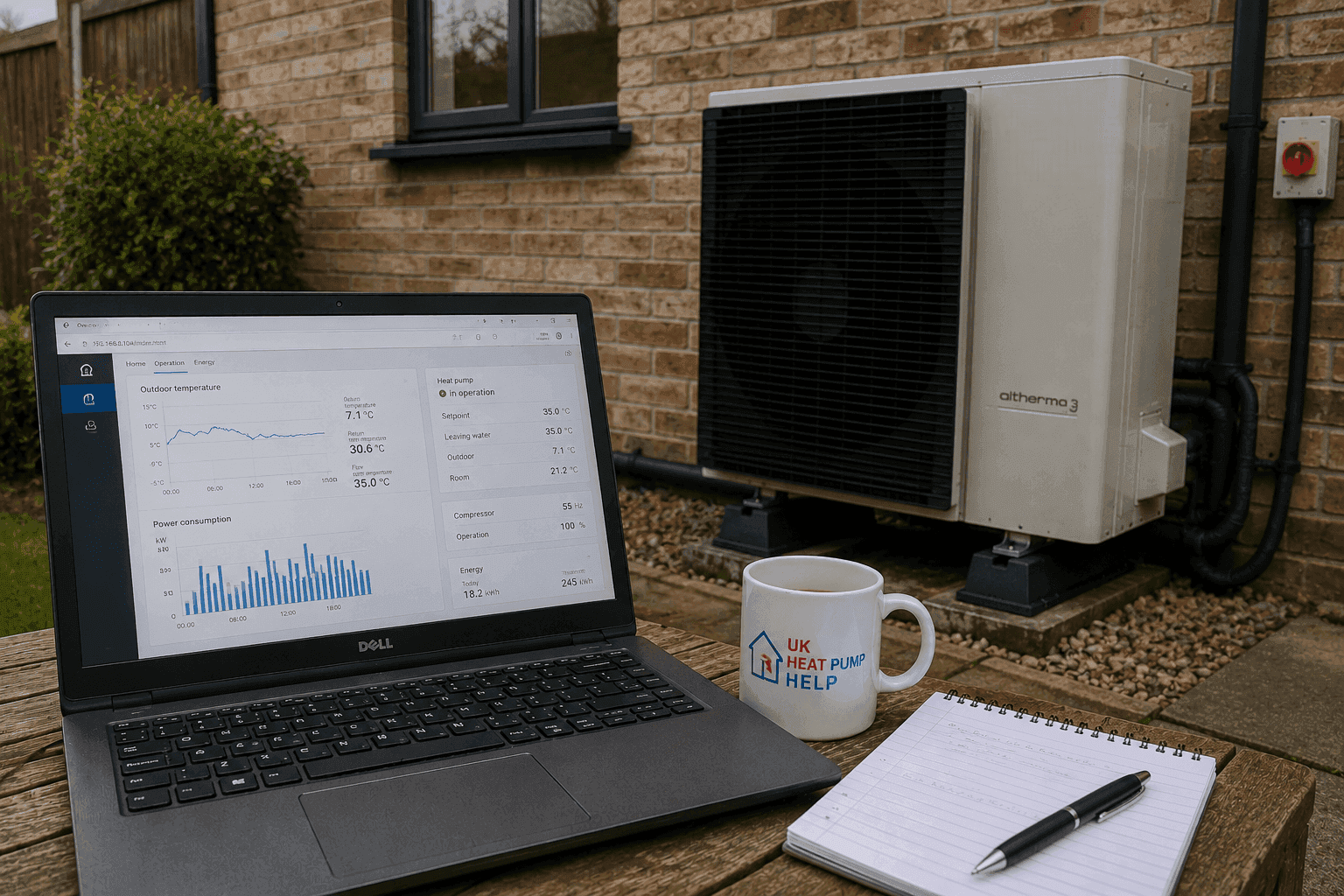
Unlike a gas boiler, a heat pump's efficiency isn't a fixed number. It shifts constantly because the conditions around the system are always changing. The biggest factors are the outdoor air temperature, the flow temperature the heat pump is producing, and the heating demand from the property itself. On a mild spring day, with outdoor temperatures around 15°C and a heating system that only needs 30-35°C water, the heat pump barely has to work, so COP is high. On a freezing winter morning, the same heat pump might need to produce 45-50°C water while extracting heat from air below 0°C. The compressor works far harder, and COP naturally drops as a result. This is completely normal and happens with every air source heat pump on the market, which is part of why heat pumps genuinely do cost more to run in winter than summer.
What do figures like A7/W35 actually mean?
Manufacturers often quote efficiency using standardised test conditions such as A7/W35, A2/W35, or A-7/W35. These exist so that every heat pump on the market gets tested under identical conditions, which makes comparison at least theoretically fair. The letters are simpler than they look: A refers to the outdoor air temperature, and W refers to the water flow temperature leaving the heat pump. So A7/W35 means 7°C outdoor air producing a 35°C flow temperature, A2/W35 means 2°C outdoor air at the same flow temperature, and A-7/W35 means -7°C outdoor air at that flow temperature. As the outdoor air gets colder or the required flow temperature climbs, COP drops, because the heat pump simply has more work to do.
What is SCOP?
SCOP stands for Seasonal Coefficient of Performance. Rather than measuring efficiency at a single operating condition, it measures how efficiently a heat pump performs across an entire heating season, using several standard operating conditions that represent different outdoor temperatures and heating demands, then calculating an overall seasonal figure. This gives a far more realistic picture of how the system is likely to perform in everyday use than any single COP snapshot ever could.
Why is SCOP the more useful figure?
For most homeowners, SCOP is genuinely the number that matters. A manufacturer might advertise a COP above 5 under ideal laboratory conditions, but your heat pump will never operate under those exact conditions year-round. Some days its efficiency will be higher, some days lower, and SCOP accounts for all of that variation to give a much better indication of annual performance and expected running costs. That's precisely why installers, designers, and manufacturers tend to lean on SCOP rather than COP when comparing different heat pumps against each other.
Does a higher COP always mean lower running costs?
Not necessarily, and this is where a lot of homeowners get caught out. Running costs depend on far more than the heat pump unit itself. They're shaped by your property's heat loss, the flow temperature your heating system actually requires, whether the system has been commissioned correctly, whether weather compensation has been set up properly, how well radiators or underfloor heating have been balanced, your hot water demand, and your electricity tariff. A well-designed system running a heat pump with a slightly lower published COP can genuinely cost less to run than a poorly designed installation using a unit with better laboratory results. Two of the biggest levers here are covered in our guides on what flow temperature your heat pump should actually run at and how weather compensation is meant to work, since getting both right tends to move real-world efficiency more than swapping to a marginally higher-spec unit ever would.
Can you actually improve your heat pump's COP?
Yes, and this is genuinely good news, because while you can't do anything about the weather, you can absolutely improve how your heating system responds to it. Some of the biggest gains come from reducing unnecessary flow temperatures, setting up weather compensation correctly, properly balancing the heating system, cleaning filters where required, making sure controls are configured correctly, and confirming the heat pump was commissioned properly in the first place. If your system feels like it's cycling more than it should, that's often tied to the same underlying settings, and our guide on why a heat pump keeps turning off is worth a read if that sounds familiar. Small improvements to system setup can add up to a noticeable difference over an entire heating season.
What counts as a good SCOP?
Most modern air source heat pumps installed in UK homes achieve a SCOP somewhere around 3.5 to 5, depending on the property, the system design, and the operating temperatures involved. The important thing to remember is that SCOP isn't purely a function of the heat pump itself. A correctly sized unit with good commissioning, sensible flow temperatures, and a properly balanced heating system will usually outperform a poorly designed installation running exactly the same equipment. That's why the quality of the installation often matters just as much as the brand of heat pump on the spec sheet.
The bottom line
COP tells you how efficiently a heat pump is operating right now. SCOP tells you how efficiently it's expected to perform across an entire heating season. Both figures have their place, but SCOP gives homeowners a far more honest picture of likely annual performance and running costs. If your heat pump doesn't seem to be hitting the efficiency you were promised, the cause is very often incorrect settings, poor commissioning, or system design, rather than a problem with the heat pump itself.
Need help with your heat pump?
If your heat pump isn't performing as efficiently as you expected, our Fix My Heat Pump service provides independent remote support to identify performance issues, incorrect settings, commissioning problems, and system design faults before you spend money on unnecessary repairs. If you're planning a new installation or comparing quotations, our Pre-Installation Heat Pump Review provides an independent assessment to help make sure your system is designed correctly from the start.
If you've spent any time researching air source heat pumps, you've almost certainly come across the terms COP and SCOP. Manufacturers love putting impressive efficiency figures on spec sheets, but a lot of homeowners are left wondering what those numbers actually mean, and more importantly, whether they reflect anything close to real-world performance.
The short version is this: COP measures how efficiently a heat pump is operating at one specific moment. SCOP measures how efficiently it performs across an entire heating season. Both are useful, but they answer very different questions, and mixing them up is one of the most common reasons homeowners end up with unrealistic expectations of their running costs.
What is COP?
COP stands for Coefficient of Performance, and it measures how much heat a heat pump produces compared with the electricity it consumes at that particular moment. A heat pump with a COP of 3 produces 3kW of heat for every 1kW of electricity it uses. One with a COP of 4 produces 4kW of heat per 1kW consumed, and one with a COP of 5 produces 5kW per 1kW. The higher the COP, the more efficiently the system is operating under those specific conditions.
Why does COP change?
Unlike a gas boiler, a heat pump's efficiency isn't a fixed number. It shifts constantly because the conditions around the system are always changing. The biggest factors are the outdoor air temperature, the flow temperature the heat pump is producing, and the heating demand from the property itself. On a mild spring day, with outdoor temperatures around 15°C and a heating system that only needs 30-35°C water, the heat pump barely has to work, so COP is high. On a freezing winter morning, the same heat pump might need to produce 45-50°C water while extracting heat from air below 0°C. The compressor works far harder, and COP naturally drops as a result. This is completely normal and happens with every air source heat pump on the market, which is part of why heat pumps genuinely do cost more to run in winter than summer.
What do figures like A7/W35 actually mean?
Manufacturers often quote efficiency using standardised test conditions such as A7/W35, A2/W35, or A-7/W35. These exist so that every heat pump on the market gets tested under identical conditions, which makes comparison at least theoretically fair. The letters are simpler than they look: A refers to the outdoor air temperature, and W refers to the water flow temperature leaving the heat pump. So A7/W35 means 7°C outdoor air producing a 35°C flow temperature, A2/W35 means 2°C outdoor air at the same flow temperature, and A-7/W35 means -7°C outdoor air at that flow temperature. As the outdoor air gets colder or the required flow temperature climbs, COP drops, because the heat pump simply has more work to do.
What is SCOP?
SCOP stands for Seasonal Coefficient of Performance. Rather than measuring efficiency at a single operating condition, it measures how efficiently a heat pump performs across an entire heating season, using several standard operating conditions that represent different outdoor temperatures and heating demands, then calculating an overall seasonal figure. This gives a far more realistic picture of how the system is likely to perform in everyday use than any single COP snapshot ever could.
Why is SCOP the more useful figure?
For most homeowners, SCOP is genuinely the number that matters. A manufacturer might advertise a COP above 5 under ideal laboratory conditions, but your heat pump will never operate under those exact conditions year-round. Some days its efficiency will be higher, some days lower, and SCOP accounts for all of that variation to give a much better indication of annual performance and expected running costs. That's precisely why installers, designers, and manufacturers tend to lean on SCOP rather than COP when comparing different heat pumps against each other.
Does a higher COP always mean lower running costs?
Not necessarily, and this is where a lot of homeowners get caught out. Running costs depend on far more than the heat pump unit itself. They're shaped by your property's heat loss, the flow temperature your heating system actually requires, whether the system has been commissioned correctly, whether weather compensation has been set up properly, how well radiators or underfloor heating have been balanced, your hot water demand, and your electricity tariff. A well-designed system running a heat pump with a slightly lower published COP can genuinely cost less to run than a poorly designed installation using a unit with better laboratory results. Two of the biggest levers here are covered in our guides on what flow temperature your heat pump should actually run at and how weather compensation is meant to work, since getting both right tends to move real-world efficiency more than swapping to a marginally higher-spec unit ever would.
Can you actually improve your heat pump's COP?
Yes, and this is genuinely good news, because while you can't do anything about the weather, you can absolutely improve how your heating system responds to it. Some of the biggest gains come from reducing unnecessary flow temperatures, setting up weather compensation correctly, properly balancing the heating system, cleaning filters where required, making sure controls are configured correctly, and confirming the heat pump was commissioned properly in the first place. If your system feels like it's cycling more than it should, that's often tied to the same underlying settings, and our guide on why a heat pump keeps turning off is worth a read if that sounds familiar. Small improvements to system setup can add up to a noticeable difference over an entire heating season.
What counts as a good SCOP?
Most modern air source heat pumps installed in UK homes achieve a SCOP somewhere around 3.5 to 5, depending on the property, the system design, and the operating temperatures involved. The important thing to remember is that SCOP isn't purely a function of the heat pump itself. A correctly sized unit with good commissioning, sensible flow temperatures, and a properly balanced heating system will usually outperform a poorly designed installation running exactly the same equipment. That's why the quality of the installation often matters just as much as the brand of heat pump on the spec sheet.
The bottom line
COP tells you how efficiently a heat pump is operating right now. SCOP tells you how efficiently it's expected to perform across an entire heating season. Both figures have their place, but SCOP gives homeowners a far more honest picture of likely annual performance and running costs. If your heat pump doesn't seem to be hitting the efficiency you were promised, the cause is very often incorrect settings, poor commissioning, or system design, rather than a problem with the heat pump itself.
Need help with your heat pump?
If your heat pump isn't performing as efficiently as you expected, our Fix My Heat Pump service provides independent remote support to identify performance issues, incorrect settings, commissioning problems, and system design faults before you spend money on unnecessary repairs. If you're planning a new installation or comparing quotations, our Pre-Installation Heat Pump Review provides an independent assessment to help make sure your system is designed correctly from the start.
Oct 11, 2026
5 min read
What Happens to a Heat Pump in a Power Cut? (UK Guide)
Read More
Oct 11, 2026
5 min read
What Happens to a Heat Pump in a Power Cut? (UK Guide)
Read More

Oct 10, 2026
5 min read
Why Does My Heat Pump Keep Tripping the Breaker? (UK Causes and What to Do)
Read More
Oct 10, 2026
5 min read
Why Does My Heat Pump Keep Tripping the Breaker? (UK Causes and What to Do)
Read More

Contact Us
Not Sure Which Service You Need?
Not Sure Which Service You Need?
Not Sure Which Service You Need?
Not Sure Which Service You Need?
Not Sure Which Service You Need?
Whether you need help with an existing heat pump, a pre-installation review, cooling advice, servicing or a room-by-room heat loss survey, send us a few details and we'll point you in the right direction.
Whether you need help with an existing heat pump, a pre-installation review, cooling advice, servicing or a room-by-room heat loss survey, send us a few details and we'll point you in the right direction.
Whether you need help with an existing heat pump, a pre-installation review, cooling advice, servicing or a room-by-room heat loss survey, send us a few details and we'll point you in the right direction.

