Why Is My Heat Pump Not Heating Hot Water Properly?
Why Is My Heat Pump Not Heating Hot Water Properly?
Why Is My Heat Pump Not Heating Hot Water Properly?
Why Is My Heat Pump Not Heating Hot Water Properly?
Why Is My Heat Pump Not Heating Hot Water Properly?

UK Heat pump Help Technical Team
Independent Heat Pump Engineer
Why Is My Heat Pump Not Heating Hot Water Properly? (UK Guide)
A heat pump that isn’t delivering reliable hot water is one of the most noticeable and frustrating performance issues a homeowner can experience. Showers that run cold sooner than expected, a cylinder that takes hours to recover, or water that never quite reaches a comfortable temperature these are all signs that something in the hot water setup isn’t working as it should.
The tricky part is that heat pumps heat water quite differently to a gas boiler, and some of what feels like a problem is actually normal operation. But some of it genuinely isn’t and knowing the difference is what this guide is about.
How Heat Pumps Heat Water Differently to a Boiler
With a gas boiler, the hot water cylinder is heated rapidly. Water can be brought from cold to 60°C in a relatively short time, and the system can reheat quickly between uses.
A heat pump works more slowly and at lower temperatures. During normal domestic hot water production, a heat pump will typically heat the cylinder to between 45°C and 55°C and it does this gradually over a longer period, often one or two hours for a full heat cycle depending on the cylinder size and the heat pump’s output.
That slower process is by design, not a fault. A heat pump pushing water temperature up quickly would be doing so at significantly reduced efficiency, much like a car engine working hardest in first gear.
What this means practically is that if you’ve moved from a gas boiler to a heat pump, some adjustment in expectation is normal. Slightly longer recovery times and water that isn’t scalding from the tap are not automatically signs of a problem.
The question to ask is not “why is my hot water slower?” but “is my hot water actually reaching the right temperature, and is there enough of it for my household’s needs?” If the answer to either of those is no, something needs looking at.
The Most Common Reasons a Heat Pump Isn’t Heating Hot Water Properly
1. The Cylinder Target Temperature Is Set Too Low
This is one of the most frequent causes of poor hot water performance, and it’s often introduced during commissioning with good intentions usually an attempt to improve overall system efficiency.
The logic goes: lower temperatures mean better COP, so setting the hot water temperature lower should save electricity. That’s true to a point, but if the stored water temperature is too low, you don’t have enough usable hot water. Mixing valves in most UK homes are set to deliver water at around 42–45°C at the tap, which means the stored temperature needs to be meaningfully above that.
If the cylinder is only being heated to 42–45°C, by the time that water is mixed at the outlet it’s barely warm and you’ll run out of comfortable hot water very quickly.
For most households, a stored hot water temperature of around 50–55°C during normal heat pump cycles strikes the right balance between efficiency and usable hot water volume. If it’s been set lower than this, that’s the first thing worth checking.
2. The Legionella Cycle Is Interfering With Normal Operation
All heat pump systems with a hot water cylinder should run a periodic high-temperature legionella protection cycle typically heating the cylinder to 60°C or above once a week. This kills any legionella bacteria that could develop in stored water held below 60°C.
The issue arises when this cycle is either running too frequently, poorly scheduled, or relying entirely on the immersion heater to reach 60°C rather than the heat pump.
When the immersion heater runs a full legionella cycle on a large cylinder, it can use a significant amount of electricity in one session sometimes more than the heat pump uses for an entire day of space heating. If this is happening multiple times a week, or if the system is configured to use the immersion heater as a primary hot water source rather than a backup, running costs will be noticeably higher than expected and the hot water behaviour will feel unpredictable.
The legionella cycle should typically run once a week, be scheduled at an off-peak time if you’re on a time-of-use tariff, and be completed primarily by the heat pump where possible with the immersion heater as a top-up only when needed.
3. The Hot Water Schedule Doesn’t Match Your Usage Pattern
Heat pumps are much more schedule-dependent than boilers when it comes to hot water. A boiler can reheat a cylinder relatively quickly on demand. A heat pump needs time to work through a full heat cycle, so the timing of when it’s scheduled to heat water matters considerably.
Common mismatches include scheduling the hot water cycle for early morning when demand peaks in the evening, or setting a single short heating window that isn’t sufficient for the cylinder size. If the system isn’t given enough time to fully reheat the cylinder before peak demand, you’ll run out of hot water even if everything else is working correctly.
If you’re finding hot water runs out at predictable times of day, look at the schedule first. The cylinder should be fully heated to its target temperature before your household’s peak usage period.
4. The Cylinder Is Too Small for the Household
Hot water capacity is determined by cylinder size, not the heat pump’s output. A heat pump that’s performing correctly will still leave a household short of hot water if the cylinder doesn’t hold enough volume for the number of people using it.
As a rough guide, a cylinder of 200–250 litres suits a household of 3–4 people with a standard usage pattern. Larger households, frequent back-to-back showers, or properties with multiple bathrooms in regular use will typically need 250–300 litres or more.
If the cylinder was specified based on assumptions that underestimated actual household demand, no adjustment to settings will resolve it the cylinder itself is the limiting factor.
5. The Cylinder Coil Is Undersized or Incompatible
This is a design issue that’s often missed, and it has a disproportionate impact on performance.
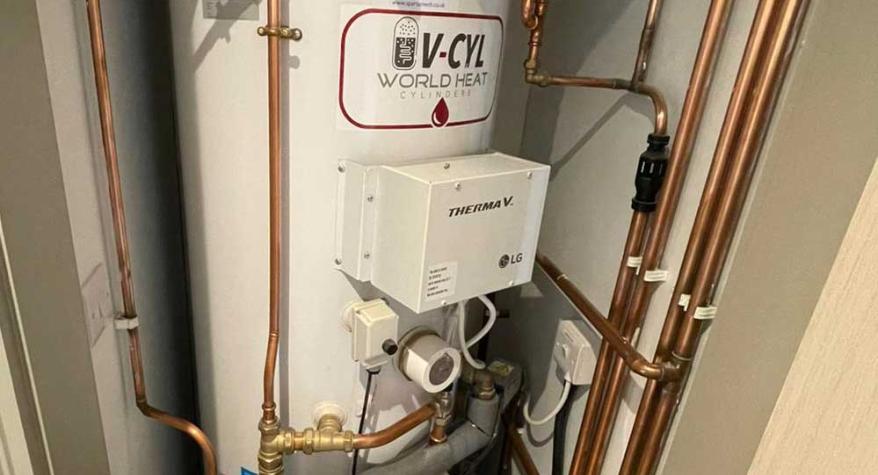
Heat pump cylinders are specifically designed with larger internal coils the heat exchanger inside the cylinder that transfers heat from the heating circuit into the stored water. A standard boiler cylinder typically has a relatively small coil, because a boiler produces water at high enough temperatures that even a small coil can transfer heat effectively.
A heat pump producing water at 45–50°C needs a significantly larger coil to transfer the same amount of heat into the cylinder in a reasonable time. If a standard boiler cylinder has been used with a heat pump, the coil is almost certainly undersized, and the result is a system that takes much longer than it should to heat the cylinder or never fully reaches the target temperature within the scheduled heat window.
If your system uses an unvented or vented cylinder that wasn’t specified as heat-pump compatible, this is worth investigating as a priority.
6. Diverter Valve or Control Sequencing Issues
The controls on a heat pump system manage the sequence between space heating and hot water production. A diverter valve or zone valve directs flow either to the heating circuit or to the hot water cylinder depending on which has priority at any given time.
If this sequencing isn’t working correctly a stuck valve, a control fault, or poorly configured priority settings the heat pump may be producing heat but not directing it to the hot water cylinder when it should be. The result can be a cylinder that never reaches temperature despite the heat pump running normally.
Signs of this include a heat pump that’s running and producing heat to the radiators correctly, but the cylinder consistently fails to reach its target temperature during the scheduled hot water window.
When It’s a Design Issue, Not a Settings Issue
Several of the causes above cylinder size, coil compatibility, control sequencing can’t be resolved through adjusting settings. They’re decisions made during system design and installation, and if they weren’t made correctly at that stage, they need to be properly assessed and addressed rather than worked around.
The most reliable way to identify whether the issue is settings-based or design-based is to have the system reviewed by someone who understands how heat pump hot water circuits are designed to work and who can look at the actual system rather than offering generic guidance.
One system we reviewed had this exact problem — a loose cylinder temperature probe was giving false readings and causing the heat pump to overheat the water unnecessarily. You can read the full details in our cylinder temperature probe fault hot water case study.
Hot water performance is often a symptom of wider system issues rather than a standalone fault. If the space heating side is also underperforming rooms not reaching temperature, the system running longer than expected it may be worth looking at how the whole system was balanced and commissioned. Our article on heat pump system balancing explains how flow distribution across the circuit affects overall performance, including the hot water side.
What to Check First If You’re Having Hot Water Problems
Before calling your installer, it’s worth noting down the following so you have a clear picture of what’s happening:
What temperature is the cylinder actually reaching during a heat cycle not the target setting, but the actual measured temperature? Most systems will show this on the controller or a connected app.
How long does the heat pump run during a hot water cycle, and does it successfully reach the target temperature within that window?
How quickly does hot water run out after the cylinder has been fully heated? This gives a useful indication of whether the issue is recovery time or total capacity.
Is the immersion heater cutting in regularly? Most modern systems allow you to see immersion heater run hours. If it’s running frequently, that’s worth understanding why.
Not Getting the Hot Water Performance You Expected?
If your heat pump system isn’t delivering reliable hot water, our Full Performance Review covers the complete hot water setup cylinder temperatures, scheduling, coil performance, control sequencing, and whether the underlying design is capable of meeting your household’s demand. You’ll receive a clear written report explaining what’s causing the issue and what needs to change.
If you’re still in the planning stage, our Pre-Installation Design & Heat Loss Review includes hot water cylinder sizing and specification as part of the assessment so the system is designed to meet your actual demand before anything is installed.
Related reading: Why Is My Heat Pump Not Working Properly? · Why Does My Heat Pump Keep Switching Between Heating and Hot Water?
You may also find Why Is My Heat Pump Not Working Properly? useful.
Why Is My Heat Pump Not Heating Hot Water Properly? (UK Guide)
A heat pump that isn’t delivering reliable hot water is one of the most noticeable and frustrating performance issues a homeowner can experience. Showers that run cold sooner than expected, a cylinder that takes hours to recover, or water that never quite reaches a comfortable temperature these are all signs that something in the hot water setup isn’t working as it should.
The tricky part is that heat pumps heat water quite differently to a gas boiler, and some of what feels like a problem is actually normal operation. But some of it genuinely isn’t and knowing the difference is what this guide is about.
How Heat Pumps Heat Water Differently to a Boiler
With a gas boiler, the hot water cylinder is heated rapidly. Water can be brought from cold to 60°C in a relatively short time, and the system can reheat quickly between uses.
A heat pump works more slowly and at lower temperatures. During normal domestic hot water production, a heat pump will typically heat the cylinder to between 45°C and 55°C and it does this gradually over a longer period, often one or two hours for a full heat cycle depending on the cylinder size and the heat pump’s output.
That slower process is by design, not a fault. A heat pump pushing water temperature up quickly would be doing so at significantly reduced efficiency, much like a car engine working hardest in first gear.
What this means practically is that if you’ve moved from a gas boiler to a heat pump, some adjustment in expectation is normal. Slightly longer recovery times and water that isn’t scalding from the tap are not automatically signs of a problem.
The question to ask is not “why is my hot water slower?” but “is my hot water actually reaching the right temperature, and is there enough of it for my household’s needs?” If the answer to either of those is no, something needs looking at.
The Most Common Reasons a Heat Pump Isn’t Heating Hot Water Properly
1. The Cylinder Target Temperature Is Set Too Low
This is one of the most frequent causes of poor hot water performance, and it’s often introduced during commissioning with good intentions usually an attempt to improve overall system efficiency.
The logic goes: lower temperatures mean better COP, so setting the hot water temperature lower should save electricity. That’s true to a point, but if the stored water temperature is too low, you don’t have enough usable hot water. Mixing valves in most UK homes are set to deliver water at around 42–45°C at the tap, which means the stored temperature needs to be meaningfully above that.
If the cylinder is only being heated to 42–45°C, by the time that water is mixed at the outlet it’s barely warm and you’ll run out of comfortable hot water very quickly.
For most households, a stored hot water temperature of around 50–55°C during normal heat pump cycles strikes the right balance between efficiency and usable hot water volume. If it’s been set lower than this, that’s the first thing worth checking.
2. The Legionella Cycle Is Interfering With Normal Operation
All heat pump systems with a hot water cylinder should run a periodic high-temperature legionella protection cycle typically heating the cylinder to 60°C or above once a week. This kills any legionella bacteria that could develop in stored water held below 60°C.
The issue arises when this cycle is either running too frequently, poorly scheduled, or relying entirely on the immersion heater to reach 60°C rather than the heat pump.
When the immersion heater runs a full legionella cycle on a large cylinder, it can use a significant amount of electricity in one session sometimes more than the heat pump uses for an entire day of space heating. If this is happening multiple times a week, or if the system is configured to use the immersion heater as a primary hot water source rather than a backup, running costs will be noticeably higher than expected and the hot water behaviour will feel unpredictable.
The legionella cycle should typically run once a week, be scheduled at an off-peak time if you’re on a time-of-use tariff, and be completed primarily by the heat pump where possible with the immersion heater as a top-up only when needed.
3. The Hot Water Schedule Doesn’t Match Your Usage Pattern
Heat pumps are much more schedule-dependent than boilers when it comes to hot water. A boiler can reheat a cylinder relatively quickly on demand. A heat pump needs time to work through a full heat cycle, so the timing of when it’s scheduled to heat water matters considerably.
Common mismatches include scheduling the hot water cycle for early morning when demand peaks in the evening, or setting a single short heating window that isn’t sufficient for the cylinder size. If the system isn’t given enough time to fully reheat the cylinder before peak demand, you’ll run out of hot water even if everything else is working correctly.
If you’re finding hot water runs out at predictable times of day, look at the schedule first. The cylinder should be fully heated to its target temperature before your household’s peak usage period.
4. The Cylinder Is Too Small for the Household
Hot water capacity is determined by cylinder size, not the heat pump’s output. A heat pump that’s performing correctly will still leave a household short of hot water if the cylinder doesn’t hold enough volume for the number of people using it.
As a rough guide, a cylinder of 200–250 litres suits a household of 3–4 people with a standard usage pattern. Larger households, frequent back-to-back showers, or properties with multiple bathrooms in regular use will typically need 250–300 litres or more.
If the cylinder was specified based on assumptions that underestimated actual household demand, no adjustment to settings will resolve it the cylinder itself is the limiting factor.
5. The Cylinder Coil Is Undersized or Incompatible
This is a design issue that’s often missed, and it has a disproportionate impact on performance.
Heat pump cylinders are specifically designed with larger internal coils the heat exchanger inside the cylinder that transfers heat from the heating circuit into the stored water. A standard boiler cylinder typically has a relatively small coil, because a boiler produces water at high enough temperatures that even a small coil can transfer heat effectively.
A heat pump producing water at 45–50°C needs a significantly larger coil to transfer the same amount of heat into the cylinder in a reasonable time. If a standard boiler cylinder has been used with a heat pump, the coil is almost certainly undersized, and the result is a system that takes much longer than it should to heat the cylinder or never fully reaches the target temperature within the scheduled heat window.
If your system uses an unvented or vented cylinder that wasn’t specified as heat-pump compatible, this is worth investigating as a priority.
6. Diverter Valve or Control Sequencing Issues
The controls on a heat pump system manage the sequence between space heating and hot water production. A diverter valve or zone valve directs flow either to the heating circuit or to the hot water cylinder depending on which has priority at any given time.
If this sequencing isn’t working correctly a stuck valve, a control fault, or poorly configured priority settings the heat pump may be producing heat but not directing it to the hot water cylinder when it should be. The result can be a cylinder that never reaches temperature despite the heat pump running normally.
Signs of this include a heat pump that’s running and producing heat to the radiators correctly, but the cylinder consistently fails to reach its target temperature during the scheduled hot water window.
When It’s a Design Issue, Not a Settings Issue
Several of the causes above cylinder size, coil compatibility, control sequencing can’t be resolved through adjusting settings. They’re decisions made during system design and installation, and if they weren’t made correctly at that stage, they need to be properly assessed and addressed rather than worked around.
The most reliable way to identify whether the issue is settings-based or design-based is to have the system reviewed by someone who understands how heat pump hot water circuits are designed to work and who can look at the actual system rather than offering generic guidance.
One system we reviewed had this exact problem — a loose cylinder temperature probe was giving false readings and causing the heat pump to overheat the water unnecessarily. You can read the full details in our cylinder temperature probe fault hot water case study.
Hot water performance is often a symptom of wider system issues rather than a standalone fault. If the space heating side is also underperforming rooms not reaching temperature, the system running longer than expected it may be worth looking at how the whole system was balanced and commissioned. Our article on heat pump system balancing explains how flow distribution across the circuit affects overall performance, including the hot water side.
What to Check First If You’re Having Hot Water Problems
Before calling your installer, it’s worth noting down the following so you have a clear picture of what’s happening:
What temperature is the cylinder actually reaching during a heat cycle not the target setting, but the actual measured temperature? Most systems will show this on the controller or a connected app.
How long does the heat pump run during a hot water cycle, and does it successfully reach the target temperature within that window?
How quickly does hot water run out after the cylinder has been fully heated? This gives a useful indication of whether the issue is recovery time or total capacity.
Is the immersion heater cutting in regularly? Most modern systems allow you to see immersion heater run hours. If it’s running frequently, that’s worth understanding why.
Not Getting the Hot Water Performance You Expected?
If your heat pump system isn’t delivering reliable hot water, our Full Performance Review covers the complete hot water setup cylinder temperatures, scheduling, coil performance, control sequencing, and whether the underlying design is capable of meeting your household’s demand. You’ll receive a clear written report explaining what’s causing the issue and what needs to change.
If you’re still in the planning stage, our Pre-Installation Design & Heat Loss Review includes hot water cylinder sizing and specification as part of the assessment so the system is designed to meet your actual demand before anything is installed.
Related reading: Why Is My Heat Pump Not Working Properly? · Why Does My Heat Pump Keep Switching Between Heating and Hot Water?
You may also find Why Is My Heat Pump Not Working Properly? useful.
Oct 17, 2026
5 min read
Replacing a Gas Boiler With a Heat Pump: What to Check First
Read More
Oct 17, 2026
5 min read
Replacing a Gas Boiler With a Heat Pump: What to Check First
Read More

Oct 16, 2026
5 min read
Heat Pump Legionella Cycle: Why It Heats to 60°C (UK Guide)
Read More
Oct 16, 2026
5 min read
Heat Pump Legionella Cycle: Why It Heats to 60°C (UK Guide)
Read More

Contact Us
Not Sure Which Service You Need?
Not Sure Which Service You Need?
Not Sure Which Service You Need?
Not Sure Which Service You Need?
Not Sure Which Service You Need?
Whether you need help with an existing heat pump, a pre-installation review, cooling advice, servicing or a room-by-room heat loss survey, send us a few details and we'll point you in the right direction.
Whether you need help with an existing heat pump, a pre-installation review, cooling advice, servicing or a room-by-room heat loss survey, send us a few details and we'll point you in the right direction.
Whether you need help with an existing heat pump, a pre-installation review, cooling advice, servicing or a room-by-room heat loss survey, send us a few details and we'll point you in the right direction.

