Do Heat Pumps Need Bigger Radiators?
Do Heat Pumps Need Bigger Radiators?
Do Heat Pumps Need Bigger Radiators?
Do Heat Pumps Need Bigger Radiators?
Do Heat Pumps Need Bigger Radiators?

UK Heat pump Help Technical Team
Independent Heat Pump Engineer
If you’re thinking about installing a heat pump, one of the most common questions is whether you’ll need to replace your radiators. You’ll often hear that heat pumps need bigger radiators but that’s only part of the story. The real answer depends on how your current system is set up and how your home loses heat. To understand why, it helps to first look at the fundamental difference in how heat pumps and boilers operate.
A gas boiler typically runs at flow temperatures of 70–80°C, delivering heat quickly to your radiators. A heat pump, by contrast, is designed to run at much lower temperatures usually around 35–50°C. Because the water circulating through the system is cooler, each radiator gives off less heat output. To deliver the same level of warmth to a room, you therefore need either greater radiator surface area, or you push the flow temperature higher which directly reduces efficiency and increases your electricity costs. Understanding your home’s heat loss is the essential starting point for answering the radiator question correctly.
Do You Always Need Bigger Radiators With a Heat Pump?
No not always. Some UK homes can have a heat pump installed without any radiator changes at all. This tends to be the case when the existing radiators were already oversized for the original boiler (fairly common in older properties that had radiators replaced over the years), when the property has low heat loss due to good insulation or a compact layout, or when the system is designed to run at a slightly higher flow temperature with that efficiency trade-off accepted from the outset. There are also homes where underfloor heating already covers part or all of the property, removing the radiator question entirely for those zones. The key issue is not a blanket rule — it is whether your specific radiators can deliver enough heat output at the lower temperatures a heat pump works at. This is precisely why a proper pre-installation heat loss review matters so much.
When Radiator Upgrades Are More Likely to Be Needed
Radiator upgrades become more likely in certain situations. If your property loses heat quickly due to solid walls, older windows or limited insulation, the demand on your radiators is higher and they may not cope at low flow temperatures. If your radiators were originally sized specifically for a high-temperature boiler which is the case in most pre-2000 UK homes they will typically be undersized for heat pump use. You can read more about how existing radiators interact with heat pump systems and what that means practically. Rooms that already struggle to stay warm in winter, even with the boiler running, are the most obvious candidates for radiator upgrades. And if your goal is to run the system as efficiently as possible keeping flow temperatures low and your electricity bills down then making sure your radiators are appropriately sized is one of the most impactful things you can do.
Why Radiator Sizing Links Directly to Heat Loss
Radiator sizing cannot be decided in isolation. Each room has a heat loss the rate at which it loses heat through its walls, windows, floor and ceiling. Your radiators need to replace that heat at whatever temperature the heat pump is running at. If they cannot, the system compensates by either running at a higher flow temperature or running for longer periods, both of which increase electricity consumption. This is why heat loss calculations are central to proper heat pump system design. Without them, you are effectively guessing and the consequences show up in your running costs and comfort.
What Happens If Radiators Are Too Small for a Heat Pump
When radiators are undersized for a heat pump system, the symptoms are usually noticeable. Rooms fail to reach temperature even when the system is running continuously. The heat pump runs constantly as it tries to meet the heating demand, which is a common issue explored in detail in our guide on heat pumps running constantly. Flow temperatures get pushed up by the system or by the engineer during setup to compensate, which reduces efficiency. Running costs end up higher than they should be, and in some cases significantly so. The heat pump unit itself is not the problem in these scenarios it is simply trying to deliver heat through emitters that are not suited to how it needs to operate. If your system is already installed and this sounds familiar, a full performance review can identify exactly where the system is being limited.
Can You Just Turn the Flow Temperature Up Instead of Upgrading Radiators?
Technically yes but it comes at a real cost. Increasing the flow temperature reduces the heat pump’s efficiency (measured as its COP, or coefficient of performance). Every degree of additional flow temperature has a direct impact on electricity consumption. Running at 55°C rather than 40°C to compensate for undersized radiators removes one of the primary benefits of using a heat pump in the first place. It can solve the comfort problem in the short term, but it creates a long-term running cost problem. The better approach is to match the radiators to the system so it can operate at the temperatures it is designed for.
What Are the Alternatives to Replacing Radiators Entirely?
If full radiator replacement is not practical or desirable, there are other approaches worth considering. Additional radiators can be added to a room to increase total output without removing the existing one. Existing single-panel radiators can often be swapped for double-panel versions using the same pipework connections, which significantly increases output for minimal disruption. Fan-assisted radiators are another option they use a small internal fan to push more heat into the room at lower flow temperatures, and can be highly effective in rooms where space for a larger radiator is limited. Underfloor heating is an option for rooms undergoing renovation. The goal in every case is the same: sufficient heat output at low flow temperatures, so the heat pump can run efficiently. The right solution depends on the room, the pipework and the overall system design.
Why Some Homeowners Say They Didn’t Need to Change Anything
You will hear people say their heat pump was installed without any radiator changes and it works perfectly well. That can genuinely be true but it is worth understanding why. In those cases, either the property has low enough heat loss that the existing radiators can keep up, or the radiators were already larger than strictly necessary for the original boiler (common in homes where radiators were upgraded over the years), or the system is running at higher flow temperatures than would be ideal for efficiency. None of these mean radiators don’t matter they mean the system has found a way to compensate. Whether that compensation is working efficiently is a separate question, and one worth asking if your running costs feel higher than expected.
Efficiency vs Comfort: An Important Distinction
A heat pump system can heat a house comfortably and still not be running as efficiently as it could. The two things are not the same. A system compensating for undersized radiators by running at higher flow temperatures is still providing warmth, but at a greater electricity cost per unit of heat delivered. Larger, properly sized radiators allow the system to run cooler, improve its COP, and reduce your electricity bills over time. If you are making decisions about radiator upgrades, it is worth thinking about this not just as a comfort question but as a long-term running cost question. The difference in annual electricity spend between a well-optimised system and a poorly optimised one can be significant as explored in our guide on how to reduce heat pump electricity bills.
What Temperature Should Radiators Run at With a Heat Pump?
The question of radiator sizing is closely connected to the question of target flow temperature. Most well-designed heat pump systems in the UK aim to run at 40–45°C under typical winter conditions, with weather compensation adjusting this automatically as outdoor temperatures drop. Whether your radiators can deliver sufficient heat at those temperatures is what determines whether upgrades are needed. For a detailed look at this, our guide on what temperature radiators should run at with a heat pump covers the topic in full.
So, Do Heat Pumps Need Bigger Radiators?
Sometimes but not always. It depends on the heat loss of the property, the size and type of existing radiators, the desired flow temperature and how the overall system is designed. When everything is matched correctly, the system works efficiently and keeps the home comfortable. When it is not matched properly, the system struggles, runs harder, and costs more to operate. Getting the radiator question right before installation not after is one of the most valuable things a homeowner can do. Our Pre-Installation Design and Heat Loss Review covers heat loss per room, radiator sizing and required flow temperatures, so you know exactly what is needed before any work begins. If your system is already installed and not performing as expected, our Fix My Heat Pump diagnostic service looks at radiator output versus demand, flow temperatures and where the system is being limited.
If you’re thinking about installing a heat pump, one of the most common questions is whether you’ll need to replace your radiators. You’ll often hear that heat pumps need bigger radiators but that’s only part of the story. The real answer depends on how your current system is set up and how your home loses heat. To understand why, it helps to first look at the fundamental difference in how heat pumps and boilers operate.
A gas boiler typically runs at flow temperatures of 70–80°C, delivering heat quickly to your radiators. A heat pump, by contrast, is designed to run at much lower temperatures usually around 35–50°C. Because the water circulating through the system is cooler, each radiator gives off less heat output. To deliver the same level of warmth to a room, you therefore need either greater radiator surface area, or you push the flow temperature higher which directly reduces efficiency and increases your electricity costs. Understanding your home’s heat loss is the essential starting point for answering the radiator question correctly.
Do You Always Need Bigger Radiators With a Heat Pump?
No not always. Some UK homes can have a heat pump installed without any radiator changes at all. This tends to be the case when the existing radiators were already oversized for the original boiler (fairly common in older properties that had radiators replaced over the years), when the property has low heat loss due to good insulation or a compact layout, or when the system is designed to run at a slightly higher flow temperature with that efficiency trade-off accepted from the outset. There are also homes where underfloor heating already covers part or all of the property, removing the radiator question entirely for those zones. The key issue is not a blanket rule — it is whether your specific radiators can deliver enough heat output at the lower temperatures a heat pump works at. This is precisely why a proper pre-installation heat loss review matters so much.
When Radiator Upgrades Are More Likely to Be Needed
Radiator upgrades become more likely in certain situations. If your property loses heat quickly due to solid walls, older windows or limited insulation, the demand on your radiators is higher and they may not cope at low flow temperatures. If your radiators were originally sized specifically for a high-temperature boiler which is the case in most pre-2000 UK homes they will typically be undersized for heat pump use. You can read more about how existing radiators interact with heat pump systems and what that means practically. Rooms that already struggle to stay warm in winter, even with the boiler running, are the most obvious candidates for radiator upgrades. And if your goal is to run the system as efficiently as possible keeping flow temperatures low and your electricity bills down then making sure your radiators are appropriately sized is one of the most impactful things you can do.
Why Radiator Sizing Links Directly to Heat Loss
Radiator sizing cannot be decided in isolation. Each room has a heat loss the rate at which it loses heat through its walls, windows, floor and ceiling. Your radiators need to replace that heat at whatever temperature the heat pump is running at. If they cannot, the system compensates by either running at a higher flow temperature or running for longer periods, both of which increase electricity consumption. This is why heat loss calculations are central to proper heat pump system design. Without them, you are effectively guessing and the consequences show up in your running costs and comfort.
What Happens If Radiators Are Too Small for a Heat Pump
When radiators are undersized for a heat pump system, the symptoms are usually noticeable. Rooms fail to reach temperature even when the system is running continuously. The heat pump runs constantly as it tries to meet the heating demand, which is a common issue explored in detail in our guide on heat pumps running constantly. Flow temperatures get pushed up by the system or by the engineer during setup to compensate, which reduces efficiency. Running costs end up higher than they should be, and in some cases significantly so. The heat pump unit itself is not the problem in these scenarios it is simply trying to deliver heat through emitters that are not suited to how it needs to operate. If your system is already installed and this sounds familiar, a full performance review can identify exactly where the system is being limited.
Can You Just Turn the Flow Temperature Up Instead of Upgrading Radiators?
Technically yes but it comes at a real cost. Increasing the flow temperature reduces the heat pump’s efficiency (measured as its COP, or coefficient of performance). Every degree of additional flow temperature has a direct impact on electricity consumption. Running at 55°C rather than 40°C to compensate for undersized radiators removes one of the primary benefits of using a heat pump in the first place. It can solve the comfort problem in the short term, but it creates a long-term running cost problem. The better approach is to match the radiators to the system so it can operate at the temperatures it is designed for.
What Are the Alternatives to Replacing Radiators Entirely?
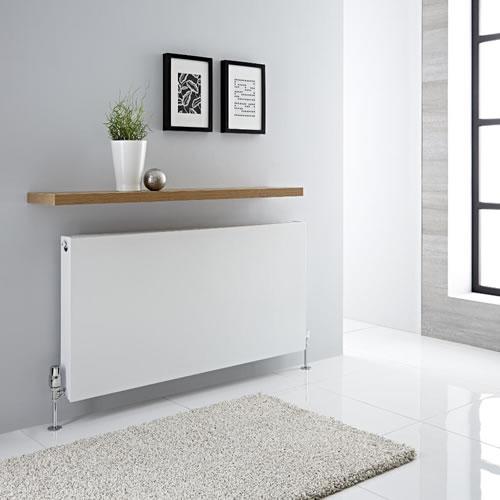
If full radiator replacement is not practical or desirable, there are other approaches worth considering. Additional radiators can be added to a room to increase total output without removing the existing one. Existing single-panel radiators can often be swapped for double-panel versions using the same pipework connections, which significantly increases output for minimal disruption. Fan-assisted radiators are another option they use a small internal fan to push more heat into the room at lower flow temperatures, and can be highly effective in rooms where space for a larger radiator is limited. Underfloor heating is an option for rooms undergoing renovation. The goal in every case is the same: sufficient heat output at low flow temperatures, so the heat pump can run efficiently. The right solution depends on the room, the pipework and the overall system design.
Why Some Homeowners Say They Didn’t Need to Change Anything
You will hear people say their heat pump was installed without any radiator changes and it works perfectly well. That can genuinely be true but it is worth understanding why. In those cases, either the property has low enough heat loss that the existing radiators can keep up, or the radiators were already larger than strictly necessary for the original boiler (common in homes where radiators were upgraded over the years), or the system is running at higher flow temperatures than would be ideal for efficiency. None of these mean radiators don’t matter they mean the system has found a way to compensate. Whether that compensation is working efficiently is a separate question, and one worth asking if your running costs feel higher than expected.
Efficiency vs Comfort: An Important Distinction
A heat pump system can heat a house comfortably and still not be running as efficiently as it could. The two things are not the same. A system compensating for undersized radiators by running at higher flow temperatures is still providing warmth, but at a greater electricity cost per unit of heat delivered. Larger, properly sized radiators allow the system to run cooler, improve its COP, and reduce your electricity bills over time. If you are making decisions about radiator upgrades, it is worth thinking about this not just as a comfort question but as a long-term running cost question. The difference in annual electricity spend between a well-optimised system and a poorly optimised one can be significant as explored in our guide on how to reduce heat pump electricity bills.
What Temperature Should Radiators Run at With a Heat Pump?
The question of radiator sizing is closely connected to the question of target flow temperature. Most well-designed heat pump systems in the UK aim to run at 40–45°C under typical winter conditions, with weather compensation adjusting this automatically as outdoor temperatures drop. Whether your radiators can deliver sufficient heat at those temperatures is what determines whether upgrades are needed. For a detailed look at this, our guide on what temperature radiators should run at with a heat pump covers the topic in full.
So, Do Heat Pumps Need Bigger Radiators?
Sometimes but not always. It depends on the heat loss of the property, the size and type of existing radiators, the desired flow temperature and how the overall system is designed. When everything is matched correctly, the system works efficiently and keeps the home comfortable. When it is not matched properly, the system struggles, runs harder, and costs more to operate. Getting the radiator question right before installation not after is one of the most valuable things a homeowner can do. Our Pre-Installation Design and Heat Loss Review covers heat loss per room, radiator sizing and required flow temperatures, so you know exactly what is needed before any work begins. If your system is already installed and not performing as expected, our Fix My Heat Pump diagnostic service looks at radiator output versus demand, flow temperatures and where the system is being limited.

Sep 30, 2026
5 min read
Best Electricity Tariffs for Heat Pump Owners in the UK
Read More
Sep 30, 2026
5 min read
Best Electricity Tariffs for Heat Pump Owners in the UK
Read More

Sep 27, 2026
5 min read
Are Heat Pumps Noisy? A UK Guide to Noise Levels and What's Normal
Read More
Sep 27, 2026
5 min read
Are Heat Pumps Noisy? A UK Guide to Noise Levels and What's Normal
Read More

Contact Us
Not Sure Which Service You Need?
Not Sure Which Service You Need?
Not Sure Which Service You Need?
Not Sure Which Service You Need?
Not Sure Which Service You Need?
Whether you need help with an existing heat pump, a pre-installation review, cooling advice, servicing or a room-by-room heat loss survey, send us a few details and we'll point you in the right direction.
Whether you need help with an existing heat pump, a pre-installation review, cooling advice, servicing or a room-by-room heat loss survey, send us a few details and we'll point you in the right direction.
Whether you need help with an existing heat pump, a pre-installation review, cooling advice, servicing or a room-by-room heat loss survey, send us a few details and we'll point you in the right direction.

