Why Does My Heat Pump Keep Turning On and Off?
Why Does My Heat Pump Keep Turning On and Off?
Why Does My Heat Pump Keep Turning On and Off?
Why Does My Heat Pump Keep Turning On and Off?
Why Does My Heat Pump Keep Turning On and Off?

UK Heat pump Help Technical Team
Independent Heat Pump Engineer
Why Does My Heat Pump Keep Turning On and Off?
If your heat pump keeps turning on and off throughout the day, it is usually a sign that the system is not running as steadily as it should be. This behaviour is commonly known as short cycling, and while a heat pump starting and stopping occasionally is completely normal, a system that is constantly switching on and off every few minutes is not operating correctly. When it happens repeatedly, short cycling affects efficiency, increases running costs, reduces comfort throughout the home, and over time can put additional stress on the system’s components. The important thing is understanding why it is happening because short cycling is almost always a symptom of something else going on within the system, rather than a fault with the heat pump unit itself.
What Exactly Is Short Cycling?
Short cycling is when a heat pump starts up, runs briefly, shuts down, and then starts again shortly afterwards repeatedly, throughout the day. Heat pumps are specifically designed to work in the opposite way: running steadily for longer periods at lower outputs, maintaining stable indoor temperatures without frequent stops and starts. This is one of the most fundamental differences between a heat pump and a traditional gas boiler, and it is why heat pump thermostat and control settings matter so much the wrong settings can force a heat pump into a cycling pattern it was never designed to follow. When the system repeatedly stops and starts, it uses more electricity during each start-up sequence, delivers uneven temperatures around the home, and puts extra mechanical stress on the compressor and other components.
What Causes a Heat Pump to Keep Turning On and Off?
There are several common causes, and in most cases more than one may be contributing at the same time. Identifying the root cause correctly rather than randomly adjusting settings is the only way to achieve a genuine, lasting improvement.
1. The heat pump is oversized for the property. This is one of the most common causes of short cycling in UK heat pump installations, and one of the most frequently overlooked. When a heat pump is too large for the actual heat loss of the property, it delivers heat faster than the house can absorb it. The system reaches the target temperature rapidly, shuts down, and then starts again shortly afterwards as the temperature drops. This creates an unstable on-off cycle that repeats throughout the day and is particularly noticeable during milder weather when heating demand is lower. An oversized heat pump will never run efficiently regardless of how the controls are set, because the fundamental mismatch between heat output and heat demand is a design problem, not a settings problem. Our guide on signs your heat pump is undersized or oversized explains what to look for and how to assess whether sizing may be the cause of your system’s behaviour.
2. Poor flow rate through the system. Heat pumps rely heavily on stable water flow to operate correctly. If the flow rate through the system is too low because of poor radiator balancing, a blocked strainer, incorrect circulation pump settings, zoning issues, or pipework restrictions the heat pump cannot move heat away from itself quickly enough. The unit overheats internally, triggers a safety shutdown, and then restarts once temperatures drop. This creates a cycling pattern that looks very similar to oversizing but has a completely different root cause and a different solution. Our article on why some heat pump systems struggle to circulate through radiators covers the most common flow-related issues in detail. Poor balancing is also one of the key topics covered in our heat pump system balancing explained guide, which is worth reading if you suspect this may be contributing to your system’s behaviour.
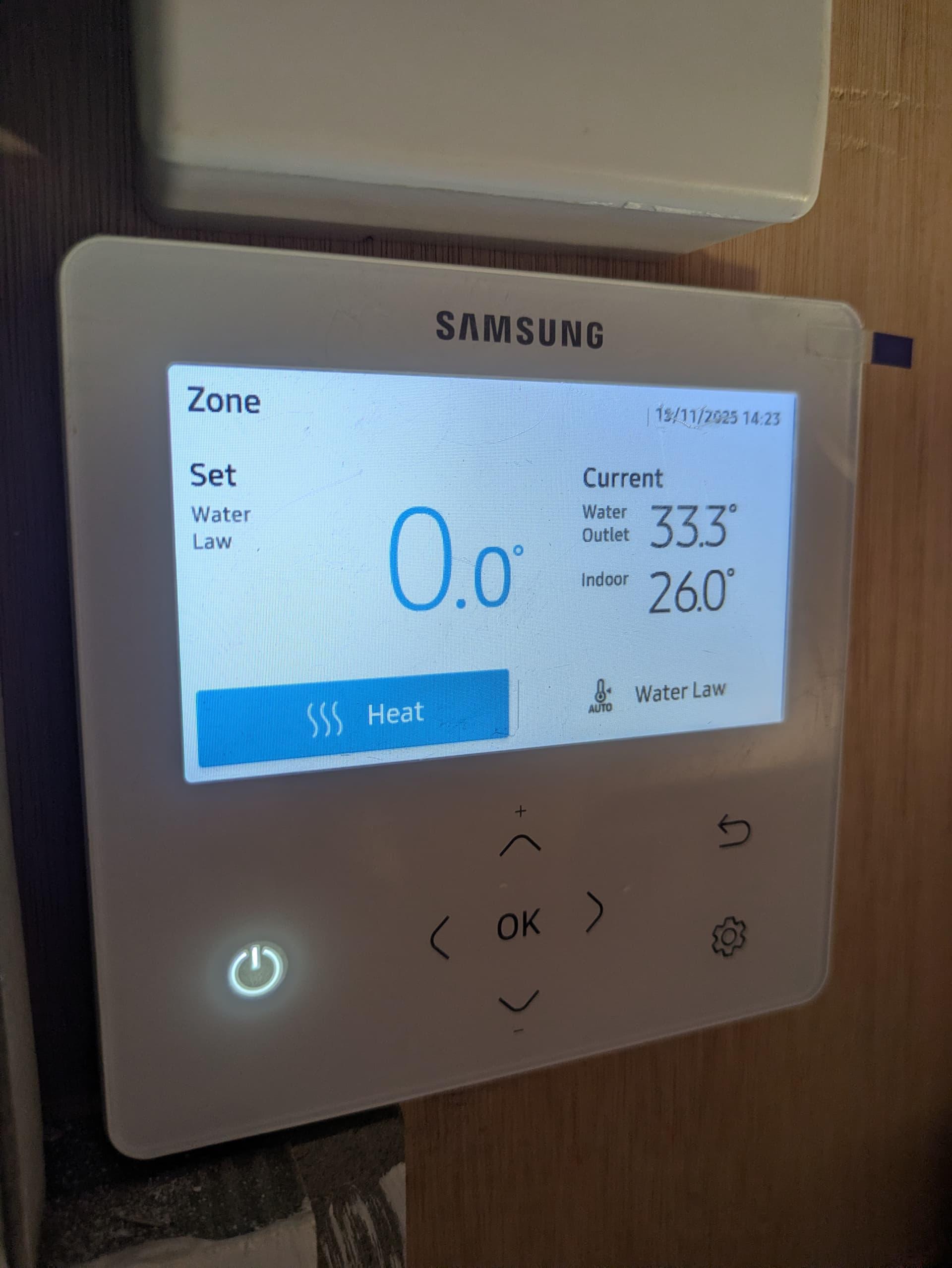
3. Incorrect thermostat or control setup. Sometimes the heat pump hardware is completely fine, but the controls are working against it. Thermostats that shut heating zones down too quickly, aggressive overnight setbacks that force rapid temperature recovery, timers that overlap and conflict with one another, or weather compensation settings that have been disabled or configured incorrectly can all push a heat pump into a cycling pattern it would not otherwise follow. This is a particularly common issue in homes where multiple thermostats and a manufacturer controller are installed without anyone properly configuring how they interact exactly the kind of problem we describe in our case study on a heat pump that seemed to have a mind of its own. Getting the controls right is one of the most impactful things you can do for system stability, and our guide on how to set a heat pump for maximum efficiency walks through the most important settings in detail.
4. Buffer tank or hydraulic layout problems. Buffer tanks are sometimes used in heat pump systems to add volume and help stabilise operation but a buffer tank that is piped incorrectly, undersized for the system, or not configured properly can actually contribute to cycling rather than preventing it. Low overall system volume, incorrect hydraulic separation between the heat pump circuit and the heating circuit, and poorly designed system layouts all create conditions where the heat pump cannot operate stably. These are typically installation-stage issues that require a proper system review to identify and correct. If your system has a buffer tank and is still short cycling, it is worth specifically reviewing how the buffer is integrated rather than assuming it is solving the problem.
5. The house is not absorbing enough heat. Sometimes the system is not able to release heat into the property efficiently enough. This can happen when radiators are undersized for the flow temperature the heat pump is running at, when rooms close down too quickly via thermostatic radiator valves, or when heating demand drops suddenly because a zone switches off. When the heat pump has nowhere to send its heat output, it shuts down and then restarts shortly afterwards as temperatures drop again. This is closely related to the oversizing problem but can also occur in correctly sized systems where radiator coverage or zoning creates temporary demand mismatches. Our article on do heat pumps need bigger radiators explains the relationship between radiator sizing and system stability in detail.
Does Short Cycling Increase Running Costs?
Yes often significantly. Heat pumps are most efficient when running steadily at low flow temperatures for extended periods. Every time the system starts up, it draws a higher current as the compressor comes up to operating speed and pressure which is less efficient than sustained running. Frequent starting and stopping therefore increases electricity consumption for the same amount of heat delivered, reduces the system’s effective COP (coefficient of performance), and creates uneven temperatures around the home that often prompt homeowners to turn flow temperatures up further compounding the cost problem. If your electricity bills are higher than expected and your system is also short cycling, the two are almost certainly connected. Our article on why your heat pump is so expensive to run covers the relationship between system behaviour and running costs in full.
Can Short Cycling Damage a Heat Pump?
Occasional cycling is completely normal and causes no harm. But constant short cycling over extended periods increases mechanical wear on the compressor which is the most expensive component in the system as well as putting additional stress on pumps and electronic controls. Over time this can reduce the overall lifespan of the system and increase the likelihood of component failures. It is worth investigating and resolving rather than accepting as normal behaviour, particularly if the system is less than five years old and should still be operating well within its design parameters.
The Key Thing Most People Miss
The heat pump unit itself is very rarely the direct cause of short cycling. In the vast majority of cases, short cycling is a symptom of system sizing, flow issues, controls configuration, or heat delivery problems elsewhere in the system. That is why randomly changing a single setting lowering the flow temperature, adjusting a thermostat, or adding a time delay rarely solves the problem permanently. The system needs to be understood properly as a whole before changes are made, and the root cause needs to be identified before any fix is applied. A heat pump that is running constantly without cycling can also be a sign of a separate but related problem and distinguishing between the two is an important part of any proper diagnostic review.
If your heat pump keeps turning on and off and you are unsure why, our Full Performance Review looks specifically at cycling behaviour, flow rates, controls and thermostats, balancing, and system setup and in most cases we can identify the root cause during the call itself. If you are planning a heat pump installation and want to make sure oversizing, flow issues, and cycling problems are designed out from the start, our Pre-Installation Design and Heat Loss Review covers heat loss, system sizing, radiator output, and hydraulic design so the system is built to run stably from day one.
Related reading: Why Does My Heat Pump Keep Turning Off?
Why Does My Heat Pump Keep Turning On and Off?
If your heat pump keeps turning on and off throughout the day, it is usually a sign that the system is not running as steadily as it should be. This behaviour is commonly known as short cycling, and while a heat pump starting and stopping occasionally is completely normal, a system that is constantly switching on and off every few minutes is not operating correctly. When it happens repeatedly, short cycling affects efficiency, increases running costs, reduces comfort throughout the home, and over time can put additional stress on the system’s components. The important thing is understanding why it is happening because short cycling is almost always a symptom of something else going on within the system, rather than a fault with the heat pump unit itself.
What Exactly Is Short Cycling?
Short cycling is when a heat pump starts up, runs briefly, shuts down, and then starts again shortly afterwards repeatedly, throughout the day. Heat pumps are specifically designed to work in the opposite way: running steadily for longer periods at lower outputs, maintaining stable indoor temperatures without frequent stops and starts. This is one of the most fundamental differences between a heat pump and a traditional gas boiler, and it is why heat pump thermostat and control settings matter so much the wrong settings can force a heat pump into a cycling pattern it was never designed to follow. When the system repeatedly stops and starts, it uses more electricity during each start-up sequence, delivers uneven temperatures around the home, and puts extra mechanical stress on the compressor and other components.
What Causes a Heat Pump to Keep Turning On and Off?
There are several common causes, and in most cases more than one may be contributing at the same time. Identifying the root cause correctly rather than randomly adjusting settings is the only way to achieve a genuine, lasting improvement.
1. The heat pump is oversized for the property. This is one of the most common causes of short cycling in UK heat pump installations, and one of the most frequently overlooked. When a heat pump is too large for the actual heat loss of the property, it delivers heat faster than the house can absorb it. The system reaches the target temperature rapidly, shuts down, and then starts again shortly afterwards as the temperature drops. This creates an unstable on-off cycle that repeats throughout the day and is particularly noticeable during milder weather when heating demand is lower. An oversized heat pump will never run efficiently regardless of how the controls are set, because the fundamental mismatch between heat output and heat demand is a design problem, not a settings problem. Our guide on signs your heat pump is undersized or oversized explains what to look for and how to assess whether sizing may be the cause of your system’s behaviour.
2. Poor flow rate through the system. Heat pumps rely heavily on stable water flow to operate correctly. If the flow rate through the system is too low because of poor radiator balancing, a blocked strainer, incorrect circulation pump settings, zoning issues, or pipework restrictions the heat pump cannot move heat away from itself quickly enough. The unit overheats internally, triggers a safety shutdown, and then restarts once temperatures drop. This creates a cycling pattern that looks very similar to oversizing but has a completely different root cause and a different solution. Our article on why some heat pump systems struggle to circulate through radiators covers the most common flow-related issues in detail. Poor balancing is also one of the key topics covered in our heat pump system balancing explained guide, which is worth reading if you suspect this may be contributing to your system’s behaviour.
3. Incorrect thermostat or control setup. Sometimes the heat pump hardware is completely fine, but the controls are working against it. Thermostats that shut heating zones down too quickly, aggressive overnight setbacks that force rapid temperature recovery, timers that overlap and conflict with one another, or weather compensation settings that have been disabled or configured incorrectly can all push a heat pump into a cycling pattern it would not otherwise follow. This is a particularly common issue in homes where multiple thermostats and a manufacturer controller are installed without anyone properly configuring how they interact exactly the kind of problem we describe in our case study on a heat pump that seemed to have a mind of its own. Getting the controls right is one of the most impactful things you can do for system stability, and our guide on how to set a heat pump for maximum efficiency walks through the most important settings in detail.
4. Buffer tank or hydraulic layout problems. Buffer tanks are sometimes used in heat pump systems to add volume and help stabilise operation but a buffer tank that is piped incorrectly, undersized for the system, or not configured properly can actually contribute to cycling rather than preventing it. Low overall system volume, incorrect hydraulic separation between the heat pump circuit and the heating circuit, and poorly designed system layouts all create conditions where the heat pump cannot operate stably. These are typically installation-stage issues that require a proper system review to identify and correct. If your system has a buffer tank and is still short cycling, it is worth specifically reviewing how the buffer is integrated rather than assuming it is solving the problem.
5. The house is not absorbing enough heat. Sometimes the system is not able to release heat into the property efficiently enough. This can happen when radiators are undersized for the flow temperature the heat pump is running at, when rooms close down too quickly via thermostatic radiator valves, or when heating demand drops suddenly because a zone switches off. When the heat pump has nowhere to send its heat output, it shuts down and then restarts shortly afterwards as temperatures drop again. This is closely related to the oversizing problem but can also occur in correctly sized systems where radiator coverage or zoning creates temporary demand mismatches. Our article on do heat pumps need bigger radiators explains the relationship between radiator sizing and system stability in detail.
Does Short Cycling Increase Running Costs?
Yes often significantly. Heat pumps are most efficient when running steadily at low flow temperatures for extended periods. Every time the system starts up, it draws a higher current as the compressor comes up to operating speed and pressure which is less efficient than sustained running. Frequent starting and stopping therefore increases electricity consumption for the same amount of heat delivered, reduces the system’s effective COP (coefficient of performance), and creates uneven temperatures around the home that often prompt homeowners to turn flow temperatures up further compounding the cost problem. If your electricity bills are higher than expected and your system is also short cycling, the two are almost certainly connected. Our article on why your heat pump is so expensive to run covers the relationship between system behaviour and running costs in full.
Can Short Cycling Damage a Heat Pump?
Occasional cycling is completely normal and causes no harm. But constant short cycling over extended periods increases mechanical wear on the compressor which is the most expensive component in the system as well as putting additional stress on pumps and electronic controls. Over time this can reduce the overall lifespan of the system and increase the likelihood of component failures. It is worth investigating and resolving rather than accepting as normal behaviour, particularly if the system is less than five years old and should still be operating well within its design parameters.
The Key Thing Most People Miss
The heat pump unit itself is very rarely the direct cause of short cycling. In the vast majority of cases, short cycling is a symptom of system sizing, flow issues, controls configuration, or heat delivery problems elsewhere in the system. That is why randomly changing a single setting lowering the flow temperature, adjusting a thermostat, or adding a time delay rarely solves the problem permanently. The system needs to be understood properly as a whole before changes are made, and the root cause needs to be identified before any fix is applied. A heat pump that is running constantly without cycling can also be a sign of a separate but related problem and distinguishing between the two is an important part of any proper diagnostic review.
If your heat pump keeps turning on and off and you are unsure why, our Full Performance Review looks specifically at cycling behaviour, flow rates, controls and thermostats, balancing, and system setup and in most cases we can identify the root cause during the call itself. If you are planning a heat pump installation and want to make sure oversizing, flow issues, and cycling problems are designed out from the start, our Pre-Installation Design and Heat Loss Review covers heat loss, system sizing, radiator output, and hydraulic design so the system is built to run stably from day one.
Related reading: Why Does My Heat Pump Keep Turning Off?
Aug 16, 2026
5 min read
Common Heat Pump Fault Codes Explained (UK Guide)
Read More
Aug 16, 2026
5 min read
Common Heat Pump Fault Codes Explained (UK Guide)
Read More

Aug 14, 2026
5 min read
Heat Pump Survey: What Should an Installer Actually Check?
Read More
Aug 14, 2026
5 min read
Heat Pump Survey: What Should an Installer Actually Check?
Read More
Recent
Common Heat Pump Fault Codes Explained (UK Guide)
Aug 16, 2026
Heat Pump Survey: What Should an Installer Actually Check?
Aug 14, 2026

What Is a Heat Loss Calculation and Why Does It Matter Before Installation?
Aug 13, 2026

Labour vs Equipment Cost: Where Does Your Heat Pump Money Go?
Aug 13, 2026

How Much Does Heat Pump Installation Cost in the UK? (2026 Guide)
Aug 12, 2026

Contact Us
Not Sure If We Can Help?
Not Sure If We Can Help?
Not Sure If We Can Help?
Not Sure If We Can Help?
Not Sure If We Can Help?
If you're unsure whether your heat pump problem can be diagnosed remotely, send us a short description of the issue and we’ll let you know if a technical review is worthwhile. No obligation.
If you're unsure whether your heat pump problem can be diagnosed remotely, send us a short description of the issue and we’ll let you know if a technical review is worthwhile. No obligation.
If you're unsure whether your heat pump problem can be diagnosed remotely, send us a short description of the issue and we’ll let you know if a technical review is worthwhile. No obligation.

