1930s House in Leeds Told Microbore Needed Replacing
1930s House in Leeds Told Microbore Needed Replacing
1930s House in Leeds Told Microbore Needed Replacing
1930s House in Leeds Told Microbore Needed Replacing
1930s House in Leeds Told Microbore Needed Replacing

UK Heat pump Help Technical Team
Independent Heat Pump Engineer
1930s House in Leeds Told Microbore Needed Replacing (£8,000+)
A homeowner in Leeds contacted us after receiving a quote telling them that their entire heating system would need to be replaced before a heat pump could be installed. The reason given was straightforward: the property had microbore pipework, and the installer had told them heat pumps simply do not work with microbore. The quote for replacing the pipework alone came to around £8,000, before any heat pump equipment or installation costs were factored in. Understandably, before committing to that level of disruption and expense, the homeowner wanted an independent opinion on whether the work was genuinely necessary. This is exactly the kind of situation our Pre-Installation Design and Heat Loss Review is designed for.
Looking at the Existing System Properly
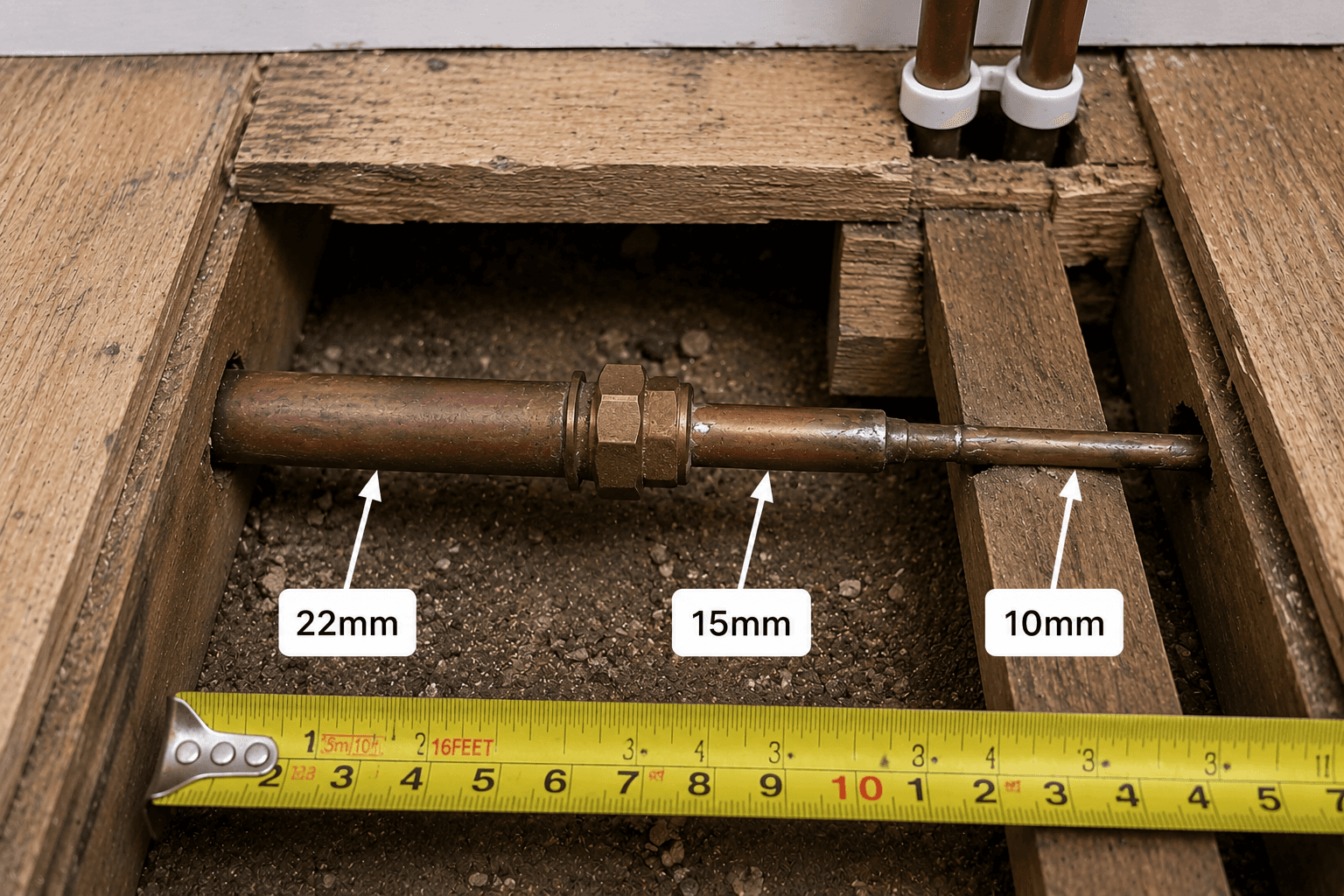
Rather than accepting the assumption that the system would not work, we asked the homeowner to lift a few floorboards so we could understand how the pipework had actually been installed across the property. This is a step that is often skipped when quotes are produced quickly and the conclusion has already been decided. What the inspection showed was important. The property was not fully microbore throughout. The main runs used 22mm pipework, branch pipework was 15mm, and the short microbore sections were confined to the connections closest to the radiators themselves. This is a very different situation from a property with long manifold-style microbore runs throughout every circuit which genuinely can create flow restriction problems for a heat pump system. Understanding the actual pipework layout, rather than assuming the worst from the property's age, changed the picture considerably. Our article on do heat pumps work with old radiators and our guide on heat loss in a house and why it matters for heat pumps both explain why existing system conditions need to be assessed properly rather than generalised.
Checking How the System Was Actually Performing
With the existing gas boiler running, we measured the Delta T the temperature difference between the flow and return across radiators throughout the property. We generally found differences of around 4°C or less. That is a useful indicator of how the system is actually moving water. A low Delta T in a system running at boiler temperatures suggests that flow rates are healthy and water is circulating well which in turn suggests that the pipework layout is not creating the kind of severe restriction that would prevent a heat pump from operating. If the system had been genuinely strangled by its pipework, we would have expected to see much higher Delta T readings as the water gave up heat quickly through restricted routes. Our article on what Delta T is on a heat pump system and why it matters explains this measurement in practical terms.
Something Else Worth Noting
While reviewing the proposed design that had accompanied the quote, we noticed that the installer had specified 55°C flow temperatures. Running a heat pump at 55°C is possible, but it significantly reduces efficiency compared to operating at 45°C or below, and it can sometimes be used whether intentionally or not to compensate for a system that has not been properly assessed. A higher flow temperature makes it easier for undersized radiators or restrictive pipework to deliver adequate heat, but it comes at a cost to the COP of the system and therefore to the homeowner's electricity bills over the long term. After reviewing the room sizes, insulation assumptions, heat loss figures, and existing radiator outputs, we felt there was a better path available. Our guide on what flow temperature a heat pump should run at and our article on do heat pumps need bigger radiators give more context on how flow temperature and emitter sizing interact.
Our Recommendation
Rather than replacing the entire heating system, we recommended running the heat pump at approximately 45°C flow temperature, retaining most of the existing pipework and radiators, and re-piping only the living room and dining room radiators using 15mm pipework. Conveniently, both of those radiators backed directly onto the airing cupboard, which made the work straightforward and limited the disruption considerably. Instead of lifting floors across the entire house, only the circuits most likely to struggle at lower flow temperatures needed attention. The rest of the system properly assessed rather than assumed to be unsuitable could remain in place.
Outcome
The homeowner avoided the full system replacement they had been quoted. Instead of a £8,000 pipework job before installation had even started, targeted re-piping of two radiators resolved the genuine concern about flow at lower temperatures. The decision was based on actual measurements of how the system was performing, not on a general assumption about what 1930s microbore pipework looks like. This case is a clear example of why proper assessment before installation matters and why an independent opinion before committing to significant expenditure can be worthwhile. Our Full Performance Review and pre-installation service both start from actual system evidence rather than generalised assumptions about property type or pipework age. A related case worth reading is our house not reaching temperature due to incorrect heat loss and undersized radiators, which shows what can happen when system design assumptions are not checked properly before installation proceeds.
1930s House in Leeds Told Microbore Needed Replacing (£8,000+)
A homeowner in Leeds contacted us after receiving a quote telling them that their entire heating system would need to be replaced before a heat pump could be installed. The reason given was straightforward: the property had microbore pipework, and the installer had told them heat pumps simply do not work with microbore. The quote for replacing the pipework alone came to around £8,000, before any heat pump equipment or installation costs were factored in. Understandably, before committing to that level of disruption and expense, the homeowner wanted an independent opinion on whether the work was genuinely necessary. This is exactly the kind of situation our Pre-Installation Design and Heat Loss Review is designed for.
Looking at the Existing System Properly
Rather than accepting the assumption that the system would not work, we asked the homeowner to lift a few floorboards so we could understand how the pipework had actually been installed across the property. This is a step that is often skipped when quotes are produced quickly and the conclusion has already been decided. What the inspection showed was important. The property was not fully microbore throughout. The main runs used 22mm pipework, branch pipework was 15mm, and the short microbore sections were confined to the connections closest to the radiators themselves. This is a very different situation from a property with long manifold-style microbore runs throughout every circuit which genuinely can create flow restriction problems for a heat pump system. Understanding the actual pipework layout, rather than assuming the worst from the property's age, changed the picture considerably. Our article on do heat pumps work with old radiators and our guide on heat loss in a house and why it matters for heat pumps both explain why existing system conditions need to be assessed properly rather than generalised.
Checking How the System Was Actually Performing
With the existing gas boiler running, we measured the Delta T the temperature difference between the flow and return across radiators throughout the property. We generally found differences of around 4°C or less. That is a useful indicator of how the system is actually moving water. A low Delta T in a system running at boiler temperatures suggests that flow rates are healthy and water is circulating well which in turn suggests that the pipework layout is not creating the kind of severe restriction that would prevent a heat pump from operating. If the system had been genuinely strangled by its pipework, we would have expected to see much higher Delta T readings as the water gave up heat quickly through restricted routes. Our article on what Delta T is on a heat pump system and why it matters explains this measurement in practical terms.
Something Else Worth Noting
While reviewing the proposed design that had accompanied the quote, we noticed that the installer had specified 55°C flow temperatures. Running a heat pump at 55°C is possible, but it significantly reduces efficiency compared to operating at 45°C or below, and it can sometimes be used whether intentionally or not to compensate for a system that has not been properly assessed. A higher flow temperature makes it easier for undersized radiators or restrictive pipework to deliver adequate heat, but it comes at a cost to the COP of the system and therefore to the homeowner's electricity bills over the long term. After reviewing the room sizes, insulation assumptions, heat loss figures, and existing radiator outputs, we felt there was a better path available. Our guide on what flow temperature a heat pump should run at and our article on do heat pumps need bigger radiators give more context on how flow temperature and emitter sizing interact.
Our Recommendation
Rather than replacing the entire heating system, we recommended running the heat pump at approximately 45°C flow temperature, retaining most of the existing pipework and radiators, and re-piping only the living room and dining room radiators using 15mm pipework. Conveniently, both of those radiators backed directly onto the airing cupboard, which made the work straightforward and limited the disruption considerably. Instead of lifting floors across the entire house, only the circuits most likely to struggle at lower flow temperatures needed attention. The rest of the system properly assessed rather than assumed to be unsuitable could remain in place.
Outcome
The homeowner avoided the full system replacement they had been quoted. Instead of a £8,000 pipework job before installation had even started, targeted re-piping of two radiators resolved the genuine concern about flow at lower temperatures. The decision was based on actual measurements of how the system was performing, not on a general assumption about what 1930s microbore pipework looks like. This case is a clear example of why proper assessment before installation matters and why an independent opinion before committing to significant expenditure can be worthwhile. Our Full Performance Review and pre-installation service both start from actual system evidence rather than generalised assumptions about property type or pipework age. A related case worth reading is our house not reaching temperature due to incorrect heat loss and undersized radiators, which shows what can happen when system design assumptions are not checked properly before installation proceeds.

Contact Us
Not Sure Which Service You Need?
Not Sure Which Service You Need?
Not Sure Which Service You Need?
Not Sure Which Service You Need?
Not Sure Which Service You Need?
Whether you need help with an existing heat pump, a pre-installation review, cooling advice, servicing or a room-by-room heat loss survey, send us a few details and we'll point you in the right direction.
Whether you need help with an existing heat pump, a pre-installation review, cooling advice, servicing or a room-by-room heat loss survey, send us a few details and we'll point you in the right direction.
Whether you need help with an existing heat pump, a pre-installation review, cooling advice, servicing or a room-by-room heat loss survey, send us a few details and we'll point you in the right direction.

