How to Set Weather Compensation on a Heat Pump (UK Guide)
How to Set Weather Compensation on a Heat Pump (UK Guide)
How to Set Weather Compensation on a Heat Pump (UK Guide)
How to Set Weather Compensation on a Heat Pump (UK Guide)
How to Set Weather Compensation on a Heat Pump (UK Guide)

UK Heat pump Help Technical Team
Independent Heat Pump Engineer
Weather compensation is probably the single most impactful setting on any heat pump system — and it is the one we see misconfigured most often. Across the hundreds of systems we have reviewed, roughly seven out of ten have weather compensation settings that are either too aggressive, too flat, or switched off entirely.
This guide explains what weather compensation actually does, how to check whether yours is set correctly, and how to adjust it based on what your home is telling you.
What does weather compensation do on a heat pump?
In simple terms, weather compensation adjusts the temperature of the water your heat pump sends to the radiators (the flow temperature) based on how cold it is outside.
When the outdoor temperature drops, your home loses heat faster, so the system increases the flow temperature to compensate. When it is mild outside, the flow temperature drops because less heat is needed.
Without weather compensation, your heat pump would run at a fixed flow temperature regardless of the weather say 50°C whether it is 12°C outside or minus 2. That means in mild autumn weather, the system massively overheats the water, the room thermostat constantly shuts the system on and off, and efficiency drops considerably.
With weather compensation working correctly, the heat pump runs at a lower, steadier output for longer periods. That is how heat pumps are designed to operate and it is where the real efficiency gains come from. For every 1°C you can reduce the average flow temperature, the system’s coefficient of performance (COP) improves by roughly 1.5 to 2.5 per cent. Over a full heating season, the difference between a well-set curve and a poorly-set one can be 15 to 25 per cent on your electricity bill.
The heating curve explained
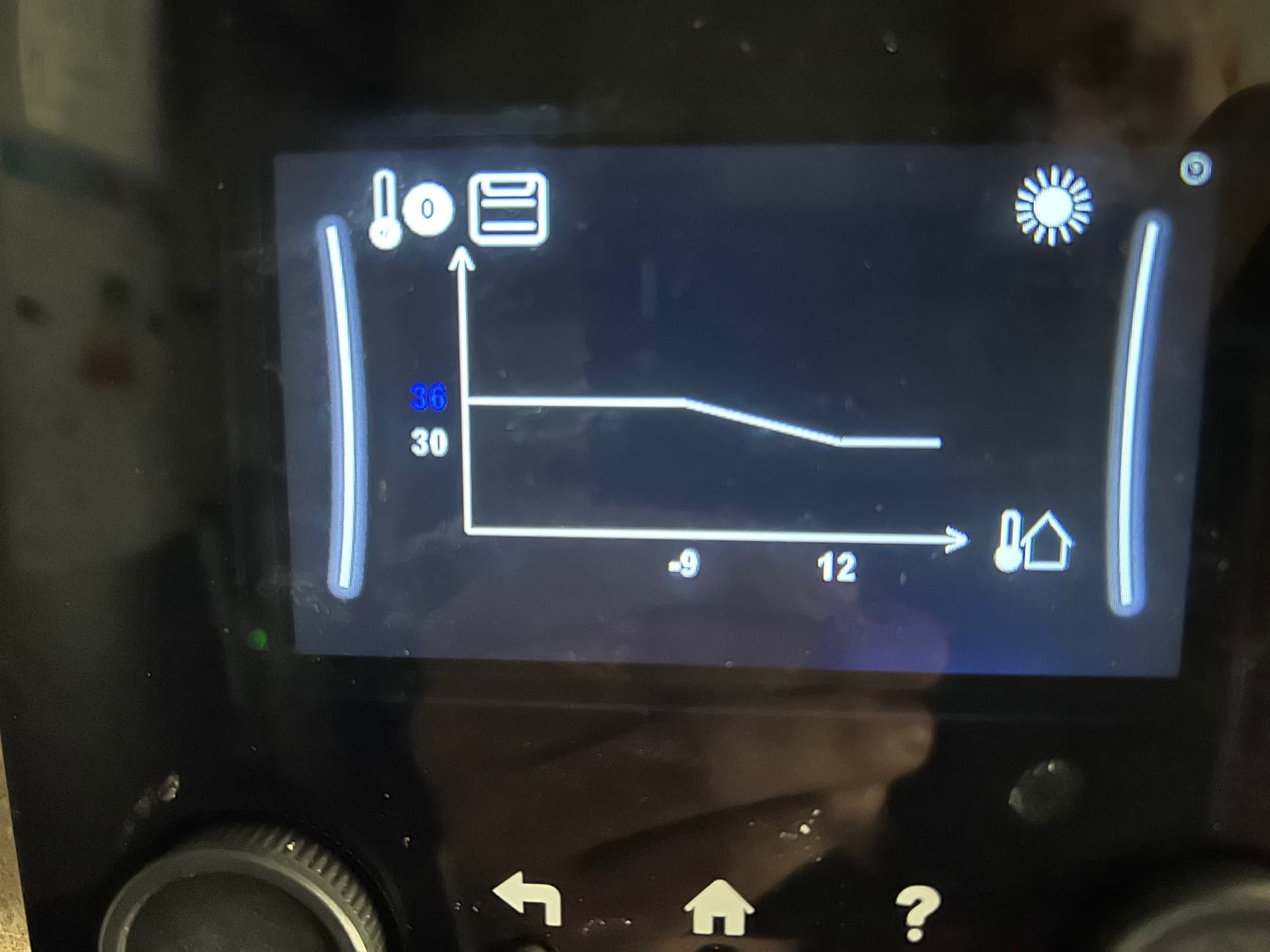
The heating curve is a line on a graph. The horizontal axis is outdoor temperature. The vertical axis is flow temperature. As the outdoor temperature falls from right to left, the flow temperature rises.
Most UK heat pump controllers whether Vaillant, Mitsubishi, Daikin, Samsung, or NIBE — allow you to adjust two things:
The slope (gradient): This controls how steeply the flow temperature rises as it gets colder. A steeper slope means the system ramps up faster. A flatter slope means it stays lower for longer.
The offset (parallel shift): This shifts the entire curve up or down by a fixed amount. Increasing the offset raises all flow temperatures across the range. Decreasing it lowers them all.
For most UK homes with radiators, a reasonable starting point is a curve that delivers around 35 to 38°C at an outdoor temperature of 10°C and around 45 to 50°C at minus 2°C. Homes with underfloor heating can run significantly lower typically 28 to 35°C across the same range.
These are starting points only. Your specific curve depends on your home’s insulation level, radiator sizing, and the heat pump model.
How to check if your weather compensation is working
Before adjusting anything, it is worth confirming weather compensation is actually active. On some systems we review, it has been disabled at commissioning sometimes deliberately, sometimes by accident.
Check your controller for a setting called “weather compensation,” “heating curve,” or “outdoor reset.” On Vaillant systems, look for the weather-compensated mode in the control menu. On Mitsubishi Ecodan, check that the outdoor sensor is enabled and the flow temperature is set to “auto” rather than a fixed value.
If you are seeing a fixed flow temperature that never changes regardless of the weather, weather compensation is likely off.
A quick real-world test: check your flow temperature on a mild day (say 10°C outside) and then on a cold day (say 2°C). If the flow temperature is the same on both days, the curve is not active.
Adjusting the curve based on how your home responds
This is where most homeowners and installers get stuck. The key principle is this: make one small change, then wait 24 to 48 hours before making another. Weather compensation is not something you can fine-tune in an afternoon it needs time to settle, ideally across a range of outdoor temperatures.
If your home is not reaching the set temperature in cold weather, the curve is too flat. Increase the slope by one increment. Do not jump several steps at once.
If your home overshoots and rooms feel stuffy, the curve is too steep. Reduce the slope by one increment.
If the home is consistently a degree or two cold across all weather conditions, the curve shape might be right but the offset needs raising. Shift the entire curve up by one or two degrees.
If the heat pump is cycling on and off frequently rather than running steadily, the curve is likely too high for the current outdoor temperature. The system is overshooting, the thermostat cuts it off, and then it restarts when the temperature drops again. This is one of the most common problems we identify and it usually points to a curve that was set too aggressively at commissioning.
Common mistakes we see in UK installations
Setting the curve during mild weather and never revisiting it. An installer commissions the system in October at 12°C outside. The curve works fine. Then January arrives at minus 2°C and the house cannot maintain temperature because the curve was never tested at the cold end.
Disabling weather compensation and fixing the flow temperature at 55°C. This happens more often than it should. The system heats the house, but it runs inefficiently and the electricity bills are 20 to 30 per cent higher than they need to be.
Thermostat set too low, fighting the weather compensation. If the room thermostat is set at 19°C but the weather compensation curve is designed for 21°C, the thermostat constantly interrupts the system. Weather compensation works best when the thermostat is set as a safety limit, not the primary control.
TRVs turned down in multiple rooms, restricting flow. When radiator valves are closed in several rooms, the flow rate drops, the heat pump struggles, and the curve cannot do its job. Check that TRVs are open in rooms that need heating.
What we look for during a review
When we assess weather compensation as part of a system review, we look at the current curve settings against your property’s heat loss, the flow temperature at different outdoor temperatures, how long the system runs versus how often it cycles, and whether the thermostat and curve are working together or against each other.
In many cases, adjusting the curve is the single most effective change we can recommend it costs nothing, requires no new hardware, and can meaningfully reduce running costs within days.
Not sure if your settings are right?
If your heat pump is costing more than you expected, or your home never quite feels comfortable, the weather compensation curve is one of the first things worth checking. We can review your current settings remotely and provide specific recommendations based on your system, your property, and your actual performance data.
Related reading: What Does Weather Compensation Actually Do?
Weather compensation is probably the single most impactful setting on any heat pump system — and it is the one we see misconfigured most often. Across the hundreds of systems we have reviewed, roughly seven out of ten have weather compensation settings that are either too aggressive, too flat, or switched off entirely.
This guide explains what weather compensation actually does, how to check whether yours is set correctly, and how to adjust it based on what your home is telling you.
What does weather compensation do on a heat pump?
In simple terms, weather compensation adjusts the temperature of the water your heat pump sends to the radiators (the flow temperature) based on how cold it is outside.
When the outdoor temperature drops, your home loses heat faster, so the system increases the flow temperature to compensate. When it is mild outside, the flow temperature drops because less heat is needed.
Without weather compensation, your heat pump would run at a fixed flow temperature regardless of the weather say 50°C whether it is 12°C outside or minus 2. That means in mild autumn weather, the system massively overheats the water, the room thermostat constantly shuts the system on and off, and efficiency drops considerably.
With weather compensation working correctly, the heat pump runs at a lower, steadier output for longer periods. That is how heat pumps are designed to operate and it is where the real efficiency gains come from. For every 1°C you can reduce the average flow temperature, the system’s coefficient of performance (COP) improves by roughly 1.5 to 2.5 per cent. Over a full heating season, the difference between a well-set curve and a poorly-set one can be 15 to 25 per cent on your electricity bill.
The heating curve explained
The heating curve is a line on a graph. The horizontal axis is outdoor temperature. The vertical axis is flow temperature. As the outdoor temperature falls from right to left, the flow temperature rises.
Most UK heat pump controllers whether Vaillant, Mitsubishi, Daikin, Samsung, or NIBE — allow you to adjust two things:
The slope (gradient): This controls how steeply the flow temperature rises as it gets colder. A steeper slope means the system ramps up faster. A flatter slope means it stays lower for longer.
The offset (parallel shift): This shifts the entire curve up or down by a fixed amount. Increasing the offset raises all flow temperatures across the range. Decreasing it lowers them all.
For most UK homes with radiators, a reasonable starting point is a curve that delivers around 35 to 38°C at an outdoor temperature of 10°C and around 45 to 50°C at minus 2°C. Homes with underfloor heating can run significantly lower typically 28 to 35°C across the same range.
These are starting points only. Your specific curve depends on your home’s insulation level, radiator sizing, and the heat pump model.
How to check if your weather compensation is working
Before adjusting anything, it is worth confirming weather compensation is actually active. On some systems we review, it has been disabled at commissioning sometimes deliberately, sometimes by accident.
Check your controller for a setting called “weather compensation,” “heating curve,” or “outdoor reset.” On Vaillant systems, look for the weather-compensated mode in the control menu. On Mitsubishi Ecodan, check that the outdoor sensor is enabled and the flow temperature is set to “auto” rather than a fixed value.
If you are seeing a fixed flow temperature that never changes regardless of the weather, weather compensation is likely off.
A quick real-world test: check your flow temperature on a mild day (say 10°C outside) and then on a cold day (say 2°C). If the flow temperature is the same on both days, the curve is not active.
Adjusting the curve based on how your home responds
This is where most homeowners and installers get stuck. The key principle is this: make one small change, then wait 24 to 48 hours before making another. Weather compensation is not something you can fine-tune in an afternoon it needs time to settle, ideally across a range of outdoor temperatures.
If your home is not reaching the set temperature in cold weather, the curve is too flat. Increase the slope by one increment. Do not jump several steps at once.
If your home overshoots and rooms feel stuffy, the curve is too steep. Reduce the slope by one increment.
If the home is consistently a degree or two cold across all weather conditions, the curve shape might be right but the offset needs raising. Shift the entire curve up by one or two degrees.
If the heat pump is cycling on and off frequently rather than running steadily, the curve is likely too high for the current outdoor temperature. The system is overshooting, the thermostat cuts it off, and then it restarts when the temperature drops again. This is one of the most common problems we identify and it usually points to a curve that was set too aggressively at commissioning.
Common mistakes we see in UK installations
Setting the curve during mild weather and never revisiting it. An installer commissions the system in October at 12°C outside. The curve works fine. Then January arrives at minus 2°C and the house cannot maintain temperature because the curve was never tested at the cold end.
Disabling weather compensation and fixing the flow temperature at 55°C. This happens more often than it should. The system heats the house, but it runs inefficiently and the electricity bills are 20 to 30 per cent higher than they need to be.
Thermostat set too low, fighting the weather compensation. If the room thermostat is set at 19°C but the weather compensation curve is designed for 21°C, the thermostat constantly interrupts the system. Weather compensation works best when the thermostat is set as a safety limit, not the primary control.
TRVs turned down in multiple rooms, restricting flow. When radiator valves are closed in several rooms, the flow rate drops, the heat pump struggles, and the curve cannot do its job. Check that TRVs are open in rooms that need heating.
What we look for during a review
When we assess weather compensation as part of a system review, we look at the current curve settings against your property’s heat loss, the flow temperature at different outdoor temperatures, how long the system runs versus how often it cycles, and whether the thermostat and curve are working together or against each other.
In many cases, adjusting the curve is the single most effective change we can recommend it costs nothing, requires no new hardware, and can meaningfully reduce running costs within days.
Not sure if your settings are right?
If your heat pump is costing more than you expected, or your home never quite feels comfortable, the weather compensation curve is one of the first things worth checking. We can review your current settings remotely and provide specific recommendations based on your system, your property, and your actual performance data.
Related reading: What Does Weather Compensation Actually Do?

Sep 30, 2026
5 min read
Best Electricity Tariffs for Heat Pump Owners in the UK
Read More
Sep 30, 2026
5 min read
Best Electricity Tariffs for Heat Pump Owners in the UK
Read More

Sep 27, 2026
5 min read
Are Heat Pumps Noisy? A UK Guide to Noise Levels and What's Normal
Read More
Sep 27, 2026
5 min read
Are Heat Pumps Noisy? A UK Guide to Noise Levels and What's Normal
Read More

Contact Us
Not Sure Which Service You Need?
Not Sure Which Service You Need?
Not Sure Which Service You Need?
Not Sure Which Service You Need?
Not Sure Which Service You Need?
Whether you need help with an existing heat pump, a pre-installation review, cooling advice, servicing or a room-by-room heat loss survey, send us a few details and we'll point you in the right direction.
Whether you need help with an existing heat pump, a pre-installation review, cooling advice, servicing or a room-by-room heat loss survey, send us a few details and we'll point you in the right direction.
Whether you need help with an existing heat pump, a pre-installation review, cooling advice, servicing or a room-by-room heat loss survey, send us a few details and we'll point you in the right direction.

