LG CH10 Error Code Explained
LG CH10 Error Code Explained
LG CH10 Error Code Explained
LG CH10 Error Code Explained
LG CH10 Error Code Explained

UK Heat pump Help Technical Team
Independent Heat Pump Engineer
What Does the LG CH10 Fault Code Mean?
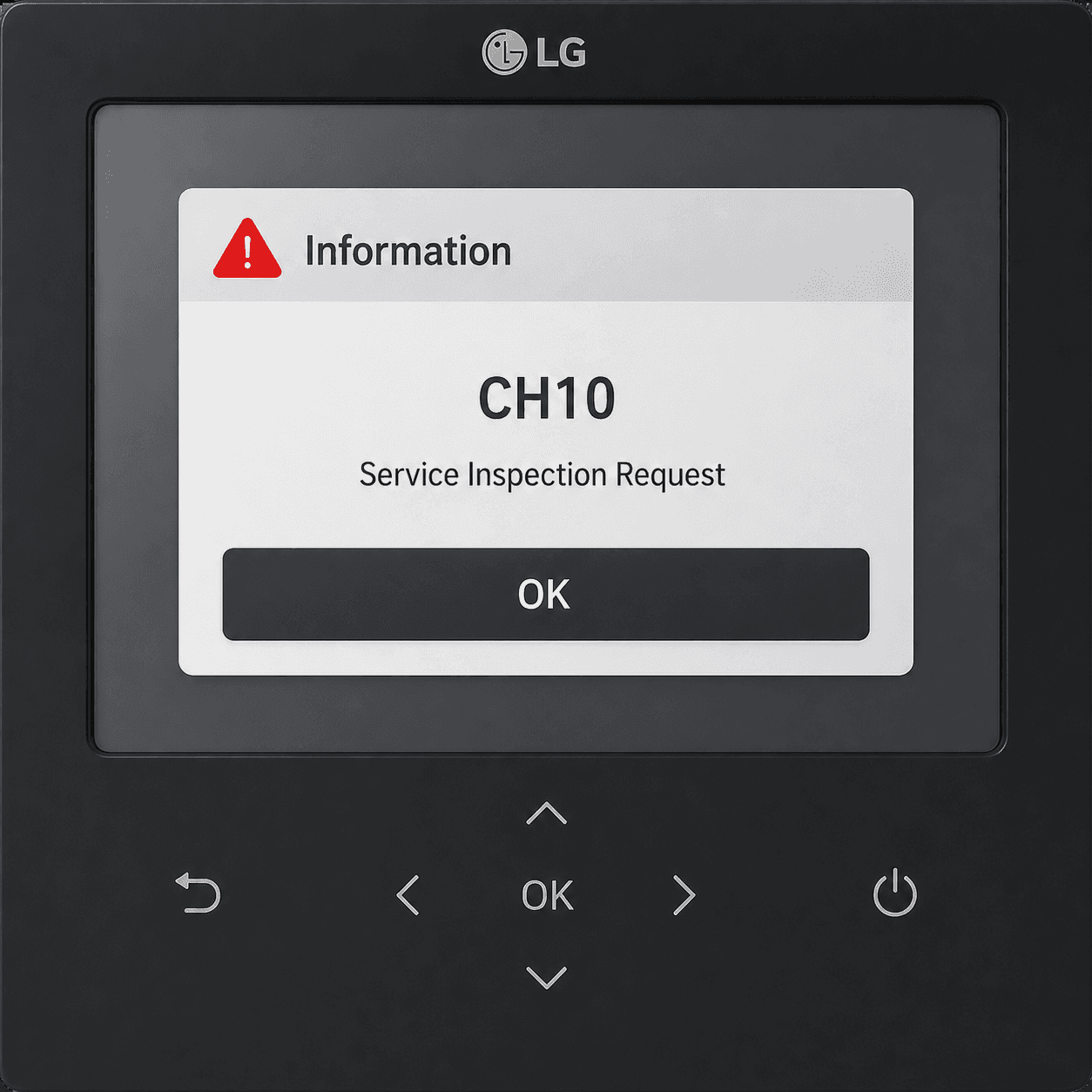
If your LG heat pump is displaying a CH10 fault code, it is completely understandable to feel worried. A fault code on a heating system especially in cold weather immediately raises questions about cost, downtime and whether something serious has gone wrong. The reality is that CH10 is one of the most commonly reported fault codes we see on LG heat pump systems across the UK, and in a significant number of cases it can be cleared without any parts being replaced at all.
CH10 on an LG heat pump is associated with the outdoor fan motor or outdoor fan operation. The heat pump’s control system continuously monitors the outdoor fan to confirm it is running correctly and within expected parameters. If the fan fails to start when it should, stops unexpectedly during operation, or the control board detects an anomaly in the fan’s behaviour, the heat pump will lock itself out as a protective measure and display the CH10 code on the controller.
This protective behaviour is intentional. The outdoor fan plays a critical role in how the heat pump extracts heat from the outside air. When the system cannot confirm the fan is running correctly, it shuts down rather than risk operating in a way that could cause further damage. The fault code is the system telling you something unexpected happened with the fan it is not necessarily telling you the fan motor has failed permanently.
Understanding this distinction matters, because it explains why a simple reset often resolves the fault entirely. Modern LG heat pump systems contain multiple control boards, sensors and communication pathways operating simultaneously. A temporary signal dropout, a brief power fluctuation, a communication glitch between boards, or a momentary condition that the system did not expect can all cause the heat pump to lock out and display CH10 even when no component has actually failed. When the system restarts from scratch, it rechecks all conditions and if nothing has actually failed, it runs normally.
Step One — How to Reset Your LG Heat Pump Correctly
Before doing anything else, and certainly before calling an engineer, carry out a full power reset. This is not the same as pressing a reset button on the controller. A controller reset does not force all the control boards to fully power down and restart, which is what is needed to properly clear a fault like CH10. You need to cut power to the entire system at the electrical isolator.
Here is exactly how to do it:
Step 1: Find the electrical isolator for your heat pump. This is typically a dedicated isolator switch mounted on the wall close to the outdoor unit, or it may be a circuit breaker in your consumer unit labelled for the heat pump. If you are not sure which circuit supplies the heat pump, your installation documents or commissioning sheet should show this. If you cannot identify it, do not proceed contact an electrician.
Step 2: Turn the isolator completely off. The heat pump, controller and any associated equipment should all lose power.
Step 3: Wait at least 30 seconds. Ten seconds is the minimum but waiting longer does no harm. Thirty seconds ensures all capacitors in the control boards have fully discharged and the system has completely powered down rather than just briefly interrupted.
Step 4: Turn the power back on. The heat pump will begin its startup sequence.
Step 5: Allow the system to fully reboot before doing anything else. LG heat pumps go through a startup sequence that can take several minutes. The controller may show a loading state or display information during this period. Do not interrupt it or make any changes to settings while it is booting.
Step 6: Check that your hot water schedule and heating schedule are still active. Occasionally a full power reset can cause schedules to revert or need re-enabling, depending on your controller setup.
In many cases the CH10 fault will have cleared at this point and your system will return to normal operation. If it does clear, monitor the system over the next 24 to 48 hours. If it does not return, the fault was most likely a temporary lockout rather than a component failure.
H2: Why Does a Reset Sometimes Solve a CH10 Fault?
This is a reasonable question and worth understanding properly. It can feel unsatisfying to reset a system and have it simply work again, with no clear explanation of what caused the fault in the first place.
The short answer is that LG heat pumps like all modern heat pump systems are complex electronic systems with multiple boards communicating continuously. Any one of a number of transient conditions can cause a control board to log a fault and lock out the system, even when the underlying hardware is completely fine. A brief voltage dip during a cold start, a momentary delay in the fan reaching operating speed, a single missed communication frame between boards, an external temperature or sensor reading that briefly exceeded expected parameters all of these can trigger a protective lockout without representing a real fault.
The same principle applies across many heat pump brands and models. If you are familiar with what causes a heat pump to keep losing pressure or why a heat pump might be fine in autumn but struggle in winter, you will recognise that heat pump faults often reflect the system responding to external or circumstantial conditions rather than a component that has broken.
H2: What to Check Around the Outdoor Unit Before Calling an Engineer
While the reset is running or if the fault returns, there are several things you can check yourself around the outdoor unit that may explain a CH10 fault and that do not require any technical knowledge or tools.
Check that the outdoor unit has adequate clearance on all sides and that nothing is obstructing the fan. Overgrown shrubs, climbing plants, garden furniture, or debris that has blown against the unit during wind can all obstruct the fan blades or restrict the airflow the unit needs. The fan needs clear space to draw air in and discharge it if that space is blocked, the fan may struggle to start or maintain speed, triggering the fault.
Check that the fan grille on the top or front of the outdoor unit is clear. Leaves, dirt, seed heads and other debris can accumulate on the grille and restrict airflow significantly without being immediately obvious. In autumn and winter this is particularly common.
Check that the outdoor unit is not completely iced over. Some frost on the outdoor unit during cold weather is entirely normal the heat pump has a defrost cycle specifically for this. However, if the unit has become heavily iced due to a defrost failure or other issue, the fan may be physically unable to turn, which would explain a CH10 fault. If you can see the fan blades through the grille, check whether they appear to be blocked by ice.
If you notice the fan not spinning at all when the heat pump is calling for heating or hot water, that is useful diagnostic information to share with an engineer. If you can hear the compressor running but the fan is stationary, this points more directly toward a fan motor issue rather than a transient fault. If you are not sure whether the compressor is running, it typically makes a low hum or vibration from the outdoor unit while operating.
H2: If the CH10 Fault Keeps Coming Back
If the CH10 fault returns shortly after resetting whether within minutes, hours or after a few cycles it means there is an underlying cause that needs to be investigated properly. Repeatedly resetting the system without identifying and addressing the cause is unlikely to resolve it and in some situations can make it harder to diagnose, because the system does not accumulate the fault history that would help an engineer understand the pattern.
A recurring CH10 fault on an LG heat pump has a number of potential causes. The outdoor fan motor may be failing. Electric motors degrade over time and a fan motor that is developing a fault may start and run normally sometimes but fail under certain conditions particularly cold starts, or when it has been running for a period and the windings heat up. An intermittent fault like this can be difficult to reproduce during a diagnostic visit but typically shows a progressive pattern of increasing frequency over time.
Wiring faults and loose electrical connections are another common cause of intermittent faults. Vibration from the outdoor unit over months and years can gradually loosen terminals and connectors. A connection that is 95% intact can pass current normally under most conditions but lose contact just enough under vibration or thermal expansion to cause a fault signal. This type of fault is especially likely if CH10 tends to appear during or just after a period of heavy operation.
Control board problems can also present as intermittent fan faults. The outdoor unit control board manages the fan motor operation and if the board is developing a fault, its outputs to the fan motor may be unreliable. This is typically a less common cause than wiring or motor issues, but it does occur particularly on systems that are several years old or that have been exposed to significant moisture ingress.
Before arranging an engineer visit, it is useful to gather as much information as you can about the fault pattern. Note exactly when the fault first appeared, how frequently it returns, whether it happens during heating mode or hot water mode or both, whether it is more likely to appear during cold weather or at a particular time of day, whether there are any unusual sounds from the outdoor unit when it faults, and whether any other work was carried out on the property around the time the fault first appeared. This information will help an engineer diagnose the fault more quickly and may reduce the time they need to spend on site.
If you are working with a plumber or heating engineer who does not specialise in heat pumps day to day, a second opinion from someone with specific LG heat pump experience can make a significant difference. Many excellent heating engineers are skilled and experienced but may not encounter LG fault codes regularly enough to have seen the full range of causes for a recurring CH10. Our Fix My Heat Pump service is designed for exactly this situation we can review the fault history, the system setup and the circumstances of the fault alongside you or your engineer, often via a video call, and help identify the most likely cause before parts are ordered.
H2: Could My Outdoor Fan Be the Problem and What Does That Mean for Repair?
If a failing outdoor fan motor is confirmed as the cause, the repair process itself is usually straightforward for a competent heat pump engineer. The fan motor assembly in most LG outdoor units is accessible and the motor and blade assembly can typically be replaced as a unit. It does not require any refrigerant handling, which means the repair can be carried out by a competent heating engineer rather than requiring an F-Gas certified engineer specifically, though using one who is familiar with LG systems is advisable to avoid damage to other components during the work.
The cost of an outdoor fan motor replacement varies depending on the specific LG model, the engineer’s call-out rate and parts availability. Before authorising any parts replacement it is worth confirming through diagnosis that the motor is the actual cause rather than a wiring fault or control board issue, both of which present similarly but have different repair paths.
H2: Other LG and Heat Pump Fault Codes You May Find Useful
If your heat pump is showing a different fault code, or if you have resolved the CH10 fault and want to understand your system better, the following articles may be helpful.
The LG CH14 error code is one of the most common flow protection faults seen on LG heat pump systems. It is frequently misdiagnosed the heat pump is often blamed when the actual cause is a blocked filter, a closed valve, or a circulation problem elsewhere in the heating system. If your system has shown both CH10 and CH14 at different times, it is worth reading that guide carefully.
If you have TRVs fitted on your radiators and your heat pump has been experiencing flow-related faults or short cycling, our article on what happens if too many TRVs are turned off explains exactly how TRV usage can affect heat pump operation in ways that many homeowners and even some engineers do not expect.
For homeowners whose system runs well most of the year but struggles specifically in colder weather, why your heat pump is fine in autumn but struggles in winter covers the most common reasons for this pattern in detail.
If you have been wondering whether your heat pump needs a volumiser or buffer tank a question that comes up frequently in relation to fan faults and short cycling our guide on whether you need a volumiser with your heat pump explains when one is genuinely needed and when it is not.
H2: Need Help With Your LG CH10 Fault?
Whether you are a homeowner trying to understand what is happening with your system, or a tradesperson looking for a second opinion on a fault you are investigating, we are happy to help. Many CH10 faults can be assessed quickly during a video call you walk us through the system using a smartphone or tablet, and depending on the fault and your level of confidence, we can guide you through further checks during the call itself.
If you would prefer not to touch the system at all, that is absolutely fine. We are also happy to work directly with your existing plumber, heating engineer or electrician rather than replacing them. Visit our Fix My Heat Pump page to find out how the process works.
Related reading: Mitsubishi Ecodan L9 Error Code Explained
You may also find Mitsubishi Ecodan L9 Error Code Explained useful.
What Does the LG CH10 Fault Code Mean?
If your LG heat pump is displaying a CH10 fault code, it is completely understandable to feel worried. A fault code on a heating system especially in cold weather immediately raises questions about cost, downtime and whether something serious has gone wrong. The reality is that CH10 is one of the most commonly reported fault codes we see on LG heat pump systems across the UK, and in a significant number of cases it can be cleared without any parts being replaced at all.
CH10 on an LG heat pump is associated with the outdoor fan motor or outdoor fan operation. The heat pump’s control system continuously monitors the outdoor fan to confirm it is running correctly and within expected parameters. If the fan fails to start when it should, stops unexpectedly during operation, or the control board detects an anomaly in the fan’s behaviour, the heat pump will lock itself out as a protective measure and display the CH10 code on the controller.
This protective behaviour is intentional. The outdoor fan plays a critical role in how the heat pump extracts heat from the outside air. When the system cannot confirm the fan is running correctly, it shuts down rather than risk operating in a way that could cause further damage. The fault code is the system telling you something unexpected happened with the fan it is not necessarily telling you the fan motor has failed permanently.
Understanding this distinction matters, because it explains why a simple reset often resolves the fault entirely. Modern LG heat pump systems contain multiple control boards, sensors and communication pathways operating simultaneously. A temporary signal dropout, a brief power fluctuation, a communication glitch between boards, or a momentary condition that the system did not expect can all cause the heat pump to lock out and display CH10 even when no component has actually failed. When the system restarts from scratch, it rechecks all conditions and if nothing has actually failed, it runs normally.
Step One — How to Reset Your LG Heat Pump Correctly
Before doing anything else, and certainly before calling an engineer, carry out a full power reset. This is not the same as pressing a reset button on the controller. A controller reset does not force all the control boards to fully power down and restart, which is what is needed to properly clear a fault like CH10. You need to cut power to the entire system at the electrical isolator.
Here is exactly how to do it:
Step 1: Find the electrical isolator for your heat pump. This is typically a dedicated isolator switch mounted on the wall close to the outdoor unit, or it may be a circuit breaker in your consumer unit labelled for the heat pump. If you are not sure which circuit supplies the heat pump, your installation documents or commissioning sheet should show this. If you cannot identify it, do not proceed contact an electrician.
Step 2: Turn the isolator completely off. The heat pump, controller and any associated equipment should all lose power.
Step 3: Wait at least 30 seconds. Ten seconds is the minimum but waiting longer does no harm. Thirty seconds ensures all capacitors in the control boards have fully discharged and the system has completely powered down rather than just briefly interrupted.
Step 4: Turn the power back on. The heat pump will begin its startup sequence.
Step 5: Allow the system to fully reboot before doing anything else. LG heat pumps go through a startup sequence that can take several minutes. The controller may show a loading state or display information during this period. Do not interrupt it or make any changes to settings while it is booting.
Step 6: Check that your hot water schedule and heating schedule are still active. Occasionally a full power reset can cause schedules to revert or need re-enabling, depending on your controller setup.
In many cases the CH10 fault will have cleared at this point and your system will return to normal operation. If it does clear, monitor the system over the next 24 to 48 hours. If it does not return, the fault was most likely a temporary lockout rather than a component failure.
H2: Why Does a Reset Sometimes Solve a CH10 Fault?
This is a reasonable question and worth understanding properly. It can feel unsatisfying to reset a system and have it simply work again, with no clear explanation of what caused the fault in the first place.
The short answer is that LG heat pumps like all modern heat pump systems are complex electronic systems with multiple boards communicating continuously. Any one of a number of transient conditions can cause a control board to log a fault and lock out the system, even when the underlying hardware is completely fine. A brief voltage dip during a cold start, a momentary delay in the fan reaching operating speed, a single missed communication frame between boards, an external temperature or sensor reading that briefly exceeded expected parameters all of these can trigger a protective lockout without representing a real fault.
The same principle applies across many heat pump brands and models. If you are familiar with what causes a heat pump to keep losing pressure or why a heat pump might be fine in autumn but struggle in winter, you will recognise that heat pump faults often reflect the system responding to external or circumstantial conditions rather than a component that has broken.
H2: What to Check Around the Outdoor Unit Before Calling an Engineer
While the reset is running or if the fault returns, there are several things you can check yourself around the outdoor unit that may explain a CH10 fault and that do not require any technical knowledge or tools.
Check that the outdoor unit has adequate clearance on all sides and that nothing is obstructing the fan. Overgrown shrubs, climbing plants, garden furniture, or debris that has blown against the unit during wind can all obstruct the fan blades or restrict the airflow the unit needs. The fan needs clear space to draw air in and discharge it if that space is blocked, the fan may struggle to start or maintain speed, triggering the fault.
Check that the fan grille on the top or front of the outdoor unit is clear. Leaves, dirt, seed heads and other debris can accumulate on the grille and restrict airflow significantly without being immediately obvious. In autumn and winter this is particularly common.
Check that the outdoor unit is not completely iced over. Some frost on the outdoor unit during cold weather is entirely normal the heat pump has a defrost cycle specifically for this. However, if the unit has become heavily iced due to a defrost failure or other issue, the fan may be physically unable to turn, which would explain a CH10 fault. If you can see the fan blades through the grille, check whether they appear to be blocked by ice.
If you notice the fan not spinning at all when the heat pump is calling for heating or hot water, that is useful diagnostic information to share with an engineer. If you can hear the compressor running but the fan is stationary, this points more directly toward a fan motor issue rather than a transient fault. If you are not sure whether the compressor is running, it typically makes a low hum or vibration from the outdoor unit while operating.
H2: If the CH10 Fault Keeps Coming Back
If the CH10 fault returns shortly after resetting whether within minutes, hours or after a few cycles it means there is an underlying cause that needs to be investigated properly. Repeatedly resetting the system without identifying and addressing the cause is unlikely to resolve it and in some situations can make it harder to diagnose, because the system does not accumulate the fault history that would help an engineer understand the pattern.
A recurring CH10 fault on an LG heat pump has a number of potential causes. The outdoor fan motor may be failing. Electric motors degrade over time and a fan motor that is developing a fault may start and run normally sometimes but fail under certain conditions particularly cold starts, or when it has been running for a period and the windings heat up. An intermittent fault like this can be difficult to reproduce during a diagnostic visit but typically shows a progressive pattern of increasing frequency over time.
Wiring faults and loose electrical connections are another common cause of intermittent faults. Vibration from the outdoor unit over months and years can gradually loosen terminals and connectors. A connection that is 95% intact can pass current normally under most conditions but lose contact just enough under vibration or thermal expansion to cause a fault signal. This type of fault is especially likely if CH10 tends to appear during or just after a period of heavy operation.
Control board problems can also present as intermittent fan faults. The outdoor unit control board manages the fan motor operation and if the board is developing a fault, its outputs to the fan motor may be unreliable. This is typically a less common cause than wiring or motor issues, but it does occur particularly on systems that are several years old or that have been exposed to significant moisture ingress.
Before arranging an engineer visit, it is useful to gather as much information as you can about the fault pattern. Note exactly when the fault first appeared, how frequently it returns, whether it happens during heating mode or hot water mode or both, whether it is more likely to appear during cold weather or at a particular time of day, whether there are any unusual sounds from the outdoor unit when it faults, and whether any other work was carried out on the property around the time the fault first appeared. This information will help an engineer diagnose the fault more quickly and may reduce the time they need to spend on site.
If you are working with a plumber or heating engineer who does not specialise in heat pumps day to day, a second opinion from someone with specific LG heat pump experience can make a significant difference. Many excellent heating engineers are skilled and experienced but may not encounter LG fault codes regularly enough to have seen the full range of causes for a recurring CH10. Our Fix My Heat Pump service is designed for exactly this situation we can review the fault history, the system setup and the circumstances of the fault alongside you or your engineer, often via a video call, and help identify the most likely cause before parts are ordered.
H2: Could My Outdoor Fan Be the Problem and What Does That Mean for Repair?
If a failing outdoor fan motor is confirmed as the cause, the repair process itself is usually straightforward for a competent heat pump engineer. The fan motor assembly in most LG outdoor units is accessible and the motor and blade assembly can typically be replaced as a unit. It does not require any refrigerant handling, which means the repair can be carried out by a competent heating engineer rather than requiring an F-Gas certified engineer specifically, though using one who is familiar with LG systems is advisable to avoid damage to other components during the work.
The cost of an outdoor fan motor replacement varies depending on the specific LG model, the engineer’s call-out rate and parts availability. Before authorising any parts replacement it is worth confirming through diagnosis that the motor is the actual cause rather than a wiring fault or control board issue, both of which present similarly but have different repair paths.
H2: Other LG and Heat Pump Fault Codes You May Find Useful
If your heat pump is showing a different fault code, or if you have resolved the CH10 fault and want to understand your system better, the following articles may be helpful.
The LG CH14 error code is one of the most common flow protection faults seen on LG heat pump systems. It is frequently misdiagnosed the heat pump is often blamed when the actual cause is a blocked filter, a closed valve, or a circulation problem elsewhere in the heating system. If your system has shown both CH10 and CH14 at different times, it is worth reading that guide carefully.
If you have TRVs fitted on your radiators and your heat pump has been experiencing flow-related faults or short cycling, our article on what happens if too many TRVs are turned off explains exactly how TRV usage can affect heat pump operation in ways that many homeowners and even some engineers do not expect.
For homeowners whose system runs well most of the year but struggles specifically in colder weather, why your heat pump is fine in autumn but struggles in winter covers the most common reasons for this pattern in detail.
If you have been wondering whether your heat pump needs a volumiser or buffer tank a question that comes up frequently in relation to fan faults and short cycling our guide on whether you need a volumiser with your heat pump explains when one is genuinely needed and when it is not.
H2: Need Help With Your LG CH10 Fault?
Whether you are a homeowner trying to understand what is happening with your system, or a tradesperson looking for a second opinion on a fault you are investigating, we are happy to help. Many CH10 faults can be assessed quickly during a video call you walk us through the system using a smartphone or tablet, and depending on the fault and your level of confidence, we can guide you through further checks during the call itself.
If you would prefer not to touch the system at all, that is absolutely fine. We are also happy to work directly with your existing plumber, heating engineer or electrician rather than replacing them. Visit our Fix My Heat Pump page to find out how the process works.
Related reading: Mitsubishi Ecodan L9 Error Code Explained
You may also find Mitsubishi Ecodan L9 Error Code Explained useful.
Oct 21, 2026
5 min read
Air to Water Heat Pump: How It Works and What It Needs
Read More
Oct 21, 2026
5 min read
Air to Water Heat Pump: How It Works and What It Needs
Read More
Oct 19, 2026
5 min read
Heat Pump System Water Treatment: Inhibitor, Filters and Annual Water Tests
Read More
Oct 19, 2026
5 min read
Heat Pump System Water Treatment: Inhibitor, Filters and Annual Water Tests
Read More

Contact Us
Not Sure Which Service You Need?
Not Sure Which Service You Need?
Not Sure Which Service You Need?
Not Sure Which Service You Need?
Not Sure Which Service You Need?
Whether you need help with an existing heat pump, a pre-installation review, cooling advice, servicing or a room-by-room heat loss survey, send us a few details and we'll point you in the right direction.
Whether you need help with an existing heat pump, a pre-installation review, cooling advice, servicing or a room-by-room heat loss survey, send us a few details and we'll point you in the right direction.
Whether you need help with an existing heat pump, a pre-installation review, cooling advice, servicing or a room-by-room heat loss survey, send us a few details and we'll point you in the right direction.

