Samsung E911 Error Code Explained
Samsung E911 Error Code Explained
Samsung E911 Error Code Explained
Samsung E911 Error Code Explained
Samsung E911 Error Code Explained

UK Heat pump Help Technical Team
Independent Heat Pump Engineer
Samsung E911 Error Code Explained
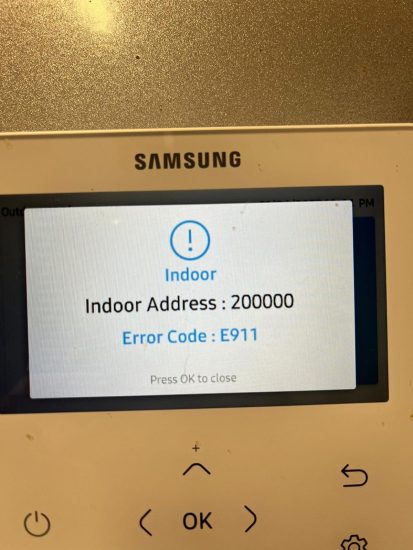
If your Samsung heat pump is displaying an E911 fault code, the first thing to know is that you do not need to panic. This is one of the most common Samsung heat pump faults we come across, and in the majority of cases the cause is simpler than homeowners expect and the heat pump itself is not faulty.
The E911 fault is generally associated with insufficient water flow through the heat pump. In straightforward terms, the heat pump is not detecting the flow rate it requires to operate safely, so it shuts down to protect itself. This is a designed response, not a failure of the unit.
What Does The Samsung E911 Fault Code Mean?
The Samsung E911 fault indicates that the heat pump has detected a flow problem within the heating system. Heat pumps rely on a continuous flow of water to move heat around the property. If the flow rate drops below the minimum the manufacturer requires, the controller detects this and shuts the system down before damage can occur. The E911 code is the way the Samsung controller communicates that this threshold has been crossed.
It is important to understand that the fault code tells you there is a flow problem it does not tell you why the flow problem exists. That requires further investigation, and the cause can be any one of several things across the system. Our article on why your heat pump shows a flow error explains how flow faults arise across different heat pump brands and what the various causes look like in practice.
Is The Heat Pump Itself Faulty?
In most cases, no. The vast majority of E911 faults we investigate are caused by something elsewhere in the heating system that is restricting circulation not by a fault with the Samsung heat pump unit itself. This distinction matters enormously, because replacing components on the heat pump without first identifying the actual cause will not fix the problem. The fault will return as soon as the system is restarted.
This is a pattern that runs through many heat pump fault code investigations. The code points to a symptom low flow but the root cause can be a dirty filter, a closed valve, an air-locked circuit, a circulation pump issue, or a design problem that has nothing to do with the Samsung unit. Our article on why heat pump repairs are often misunderstood in the UK explains why this diagnostic step is so often skipped, and why it leads to expensive and unnecessary parts replacements.
What Causes A Samsung E911 Fault?
Several different issues can cause an E911 error. Common causes include dirty or blocked magnetic system filters, blocked strainers on the pipework, air trapped within the heating circuit, problems with the circulation pump including incorrect speed settings, too many TRVs turned off or turned down simultaneously, incorrect pump configuration in the installer settings, insufficient total system water volume, excessive zoning causing the available flow path to collapse, isolation valves that have been left partially or fully closed following maintenance, and underlying system design issues that were present from installation.
The fact that multiple different causes can produce the same fault code is one of the reasons proper diagnosis matters so much. Guessing at the most likely cause and replacing parts accordingly can become very expensive very quickly if the wrong component is targeted.
What Can I Check Myself Before Calling An Engineer?
There are several straightforward things worth checking before arranging an engineer visit, and in some cases one of these checks will identify the cause directly.
Are Too Many Radiators Turned Off?
Heat pumps need water to circulate freely around the heating system at all times. If a significant number of TRVs have been turned down or closed, flow rates can drop significantly sometimes enough to trigger an E911 fault. This is one of the most common causes we find on systems where the fault has appeared gradually over time rather than immediately after installation. Our article on what happens if too many TRVs are turned off explains exactly what happens to a heat pump system when TRVs restrict the flow path and what the consequences are beyond just the fault code. Our article on should you use TRVs with a heat pump covers the broader question of how TRVs should and should not be used on heat pump systems.
Has The System Recently Been Drained Or Had Maintenance?
Air trapped within the heating circuit after a drain-down or maintenance visit can restrict circulation and trigger flow-related fault codes. If any work has been carried out on the system recently, bleeding the radiators and checking that all circuits are fully purged of air is worth doing before anything else.
Are There Any Closed Isolation Valves?
It sounds obvious, but a partially or fully closed isolation valve is something we see regularly following maintenance work or installer visits. Check any valves on the pipework near the heat pump, the cylinder, and the manifolds if underfloor heating is present. A valve that appears to be open may actually be partially closed if it was not returned to the fully open position after work was completed.
Is The System Pressure Correct?
Low system pressure can contribute to circulation issues, particularly on systems where the expansion vessel is undersized or has lost charge. Check the pressure gauge for most domestic heat pump systems it should read between 1.0 and 1.5 bar when cold. If it is consistently dropping, there may be a separate pressure loss issue worth investigating. Our article on why does my heat pump keep losing pressure covers the full range of causes for pressure loss on heat pump systems.
Are The Filters And Strainers Clean?
Dirty magnetic filters and blocked inline strainers are one of the first things we check when an E911 appears. As debris, magnetite, and scale accumulate in the system over time, they gradually restrict water flow. The heat pump may have been operating without issue for months before the build-up reaches a point where it triggers a flow fault. If the magnetic filter has not been cleaned recently, this is worth doing before anything else. Our article on how dirty filters can cause heat pump problems explains how filter maintenance affects heat pump performance and why it should be part of any annual service routine.
Can Low Flow Cause Problems Even Without An E911 Appearing?
Yes, and this is important to understand. Even if the flow rate has not yet dropped far enough to trigger the E911 lockout, reduced circulation can cause a range of performance problems that are often mistakenly attributed to other causes. These include reduced heating efficiency as the heat pump struggles to transfer heat at its designed rate, poor heating performance in parts of the property, increased short cycling as the heat pump reaches its flow temperature target quickly on a small water volume and repeatedly switches on and off, defrost problems if the flow is insufficient to support the defrost cycle correctly, and higher running costs across the board.
Our article on why does my heat pump keep turning on and off covers short cycling in detail, including how flow restriction is one of its most common causes. Our article on why is my heat pump so expensive to run explains how poor flow and cycling behaviour affects running costs in ways that are often not immediately obvious to homeowners.
Why Do We See This Fault Appear On Systems That Previously Worked Fine?
Many heat pump systems operate without any flow-related faults for months or even years before the E911 appears. This is because the issues that eventually cause it tend to develop gradually. A slow build-up of debris in the filters, air that has gradually come out of solution and collected in high points of the circuit, TRVs that have been progressively turned down over time, or a circulation pump that has been running at a reduced speed setting since installation can all reach a tipping point where the flow rate finally drops below the threshold that triggers the E911.
This gradual development is also why it is important not to assume the system has suddenly developed a new fault. In many cases, the underlying condition has been present for some time and the E911 is simply the first visible indication that it has reached a critical level. Our article on common commissioning mistakes with air source heat pumps covers the installation and setup errors that most commonly lead to flow-related problems further down the line.
A Real Example We Diagnosed
We recently helped a homeowner whose Samsung heat pump was displaying the related E911 fault in a detached property in Sussex. The fault was identified and fully resolved during a single remote video call no engineer visit was required and no parts were replaced. You can read the full details in our case study on the detached home in Sussex — Samsung E911 fault fixed remotely during a video call.
Need Help With A Samsung E911 Fault?
If you are dealing with a Samsung E911 fault and are not sure where to start, we may be able to help. Many homeowners arrange a video call and walk us through the system using a smartphone or tablet. During the call we can review the fault history, check filters and strainers, assess pump settings and pipework arrangements, look at any valves or controls that may be contributing to the problem, and discuss any recent changes to the system or how it has been used.
Depending on the issue and your level of confidence, we may be able to guide you through some checks during the call and resolve the fault with you directly. We are also happy to work alongside your plumber, heating engineer, or electrician if they are attending the property many experienced tradespeople do not work on heat pumps every day, and a second opinion from someone who does can save a significant amount of time and money. Visit our Fix My Heat Pump page to find out more about how our remote diagnostic service works, or contact us directly to describe your situation first.
Related Case Studies
The detached home in Sussex — Samsung E911 fault fixed remotely during a video call is a direct example of this fault being diagnosed and resolved remotely on a Samsung monobloc heat pump the same model family that this article covers.
The heat pump short cycling and high running costs — zoning design issue case shows what happens when a system is over-zoned and flow rates collapse the kind of design problem that can produce E911 faults alongside poor performance and high running costs.
The heat pump freezing up repeatedly — pipework and system design issue case demonstrates how flow and system design problems can cause a heat pump to struggle in ways that go beyond fault codes — a useful comparison for anyone trying to understand whether their E911 is a standalone fault or part of a wider system issue.
The detached bungalow in Kent — living room warm, rest of house cold case is relevant for anyone whose system has flow issues combined with uneven heating across the property, as the two problems often share the same underlying cause.
Related Articles
Our article on what happens if too many TRVs are turned off explains in detail how closing radiators affects flow rates on heat pump systems and why this is one of the most common triggers for E911 and similar flow fault codes.
Our article on do I need a volumiser with my heat pump is relevant for anyone whose E911 fault has been linked to insufficient system volume, particularly on installations where a volumiser or bypass was not fitted.
Our article on why your heat pump shows a flow error covers the full range of flow fault causes across different heat pump brands and is a useful companion to this Samsung-specific guide.
Samsung E911 Error Code Explained
If your Samsung heat pump is displaying an E911 fault code, the first thing to know is that you do not need to panic. This is one of the most common Samsung heat pump faults we come across, and in the majority of cases the cause is simpler than homeowners expect and the heat pump itself is not faulty.
The E911 fault is generally associated with insufficient water flow through the heat pump. In straightforward terms, the heat pump is not detecting the flow rate it requires to operate safely, so it shuts down to protect itself. This is a designed response, not a failure of the unit.
What Does The Samsung E911 Fault Code Mean?
The Samsung E911 fault indicates that the heat pump has detected a flow problem within the heating system. Heat pumps rely on a continuous flow of water to move heat around the property. If the flow rate drops below the minimum the manufacturer requires, the controller detects this and shuts the system down before damage can occur. The E911 code is the way the Samsung controller communicates that this threshold has been crossed.
It is important to understand that the fault code tells you there is a flow problem it does not tell you why the flow problem exists. That requires further investigation, and the cause can be any one of several things across the system. Our article on why your heat pump shows a flow error explains how flow faults arise across different heat pump brands and what the various causes look like in practice.
Is The Heat Pump Itself Faulty?
In most cases, no. The vast majority of E911 faults we investigate are caused by something elsewhere in the heating system that is restricting circulation not by a fault with the Samsung heat pump unit itself. This distinction matters enormously, because replacing components on the heat pump without first identifying the actual cause will not fix the problem. The fault will return as soon as the system is restarted.
This is a pattern that runs through many heat pump fault code investigations. The code points to a symptom low flow but the root cause can be a dirty filter, a closed valve, an air-locked circuit, a circulation pump issue, or a design problem that has nothing to do with the Samsung unit. Our article on why heat pump repairs are often misunderstood in the UK explains why this diagnostic step is so often skipped, and why it leads to expensive and unnecessary parts replacements.
What Causes A Samsung E911 Fault?
Several different issues can cause an E911 error. Common causes include dirty or blocked magnetic system filters, blocked strainers on the pipework, air trapped within the heating circuit, problems with the circulation pump including incorrect speed settings, too many TRVs turned off or turned down simultaneously, incorrect pump configuration in the installer settings, insufficient total system water volume, excessive zoning causing the available flow path to collapse, isolation valves that have been left partially or fully closed following maintenance, and underlying system design issues that were present from installation.
The fact that multiple different causes can produce the same fault code is one of the reasons proper diagnosis matters so much. Guessing at the most likely cause and replacing parts accordingly can become very expensive very quickly if the wrong component is targeted.
What Can I Check Myself Before Calling An Engineer?
There are several straightforward things worth checking before arranging an engineer visit, and in some cases one of these checks will identify the cause directly.
Are Too Many Radiators Turned Off?
Heat pumps need water to circulate freely around the heating system at all times. If a significant number of TRVs have been turned down or closed, flow rates can drop significantly sometimes enough to trigger an E911 fault. This is one of the most common causes we find on systems where the fault has appeared gradually over time rather than immediately after installation. Our article on what happens if too many TRVs are turned off explains exactly what happens to a heat pump system when TRVs restrict the flow path and what the consequences are beyond just the fault code. Our article on should you use TRVs with a heat pump covers the broader question of how TRVs should and should not be used on heat pump systems.
Has The System Recently Been Drained Or Had Maintenance?
Air trapped within the heating circuit after a drain-down or maintenance visit can restrict circulation and trigger flow-related fault codes. If any work has been carried out on the system recently, bleeding the radiators and checking that all circuits are fully purged of air is worth doing before anything else.
Are There Any Closed Isolation Valves?
It sounds obvious, but a partially or fully closed isolation valve is something we see regularly following maintenance work or installer visits. Check any valves on the pipework near the heat pump, the cylinder, and the manifolds if underfloor heating is present. A valve that appears to be open may actually be partially closed if it was not returned to the fully open position after work was completed.
Is The System Pressure Correct?
Low system pressure can contribute to circulation issues, particularly on systems where the expansion vessel is undersized or has lost charge. Check the pressure gauge for most domestic heat pump systems it should read between 1.0 and 1.5 bar when cold. If it is consistently dropping, there may be a separate pressure loss issue worth investigating. Our article on why does my heat pump keep losing pressure covers the full range of causes for pressure loss on heat pump systems.
Are The Filters And Strainers Clean?
Dirty magnetic filters and blocked inline strainers are one of the first things we check when an E911 appears. As debris, magnetite, and scale accumulate in the system over time, they gradually restrict water flow. The heat pump may have been operating without issue for months before the build-up reaches a point where it triggers a flow fault. If the magnetic filter has not been cleaned recently, this is worth doing before anything else. Our article on how dirty filters can cause heat pump problems explains how filter maintenance affects heat pump performance and why it should be part of any annual service routine.
Can Low Flow Cause Problems Even Without An E911 Appearing?
Yes, and this is important to understand. Even if the flow rate has not yet dropped far enough to trigger the E911 lockout, reduced circulation can cause a range of performance problems that are often mistakenly attributed to other causes. These include reduced heating efficiency as the heat pump struggles to transfer heat at its designed rate, poor heating performance in parts of the property, increased short cycling as the heat pump reaches its flow temperature target quickly on a small water volume and repeatedly switches on and off, defrost problems if the flow is insufficient to support the defrost cycle correctly, and higher running costs across the board.
Our article on why does my heat pump keep turning on and off covers short cycling in detail, including how flow restriction is one of its most common causes. Our article on why is my heat pump so expensive to run explains how poor flow and cycling behaviour affects running costs in ways that are often not immediately obvious to homeowners.
Why Do We See This Fault Appear On Systems That Previously Worked Fine?
Many heat pump systems operate without any flow-related faults for months or even years before the E911 appears. This is because the issues that eventually cause it tend to develop gradually. A slow build-up of debris in the filters, air that has gradually come out of solution and collected in high points of the circuit, TRVs that have been progressively turned down over time, or a circulation pump that has been running at a reduced speed setting since installation can all reach a tipping point where the flow rate finally drops below the threshold that triggers the E911.
This gradual development is also why it is important not to assume the system has suddenly developed a new fault. In many cases, the underlying condition has been present for some time and the E911 is simply the first visible indication that it has reached a critical level. Our article on common commissioning mistakes with air source heat pumps covers the installation and setup errors that most commonly lead to flow-related problems further down the line.
A Real Example We Diagnosed
We recently helped a homeowner whose Samsung heat pump was displaying the related E911 fault in a detached property in Sussex. The fault was identified and fully resolved during a single remote video call no engineer visit was required and no parts were replaced. You can read the full details in our case study on the detached home in Sussex — Samsung E911 fault fixed remotely during a video call.
Need Help With A Samsung E911 Fault?
If you are dealing with a Samsung E911 fault and are not sure where to start, we may be able to help. Many homeowners arrange a video call and walk us through the system using a smartphone or tablet. During the call we can review the fault history, check filters and strainers, assess pump settings and pipework arrangements, look at any valves or controls that may be contributing to the problem, and discuss any recent changes to the system or how it has been used.
Depending on the issue and your level of confidence, we may be able to guide you through some checks during the call and resolve the fault with you directly. We are also happy to work alongside your plumber, heating engineer, or electrician if they are attending the property many experienced tradespeople do not work on heat pumps every day, and a second opinion from someone who does can save a significant amount of time and money. Visit our Fix My Heat Pump page to find out more about how our remote diagnostic service works, or contact us directly to describe your situation first.
Related Case Studies
The detached home in Sussex — Samsung E911 fault fixed remotely during a video call is a direct example of this fault being diagnosed and resolved remotely on a Samsung monobloc heat pump the same model family that this article covers.
The heat pump short cycling and high running costs — zoning design issue case shows what happens when a system is over-zoned and flow rates collapse the kind of design problem that can produce E911 faults alongside poor performance and high running costs.
The heat pump freezing up repeatedly — pipework and system design issue case demonstrates how flow and system design problems can cause a heat pump to struggle in ways that go beyond fault codes — a useful comparison for anyone trying to understand whether their E911 is a standalone fault or part of a wider system issue.
The detached bungalow in Kent — living room warm, rest of house cold case is relevant for anyone whose system has flow issues combined with uneven heating across the property, as the two problems often share the same underlying cause.
Related Articles
Our article on what happens if too many TRVs are turned off explains in detail how closing radiators affects flow rates on heat pump systems and why this is one of the most common triggers for E911 and similar flow fault codes.
Our article on do I need a volumiser with my heat pump is relevant for anyone whose E911 fault has been linked to insufficient system volume, particularly on installations where a volumiser or bypass was not fitted.
Our article on why your heat pump shows a flow error covers the full range of flow fault causes across different heat pump brands and is a useful companion to this Samsung-specific guide.
Oct 21, 2026
5 min read
Air to Water Heat Pump: How It Works and What It Needs
Read More
Oct 21, 2026
5 min read
Air to Water Heat Pump: How It Works and What It Needs
Read More
Oct 19, 2026
5 min read
Heat Pump System Water Treatment: Inhibitor, Filters and Annual Water Tests
Read More
Oct 19, 2026
5 min read
Heat Pump System Water Treatment: Inhibitor, Filters and Annual Water Tests
Read More

Contact Us
Not Sure Which Service You Need?
Not Sure Which Service You Need?
Not Sure Which Service You Need?
Not Sure Which Service You Need?
Not Sure Which Service You Need?
Whether you need help with an existing heat pump, a pre-installation review, cooling advice, servicing or a room-by-room heat loss survey, send us a few details and we'll point you in the right direction.
Whether you need help with an existing heat pump, a pre-installation review, cooling advice, servicing or a room-by-room heat loss survey, send us a few details and we'll point you in the right direction.
Whether you need help with an existing heat pump, a pre-installation review, cooling advice, servicing or a room-by-room heat loss survey, send us a few details and we'll point you in the right direction.

